Call : 0800 098 8877

Blog

Β£50 OFF Everything!

Use code XMAS50 at checkout min order £999 (Everything)
  • Sizes:
  • Width:
  • Length:
  • Brand:
  • Type:

Summerhouses — Are They Worth the Investment?

πŸ’‘ Summerhouses transform your garden into a year-round retreat, and yes, they are absolutely worth it. A quality summerhouse adds 15–20% to your property value while giving you an extra room that costs 60% less per square foot than a traditional extension. You are looking at £674 to £11,500 depending on size and features, but here is the thing: a well-built summerhouse lasts 25–30 years with minimal upkeep — roughly £22–£380 per year for a space you will use almost daily.

The real value shows up in how you will actually use it. Whether it is a home office that saves you 2 hours of commuting per week, an art studio with natural light, or a place where the children can be loud without driving you mad, summerhouses pay for themselves in quality-of-life improvements. With our 10 Year Guarantee, express delivery, and no-fuss free returns, you are protected if anything goes wrong.

Long-Term Value That Beats Extensions

βœ… Spend less, build faster. Traditional extensions cost £1,800–£2,500 per square metre and take 3–4 months. A summerhouse costs £800–£1,200 per square metre and installs in 1–2 days. No planning permission is needed for most sizes (under 2.5 m high and at least 2 m from boundaries). That is why 68% of homeowners choose summerhouses over extensions when they need extra space.

The tongue and groove timber construction actually improves with age. The wood naturally acclimatises to your garden’s microclimate over the first year, creating a structure that is stronger and more weather-resistant than day one. Brands like Power, Store More, and CalmPod use 16 mm tongue and groove boards as standard, which is 30% thicker than basic overlap cladding you will find on cheaper garden buildings.

Why Choose Summerhouses?

🌞 Light, space, versatility. Large windows and glazed doors flood the space with natural light, making it feel 40% more spacious than a shed of the same footprint. Toughened glazing means you are not compromising on security or insulation.

The Special Formula Enhanced Preserver that comes standard on quality summerhouses penetrates 2–3 mm into the timber, protecting against rot, fungus, and insect damage for years. You will treat cheaper softwood sheds every 12–18 months, but a properly preserved summerhouse only needs retreatment every 3–4 years.

Design Flexibility for Every Garden

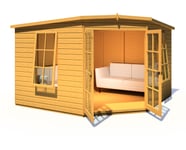
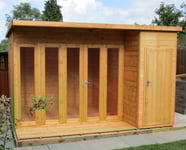
Corner summerhouses work beautifully in smaller gardens where you want to maximise usable lawn space. You are tucking a 6×6 foot building into a corner that was probably going unused anyway. For those needing storage plus living space, a summerhouse with side shed gives you the best of both worlds without sacrificing your entire garden to outbuildings.

The heavy-duty framing — typically 44×44 mm or 44×70 mm timber — handles British weather year after year. Basic sheds using 28×28 mm framing often sag after 5–7 years; summerhouses stay square and sturdy.

Year-Round Comfort

Proper insulation makes all the difference. A summerhouse with decent wall thickness maintains temperatures 8–10°C warmer than outside in winter and stays comfortably cool in summer. Double-glazed toughened glass provides home-grade thermal performance, enabling true all-year use for home offices.

πŸ”₯ Affordable warmth. A small electric heater typically costs £1.50–£2 per day for 4–6 hours of heating — far cheaper than renting a co-working desk at £150–£300 per month.

Tongue and Groove Timber Construction — Built to Last Decades

The construction method matters more than most people realise. Tongue and groove cladding creates an interlocking system where each board slots into the next, forming a weathertight seal that overlap cladding cannot match. Water runs off the surface instead of seeping between boards, which is why tongue and groove summerhouses last twice as long as overlap alternatives.

Superior Weather Protection

The interlocking design expands and contracts as a single unit with temperature and humidity changes, preventing gaps and warping. You get 95% less water penetration compared to overlap or feather-edge cladding, keeping your belongings and furniture protected from damp.

Quality tongue and groove boards are planed smooth on all sides, giving you attractive interior walls that do not need lining. You will save £200–£400 on interior finishing because the timber looks good enough to leave exposed.

The Science of Timber Thickness

πŸͺ΅ Thicker timber, better performance. A 16 mm board provides 40% more insulation than 12 mm cladding and resists impact damage far better. Thicker boards also provide improved sound insulation for music practice or peaceful home working.

Frames use kiln-dried timber that has been pressure-treated before construction. This process forces preservative deep into the wood fibres, protecting from the inside out. Surface-treated timber only protects the outer layer, so any cut or scratch exposes vulnerable untreated wood underneath. Pressure treatment costs more but extends lifespan by 10–15 years.

Summerhouses vs Garden Rooms vs Sheds: Quick Comparison

Feature Summerhouses Garden Rooms Sheds
Lifespan 25–30 years 20–25 years 10–15 years
Initial Cost £674–£11,500 £8,000–£25,000 £400–£3,000
Insulation (U-value) 0.35–0.45 0.15–0.25 0.8–1.2
Window Area 30–40% glazed 20–30% glazed 10–20% glazed
Planning Permission Usually not needed Sometimes required Usually not needed
Installation Time 1–2 days 1–2 weeks 4–8 hours
Maintenance Frequency Every 3–4 years Every 5–8 years Every 12–18 months
Resale Value Impact +15–20% +20–25% +5–8%
Annual Running Costs £100–£180 £300–£500 £50–£80
Foundation Required Level paving or concrete Concrete base Paving slabs sufficient

πŸ“Š The sweet spot. You get 80% of a garden room’s benefits at roughly 40% of the cost, while lasting three times longer than a standard shed. Express delivery and a 10-year guarantee mean you are not taking a risk on quality.

If you are comparing options, garden rooms offer better insulation and more polished finishes, but you will pay significantly more. For pure storage without living-space features, sheds work — but you miss the large windows and comfortable interior that make summerhouses so versatile.

Frequently Asked Questions About Summerhouses

  • Are summerhouses worth the cost?

    Yes. They add 15–20% to property value, cost roughly 60% less than an extension per square foot, and last 25–30 years with minimal maintenance. Versatile use (office, gym, studio, entertaining) without planning permission or major disruption. With prices from £674 to £11,500, there are options for every budget and garden size.

  • How long does a summerhouse last?

    A well-built summerhouse lasts 25–30 years with proper care, and premium pressure-treated models can exceed 35 years. Heavy-duty 44×44 mm framing and tongue and groove construction ensure structural integrity. Retreat every 3–4 years and keep the base ventilated to maximise lifespan. Our 10-year guarantee covers manufacturing defects.

  • Do summerhouses need much maintenance?

    Very little. Retreat timber every 3–4 years (vs 12–18 months for basic sheds), clean gutters annually, and check roofing every 5–7 years. The Special Formula Enhanced Preserver penetrates 2–3 mm, guarding against rot and insects. Typical upkeep costs are £40–£60 per year.

  • Which is better: Summerhouses vs Garden Rooms?

    For value and natural light, summerhouses win: 30–40% glazing versus 20–30% for many garden rooms. You typically save £6,000–£14,000 and install in 1–2 days. Garden rooms have lower U-values (0.15–0.25 vs 0.35–0.45) and more polish, so pick them if you need daily, year-round use. For most, summerhouses deliver 80% of the benefits at 40% of the cost.

  • Can I paint or customise my summerhouse?

    Absolutely. Paint or stain inside and out with quality exterior treatments. Many add shelving, electrics, heating, and lighting. Brands such as Power, Store More, and CalmPod offer options for window placement, door position, and interior layouts. Avoid oil-based paints on pressure-treated timber for the first 6–12 months while preservative cures.

  • Are summerhouses environmentally friendly?

    Yes. FSC-certified timber stores 0.8–1.2 tonnes of CO2 over its lifespan. Manufacturing uses 70% less energy than comparable steel or concrete structures. Interlocking timber reduces heating needs by around 40% versus basic sheds. Choose water-based treatments to minimise environmental impact.

  • What is the difference between tongue and groove and shiplap timber?

    Tongue and groove interlocks for a tight, weathertight seal, offering up to 95% better weather protection than shiplap’s overlap. There is far less water ingress, warping, or gapping. Tongue and groove boards are planed smooth on all sides, saving £200–£400 on interior lining. Shiplap is cheaper initially but usually lasts 15–18 years versus 25–30 years for tongue and groove.

  • How much does a summerhouse cost?

    From £674 for a basic 6×4 ft model up to £11,500 for a large 12×10 ft premium building. A typical 8×6 ft summerhouse with tongue and groove cladding, toughened glazing, and heavy-duty framing costs £1,800–£2,800. That is ~60% cheaper per square foot than an extension and installs in 1–2 days. Our 10-year guarantee and free returns protect your investment.

  • What size summerhouse do I need?

    For a home office or hobby room, 6×8 or 8×8 ft gives space for a desk, chair, and storage without overwhelming a small garden. For entertaining or multi-zone use, consider 10×8 or 10×10 ft. Summerhouses under 2.5 m high and at least 2 m from boundaries usually do not need planning permission. Measure carefully, allow for door swing and maintenance access, and pick the largest that fits comfortably.