How to Grow Seeds in a Greenhouse
Growing seeds in a greenhouse gives you a 6–8 week head start over outdoor sowing. You get access to 400+ varieties unavailable at garden centres. Maintain soil temperatures between 18–24°C for germination. Water from below to prevent damping off and harden seedlings over 10 days before transplanting. A £30–£50 investment in supplies pays back tenfold in the first season.
Key Takeaways
- Start greenhouse seeds 6–8 weeks before last frost for most vegetables and flowers
- Use sterile seed starting mix to prevent damping off disease in greenhouse environments
- Maintain 18–24°C greenhouse soil temperature for optimal germination
- Provide 14–16 hours of direct light daily once seedlings emerge
- Water from below to prevent fungal problems and strengthen roots
- Harden off gradually over 7–10 days before transplanting seedlings outdoors
- Use a weak fertiliser solution (quarter strength) once true leaves appear
Installer's Note
We set up greenhouses for seed growing every spring. The single biggest mistake we see is customers skipping ventilation. Even in February, a closed greenhouse hits 30°C on a sunny afternoon and kills every seedling inside. Fit automatic vent openers before you sow a single seed. Position a greenhouse thermometer at tray level, not head height. Floor temperatures run 5°C cooler than the ceiling.
How to start seeds in a greenhouse
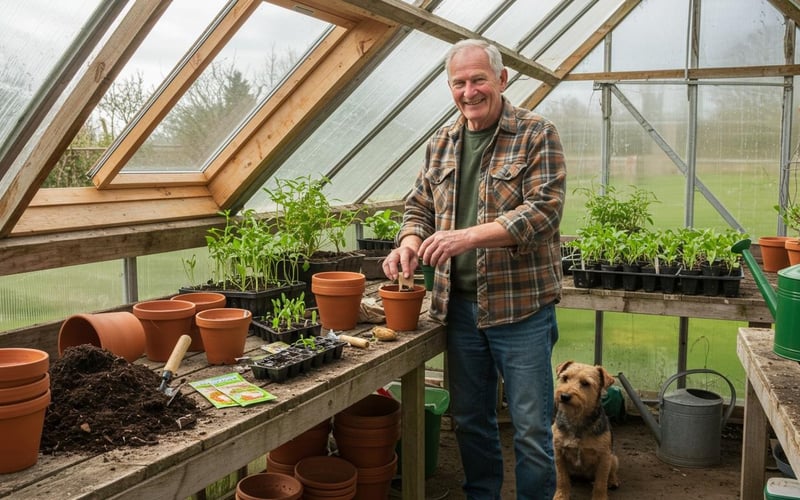
Before sowing your first seed, set up your greenhouse environment properly. Position seed trays on the south-facing side where they receive maximum natural light. Install shelving to use vertical space. A standard 8×6 greenhouse can house 12 or more seed trays when properly arranged.
Insulate against temperature swings by lining greenhouse walls with bubble wrap during February to April sowings. This simple step maintains 3–5°C warmer night-time temperatures. That difference is critical for heat-loving seedlings like tomatoes and peppers. Our guide on insulating your greenhouse covers the best methods in detail.
Create dedicated zones within your greenhouse. Place germination trays in the warmest spots. Use moderate areas for growing on and cooler spots near vents for hardening off. This temperature gradient lets you manage different growth stages at the same time.
Why grow seeds in a greenhouse
Starting seeds in your greenhouse costs pennies compared to buying seedlings. A £2 packet contains 25–100 seeds. Nursery seedlings cost £3–£5 each. For tomatoes alone, you will save £75 or more per season.
Beyond cost, your greenhouse gives you access to 400+ tomato varieties. Garden centres stock just 5–10. Rare heirlooms, speciality peppers, and unusual flowers all become possible.
Disease prevention is another strong advantage. Commercial seedlings can harbour pathogens. Your greenhouse-started seeds begin life in controlled, clean conditions. This cuts the risk of blight, mosaic virus, and root rot.
Start seeds in your greenhouse during February to March and you will harvest weeks before neighbours who plant in May. For cool-season crops like kale, this means two full harvests yearly instead of one. A greenhouse environment extends your growing season by 8–12 weeks annually.
Essential supplies for greenhouse seed starting
Success requires specific tools. Here is what you need.
Must-haves
- Sterile seed starting mix (£5–£8)
- Containers with drainage (£3–£15)
- Clear plastic cover or cling film (£2–£5)
- Labels and waterproof marker (£3)
- Spray bottle or bottom-watering tray (£2–£4)
Worth the investment
- LED grow light (£25–£85)
- Heat mat with thermostat (£20–£40)
- Fan for air circulation (£10–£15)
A dedicated workspace makes a real difference. A potting shed is ideal for organising supplies and protecting delicate seedlings from household traffic.
Skip the compressed peat pellets and "complete kits" with flimsy trays. They fail more often than they succeed.
|
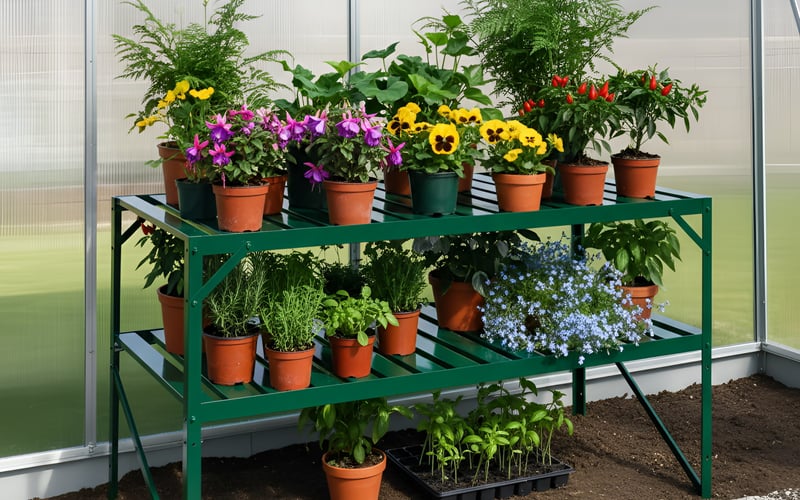
Matt's Pick for Seed StartingVitavia 2 Tier Green Staging Best For: Organising seed trays at the ideal working height with drainage through slatted shelves. Why I Recommend It: I use this staging in every greenhouse we set up for seed growing. The 1200mm width fits four standard seed trays side by side. The slatted shelves let excess water drain away, which prevents the waterlogging that causes damping off. Powder-coated aluminium means it will not rust or rot. Comes with a 10-year warranty. Price: £109 |
Seed starting mix: what actually works
Standard potting soil kills seedlings. It is too dense and harbours fungi that cause damping off. You need a sterile, lightweight mix.
Commercial seed starting mixes contain:
- Fine peat moss or coco coir (holds moisture)
- Perlite or vermiculite (provides drainage)
- Small amount of compost (supplies nutrients)
- Limestone (balances pH)
Make your own at half the cost:
- 3 parts fine coco coir (sustainable alternative to peat)
- 1 part perlite
- 1 part vermiculite
- Half a part worm castings
Pre-moisten this mix until it holds shape when squeezed but releases no water droplets. This achieves the 70–80% moisture level seeds require for germination.
Choosing the right containers
Not all seed starting containers perform equally.
Best performers
- Cell trays with 3.8–5cm cells (ideal for most vegetables)
- 7.5cm square pots (well suited for tomatoes, peppers, cucumbers)
- Root trainers (essential for peas, beans, sunflowers)
- Soil blocks (eliminates transplant shock completely)
Adequate options
- Clean yoghurt pots with drainage holes
- Egg cartons (for short-term seedlings only)
- Toilet paper tubes (for direct transplanting)
Limited on space? A mini greenhouse provides ideal conditions for seed trays. They take minimal room on patios or balconies.
Avoid shallow seed trays without dividers — they force seedling roots to tangle. Every container needs drainage. Drill holes in repurposed containers using a 6mm bit.
Seed starting timeline
Time your seeding based on your last frost date (between April and May for most UK areas). Count backward:
- 10–12 weeks before: onions, leeks, celery
- 8–10 weeks before: peppers, aubergine, petunias
- 6–8 weeks before: tomatoes, broccoli, cabbage, marigolds
- 4–6 weeks before: cucumbers, melons, zinnias
- 2–4 weeks before: squash, sunflowers, beans
Some seeds germinate slowly. Tomatoes and peppers take 7–14 days. Lettuce and radishes sprout in 3–5 days. Factor this into your planning.
For continuous harvests, start seeds in 2-week intervals. Three sowings of carrots spaced 14 days apart provide 30+ days of fresh harvests instead of one glut.
Step-by-step planting process
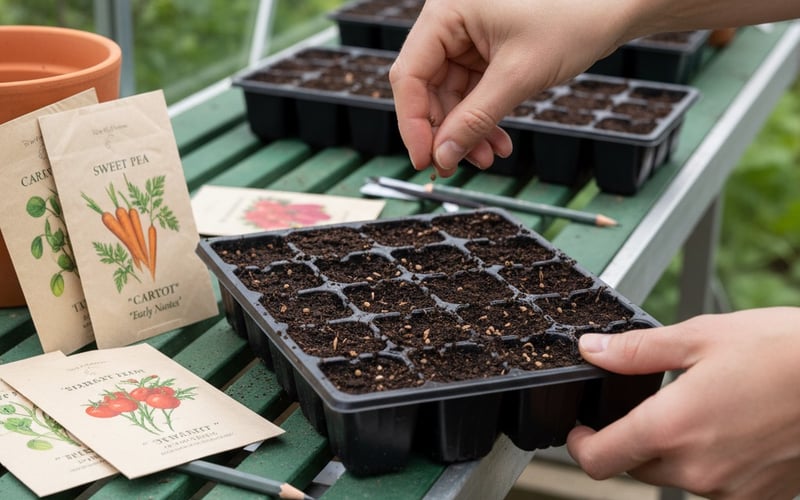
- Fill containers with pre-moistened mix to 0.6cm below the rim
- Compress slightly (not firmly) to eliminate air pockets
- Place seeds at these exact depths:
- Dust-like seeds (petunias): surface sow, no covering
- Small seeds (lettuce, basil): 0.3cm deep
- Medium seeds (tomatoes, brassicas): 0.6cm deep
- Large seeds (beans, cucumbers): 1.3cm deep
- Cover with mix to the proper depth using a fine-mesh sieve
- Mist gently with water or bottom water by placing in 1.3cm of water
- Cover with plastic to retain humidity (remove once sprouted)
- Label immediately with variety and date
For tiny seeds, mix with fine sand (1:4 ratio) for even distribution.
After sowing, place warm-germinating seeds (tomatoes, peppers) on a heat mat at 21–24°C. Cool-germinators (lettuce, spinach) need 15–18°C.
Light requirements for seedlings
Seedlings need more light than most gardeners provide. Insufficient light causes leggy, weak plants that never recover.
Light requirements by stage:
- Germination: Most seeds do not need light (exceptions: lettuce, petunias)
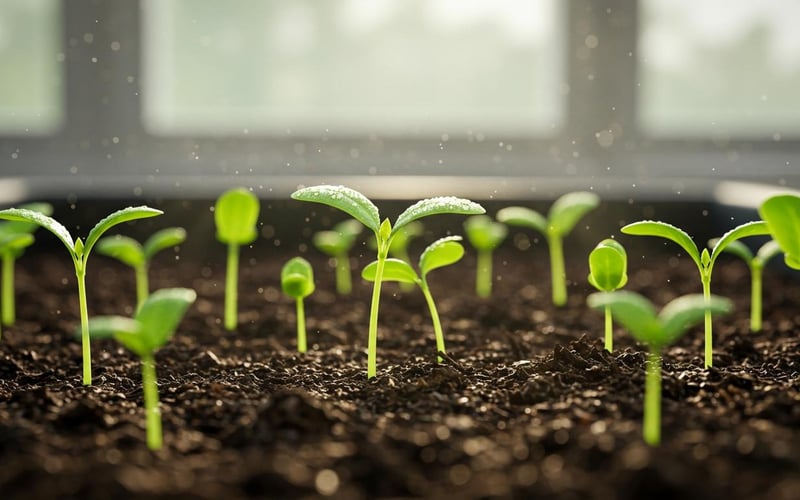
- Post-emergence: 14–16 hours of direct light daily
- Hardening off: Gradual increase to full sunlight
Window light rarely suffices. Even south-facing windows provide half the intensity of proper grow lights. Position LED grow lights 10–15cm above seedlings for 14–16 hours daily. Raise lights as plants grow to prevent leaf burn.
For best results, use fixtures delivering 65–85 µmol/m²/s PAR (Photosynthetically Active Radiation) at seedling level.
Budget option: standard shop lights with full-spectrum LED bulbs work well when positioned 5–7cm from seedling tops.
Temperature control for germination
Temperature affects germination more than any other factor. Each species has specific requirements.
Warm-germinators (21–26°C)
- Tomatoes, peppers, aubergine
- Cucumbers, melons, squash
- Basil, marigolds
Medium-germinators (18–21°C)
- Broccoli, cabbage, kale
- Lettuce, chard, spinach
- Snapdragons, cosmos
Cool-germinators (13–16°C)
- Peas, carrots, radishes
- Spinach, leafy greens
- Sweet peas, calendula
After germination, reduce temperatures by 3–5°C to prevent leggy growth. Night temperatures should drop 5–8°C below day temperatures to simulate natural conditions.
Digital thermometers with probes placed in the soil provide the only accurate reading. Room temperature gauges mislead — soil temperatures typically run 3–5°C cooler than ambient air. When we set up greenhouse heaters for customers, we always recommend a soil probe thermometer alongside.
Matt's Tip: Get a Soil Thermometer
I have seen more failed seed batches from wrong soil temperature than from any other cause. Air temperature at head height means nothing for germination. Buy a digital probe thermometer for £8–£12 and push it into the compost at seed depth. Check it morning and afternoon for the first week. You will be surprised how much soil temperature swings inside a greenhouse, even on a calm day.
Watering techniques that prevent damping off
More seedlings die from improper watering than any other cause. Master these techniques.
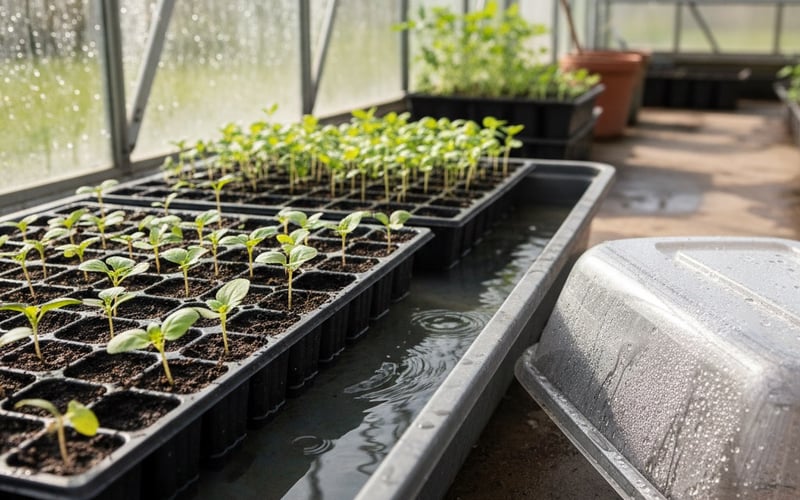
Bottom watering is the best method:
- Place containers in a tray with 1.3cm of water
- Allow 10–30 minutes for absorption
- Remove containers once the surface darkens
- Let soil approach dryness before watering again
This method forces roots to grow downward seeking moisture. It prevents the constantly wet surface that triggers fungal diseases.
If you must top-water, use a fine mister or spray bottle. Water early in the day so foliage dries before night.
The soil surface should dry slightly between waterings, but deeper layers should remain moist. Check by weight — dry containers feel noticeably lighter.
Feeding your seedlings
Seedlings need minimal nutrition until they develop true leaves (the second set that appears). Excessive fertiliser kills young plants.
- Mix organic liquid fertiliser at quarter recommended strength
- Apply once weekly during regular watering
- Increase to half strength after 2–3 weeks
Fish emulsion and seaweed extract provide balanced nutrition without burning tender roots. Chemical fertilisers work but require extreme precision in dilution.
Stop fertilising 5–7 days before transplanting to prepare seedlings for the move outdoors.
Hardening off: the 10-day transplant schedule
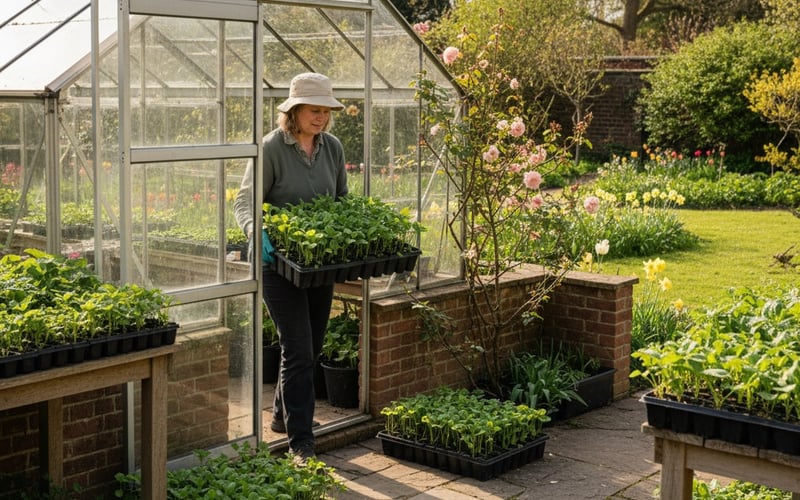
Hardening off transitions seedlings from protected greenhouse conditions to outdoor growing. Follow this 10-day schedule exactly:
- Day 1–2: Place seedlings in a sheltered outdoor spot for 1–2 hours in indirect light
- Day 3–4: Increase to 3–4 hours, introducing morning direct sunlight
- Day 5–6: Extend to 4–6 hours with more direct light exposure
- Day 7–8: Leave seedlings out for the full day, bring in at night
- Day 9–10: Leave seedlings out day and night unless frost threatens
During this process, reduce watering slightly but never allow plants to wilt. Provide protection from wind, which dehydrates seedlings rapidly.
Skip this process and you will lose plants. No exceptions. If you are new to greenhouse growing, our beginners guide covers the full seasonal cycle.
Troubleshooting common seedling problems
Leggy seedlings
- Cause: Insufficient light
- Solution: Move lights closer (5–10cm above plants), increase duration to 16 hours
Damping off (seedlings fall over)
- Cause: Fungal infection from overwatering or poor air circulation
- Solution: Improve ventilation, reduce watering, apply cinnamon (natural fungicide)
Yellow leaves
- Cause: Overwatering or nutrient deficiency
- Solution: Let soil dry more between waterings. Apply dilute fertiliser if true leaves have developed.
White fuzzy mould on soil
- Cause: Excessive moisture, poor air circulation
- Solution: Remove visible mould, apply a thin layer of dry vermiculite, add a fan for air movement
No germination
- Cause: Old seeds, improper temperature, planting too deep
- Solution: Try fresh seeds, check soil temperature requirements, plant at the correct depth
Curled leaves
- Cause: Heat stress or lights too close
- Solution: Move lights further away, reduce temperature, ensure adequate ventilation
Seed starting calendar for the UK
| Month | Essential Tasks | What to Start | Greenhouse Management |
|---|---|---|---|
| January | Order seeds | Onions, leeks | Clean and sterilise containers |
| February | Inventory supplies | Peppers, aubergines, cool-season flowers | Test heat mats and lights |
| March | Prepare potting area | Tomatoes, brassicas, first herbs | Monitor night temperatures |
| April | Begin outdoor prep | Cucumbers, melons, squash | Start hardening off early seedlings |
| May | Final frost watch | Heat-loving flowers, beans | Transplant hardened seedlings outdoors |
| June–July | Summer maintenance | Succession lettuce, autumn brassicas | Shade new transplants as needed |
| August–September | Collect open-pollinated seeds | Autumn and winter crops, cold frames | Clean empty containers |
| October–December | Evaluate results | Winter greens (with protection) | Store equipment, plan next season |
Growing seeds in your greenhouse is one of the most rewarding parts of gardening. The £30–£50 investment in basic supplies pays back tenfold in the first season alone. Begin with easy varieties like tomatoes, lettuce, and squash. Add more challenging seeds only after mastering the fundamentals. Keep a record of every sowing — variety name, date, germination rate, and transplant success. That data becomes invaluable year after year. For more seasonal guidance and tips on heating through the colder months, see the related articles below.
Frequently asked questions about growing seeds in a greenhouse
How do greenhouse conditions affect seed germination compared to windowsills?
Seeds germinate 3–5 days faster in a greenhouse than on a windowsill. Greenhouses provide more consistent temperatures and higher light levels. Ideal humidity of 60–70% and the absence of dry indoor heating create better conditions. Even an unheated greenhouse typically runs 3–5°C warmer than outdoor temperatures.
How deep should I plant seeds in greenhouse trays?
Plant seeds at a depth equal to 2–3 times their diameter. Tiny seeds like lettuce need just a dusting of soil (0.3cm). Peas and beans require deeper planting at 1.3–2.5cm. Greenhouse conditions may need slightly more covering than indoor sowing due to faster surface drying.
Do all seeds need light to germinate?
No, most seeds germinate in darkness. Some species including lettuce, petunias, and snapdragons require light. Press these onto the soil surface without covering. In a greenhouse, protect light-requiring seeds from direct midday sun until after germination.
How often should I water seedlings in a greenhouse?
Water when the soil surface appears dry, typically every 1–2 days. In spring, check daily. During summer, seedlings may need water every day. Always prefer bottom watering to reduce disease risk. Greenhouse seedlings dry out faster than indoor ones.
Why are my greenhouse seedlings falling over and dying?
This is damping off disease, caused by fungal pathogens. Prevention requires sterile media, good air circulation, proper watering, and adequate spacing. Open vents during midday even in early spring to prevent stagnant, humid conditions that promote fungal growth.
Can I use regular garden soil for starting seeds?
No, garden soil compacts easily and contains pathogens. Always use sterile seed starting mix. It provides proper drainage and aeration while reducing disease risk. Greenhouse warmth and humidity accelerate pathogen growth in non-sterile media.
How do I maintain temperature in an unheated greenhouse for seed starting?
Use passive solar techniques and localised heat sources. Black water-filled containers store daytime heat. Bubble wrap insulation retains warmth. Thermal mass (bricks, stones) under seed trays releases heat overnight. For critical seedlings, use a small electric propagator (£30–£45) for spot heating rather than warming the entire structure.