Greenhouse Propagation Guide: Seeds, Cuttings and Division
A greenhouse turns propagation from guesswork into a reliable system. With controlled temperature, humidity and light, you can raise thousands of plants from seed, cuttings and division for a fraction of the cost of buying them. A single heated propagator at 18-21°C lifts seed germination rates from 40-60% on a cold windowsill to 85-95% under glass. Softwood cuttings taken in May root in 14-21 days with bottom heat. Division gives you free plants instantly.
Propagation is the single most cost-effective thing you can do in a greenhouse. From our work with Greenhouse Stores customers since 2012, I have watched people save hundreds of pounds a year by raising their own plants from seed and cuttings. One customer filled an entire 8x10 greenhouse border from a single packet of tomato seeds and six fuchsia cuttings. The equipment costs under £50 and the technique is straightforward once you understand the four methods.
Key Takeaways
- Seeds need 18-21°C compost temperature for reliable germination - a heated propagator delivers this consistently
- Softwood cuttings root in 14-21 days when taken May-July with bottom heat at 18-20°C
- Semi-ripe cuttings taken July-September root in 4-8 weeks and are the easiest method for shrubs
- Division costs nothing and gives instant results - split perennials in March-April or September-October
- Bottom heat raises cutting success from 40% to 90% - the single biggest factor in propagation success
- A 10-packet seed order costs £25-30 and produces 500+ plants worth £1,500+ at garden centre prices
Browse our full range of greenhouses →
Expert Tip
The greenhouses that produce the most plants are not always the biggest. I have seen a 6x4 greenhouse with proper staging, a heated propagator and good ventilation outperform a 10x12 where the owner just scattered seed trays on the floor. Propagation success comes down to three things: consistent temperature, the right compost, and timing. Get those right in any size greenhouse and you will raise more plants than you know what to do with.
How to Propagate from Seed in a Greenhouse
Seed propagation is the most common and cost-effective method. A single £2.50 packet of tomato seeds contains 15-25 seeds. At garden centre prices of £3-5 per plant, that is £45-125 worth of plants from one packet.
The key to reliable germination is consistent compost temperature, not air temperature. A greenhouse air temperature of 15°C can still mean 10°C at compost level, which is too cold for most tender crops. This is exactly why a heated propagator makes such a difference.
| Crop | Sow (Month) | Germination Temp | Days to Germinate | Depth | Notes |
|---|---|---|---|---|---|
| Tomatoes | Feb-April | 18-21°C | 7-14 | 0.5cm | Pot on when first true leaves appear |
| Peppers & chillies | Feb-March | 21-25°C | 14-21 | 0.5cm | Slow to germinate - be patient |
| Cucumbers | April-May | 20-25°C | 5-7 | 1cm, on edge | Sow individually in 9cm pots |
| Aubergines | Feb-March | 21-25°C | 14-21 | 0.5cm | Need long season - sow early |
| Lettuce | Feb-Sept | 10-15°C | 7-10 | Surface sow | Will not germinate above 25°C |
| Brassicas | Feb-May | 15-20°C | 5-10 | 1cm | Prick out at cotyledon stage |
| Courgettes | April-May | 18-21°C | 5-7 | 2.5cm, on edge | Sow individually - hate root disturbance |
| Sweet peas | Oct or Feb-March | 12-15°C | 10-14 | 1cm | Nick seed coat or soak overnight first |
| Half-hardy annuals | March-April | 15-18°C | 7-14 | Surface or 0.5cm | Cosmos, zinnias, marigolds |
| Hardy annuals | Sept or March | 10-15°C | 10-21 | 0.5-1cm | Cornflowers, nigella, calendula |
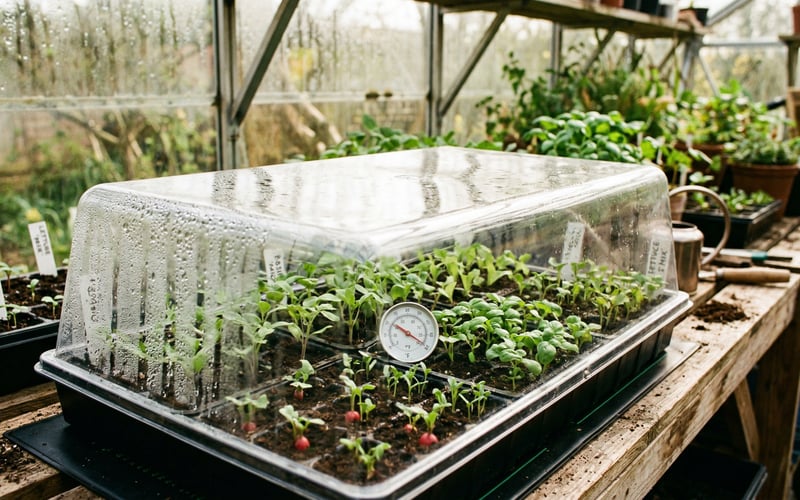
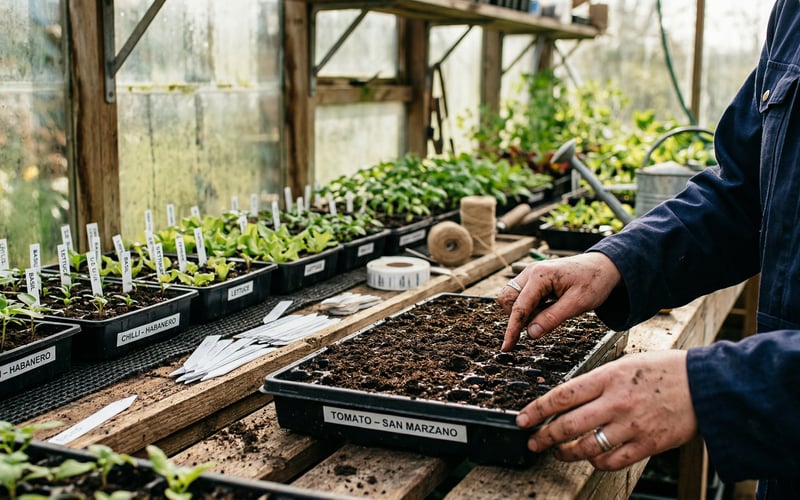
Step-by-step seed sowing
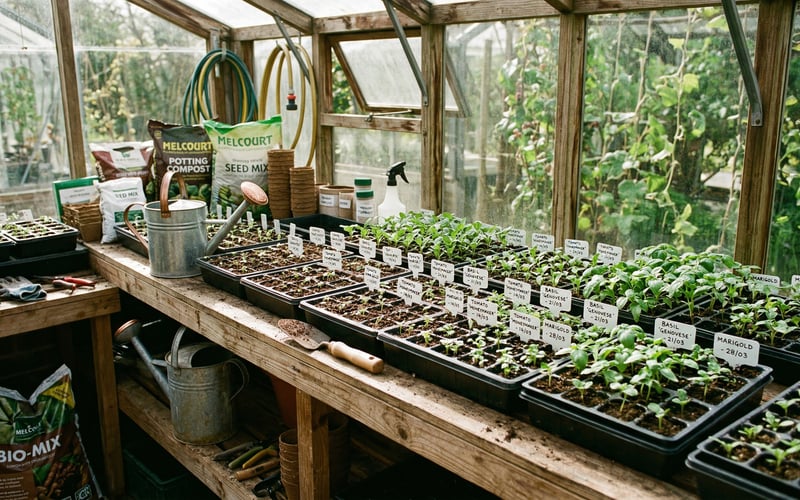
- Fill trays with fresh seed compost - never use old compost or multi-purpose. Seed compost is fine-textured and low in nutrients, which prevents damping off
- Water the compost before sowing - not after. Watering after sowing washes tiny seeds too deep
- Sow thinly - overcrowded seedlings compete for light and develop weak, leggy stems
- Cover with vermiculite (not compost) to the depth shown in the table above. Vermiculite holds moisture without capping the surface
- Place in heated propagator at the correct temperature - check the table for each crop
- Remove the lid as soon as seedlings emerge - leaving it on causes damping off within 48 hours
- Move to a bright spot on staging - 15cm from the glass gives the best light without scorching
- Prick out when the first true leaves appear - hold by the leaf, never the stem
Matt's Tip: The Vermiculite Trick
I switched from covering seeds with compost to vermiculite eight years ago and my germination rates jumped 15-20%. Vermiculite lets light through (important for surface-sown seeds), holds moisture evenly, and does not form a hard crust. I buy a 100-litre bag for about £15 and it lasts a full season. Every professional grower I know uses it.
How to propagate from cuttings
Cuttings let you clone exact copies of a parent plant for free. There are three types, each taken at a different time of year. A greenhouse gives you the controlled environment that makes the difference between 40% success outdoors and 90% success under glass.
| Cutting Type | When to Take | Material | Rooting Time | Bottom Heat | Best For |
|---|---|---|---|---|---|
| Softwood | May-July | Soft, new growth tips 5-10cm | 14-21 days | 18-20°C | Fuchsias, pelargoniums, dahlias, hydrangeas, salvias |
| Semi-ripe | July-September | Current year's growth, firm at base, soft at tip, 10-15cm | 4-8 weeks | 15-18°C | Lavender, rosemary, box, escallonia, camellia, hebe |
| Hardwood | November-March | Fully mature, pencil-thick woody stems 20-30cm | 3-12 months | Not needed | Roses, cornus, willow, forsythia, privet, gooseberry |
Taking softwood cuttings (the fastest method)
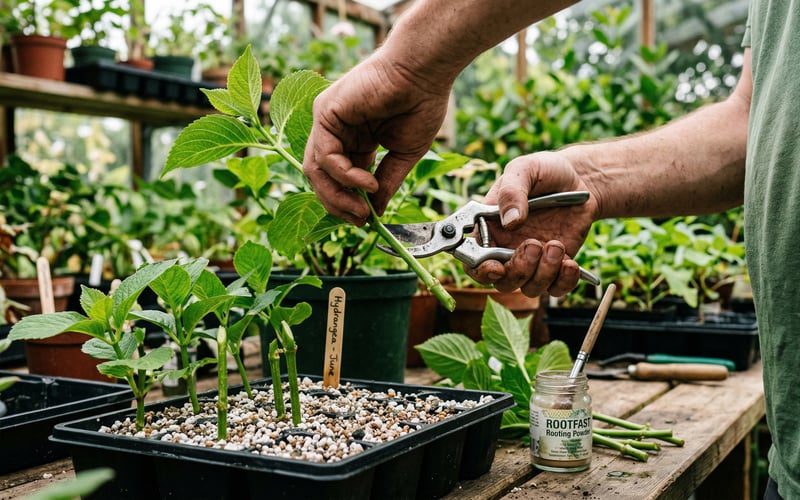
- Take cuttings early morning when stems are fully turgid (full of water)
- Cut 5-10cm of new growth just below a leaf node with a sharp, clean blade
- Remove lower leaves - leave only the top 2-3 pairs
- Dip the cut end in rooting hormone powder - tap off excess. Hormone raises success rates by 20-30%
- Insert into a 50:50 mix of perlite and peat-free compost - firm gently
- Water lightly and cover with a clear plastic bag or propagator lid
- Place on a heated mat or in a propagator at 18-20°C
- Mist daily and ventilate for 10 minutes to prevent fungal problems
- Roots form in 14-21 days - test by gently tugging the cutting. Resistance means roots
- Pot on into individual 9cm pots once rooted and grow on in the greenhouse
Semi-ripe cuttings (the easiest method)
Semi-ripe cuttings are more forgiving than softwood because the firmer stems lose less water. Take 10-15cm lengths of this year's growth in July-September. The base should be firm and woody, the tip still soft and green. Wound the base by scraping a thin strip of bark with a knife - this exposes more cambium for root formation. Use rooting hormone and insert into gritty compost (70% perlite, 30% compost). They root in 4-8 weeks with bottom heat at 15-18°C.
Read our greenhouse herb growing guide for specific propagation advice on rosemary, lavender, sage and thyme - all propagate brilliantly from semi-ripe cuttings taken in July.
|
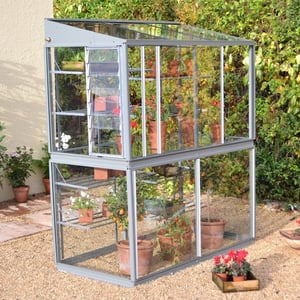
Matt's pick for propagationBest For: Dedicated propagation space alongside a main greenhouse Why I Recommend It: The Exbury mini greenhouse gives you a separate propagation zone with its own temperature control. I have fitted dozens of these alongside larger greenhouses. The 3x5 footprint holds 6-8 seed trays on two levels and the toughened glass retains heat better than polycarbonate for bottom-heat propagation. Price: From £1,125 |
How to propagate by division
Division is the simplest propagation method. You lift a mature plant, split it into sections, and replant. Each section is already a complete plant with roots, so there is no waiting for rooting. The greenhouse role is growing the divisions on in pots until they establish.
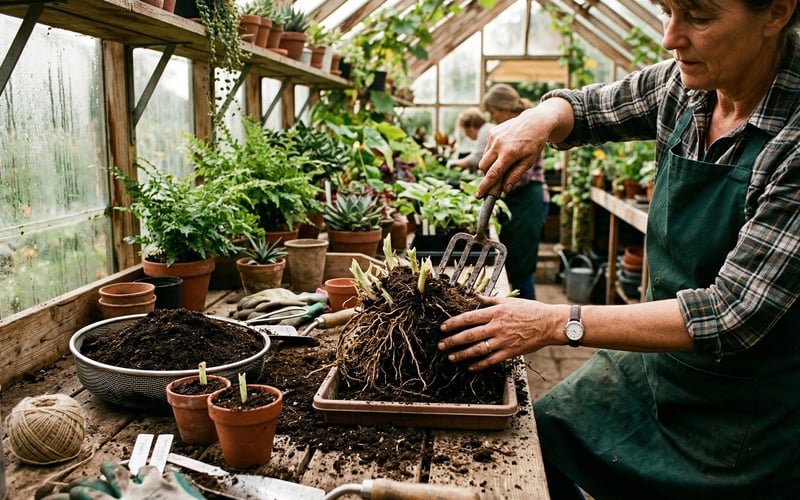
When to divide: March-April (spring growers) or September-October (after flowering). Never divide in summer heat or deep winter.
Plants that divide well: Hostas, hemerocallis, agapanthus, crocosmia, geraniums, astilbe, rudbeckia, heuchera, grasses, sedums, primulas, snowdrops (in the green).
Division method
- Water the plant thoroughly the day before
- Lift the entire clump with a garden fork
- Shake off excess soil so you can see the root structure
- Split into sections - use two back-to-back forks for large clumps, a sharp knife for smaller ones. Each piece needs at least 3-5 shoots and a healthy root section
- Pot into fresh compost and grow on in the greenhouse for 2-4 weeks
- Plant out once actively growing
One mature hosta can yield 6-10 divisions. At £8-15 per plant at a garden centre, that is £48-150 worth of plants from a single division session.
Matt's Installation Tip
When customers ask me where to position a greenhouse for propagation, I always say: as close to the house as possible on the south or west side. Propagation means daily checking, misting, and temperature monitoring. If the greenhouse is at the bottom of the garden, you will skip visits on cold, rainy evenings and lose cuttings to drought or fungal problems. Proximity matters more than perfection. I have seen more plants saved by a conveniently placed 6x4 than a distant 10x12.
Using bottom heat and heated propagators
Bottom heat is the single biggest factor in propagation success. Warming the compost from below encourages root growth while keeping the top of the cutting or seedling cool, which reduces water loss.
| Propagation Method | Without Bottom Heat | With Bottom Heat | Improvement |
|---|---|---|---|
| Seed germination (tender crops) | 40-60% success | 85-95% success | +35-45% |
| Softwood cuttings | 30-50% rooting | 80-90% rooting | +40-50% |
| Semi-ripe cuttings | 50-65% rooting | 80-90% rooting | +25-30% |
| Rooting time (softwood) | 21-35 days | 14-21 days | 7-14 days faster |
There are two ways to provide bottom heat:
Heated propagators are self-contained units with a heated base and clear lid. They cost £25-60 and hold 2-3 standard seed trays. The thermostat maintains a consistent temperature regardless of greenhouse air temperature. This is the easiest option for most gardeners.
Heated mats sit under seed trays and warm the compost from below. They cover a larger area than a propagator and cost £30-50. You need a separate thermostat controller (£15-25) to prevent overheating. I use heated mats on my greenhouse staging to turn an entire shelf into a propagation bench.
For either method, aim for a compost temperature 5-8°C above the ambient greenhouse air temperature. A soil thermometer (under £10) is essential - do not guess temperatures for propagation.
Month-by-month propagation calendar
Use this calendar to plan your propagation year. A greenhouse extends every window by 4-6 weeks compared to outdoor propagation.
| Month | Seeds to Sow | Cuttings to Take | Division |
|---|---|---|---|
| January | Sweet peas, pelargoniums, begonias (heated propagator) | - | - |
| February | Tomatoes, peppers, chillies, aubergines, early brassicas | Overwintered chrysanthemum basal cuttings | - |
| March | Half-hardy annuals, brassicas, lettuce, onions, leeks | Dahlia basal cuttings, chrysanthemums | Perennials as they break dormancy: hostas, grasses, hemerocallis |
| April | Cucumbers, courgettes, runner beans, sweetcorn, basil | Softwood: fuchsias, pelargoniums from overwintered stock | Late perennials: agapanthus, crocosmia, sedums |
| May | Succession sow salads, French beans, outdoor cucumbers | Softwood: hydrangeas, lavender tips, rosemary tips, salvias | Primulas after flowering |
| June | Succession sow salads, late brassicas for autumn/winter | Softwood: box, hebe, penstemon, dianthus, clematis | Bearded iris after flowering |
| July | Spring cabbage, autumn lettuce, turnips | Semi-ripe: lavender, rosemary, box, escallonia, camellia | - |
| August | Overwintering onions, spring greens | Semi-ripe: euonymus, choisya, skimmia, holly, pyracantha | - |
| September | Hardy annuals for early flowers, winter salads under glass | Semi-ripe: last chance for evergreen cuttings | Perennials: hostas, astilbe, rudbeckia, helenium |
| October | Broad beans, sweet peas (overwinter in cold greenhouse) | Hardwood: roses, cornus, forsythia, willow | Rhubarb, herbs |
| November | Garlic (under glass for head start) | Hardwood: fruit bushes (currants, gooseberries) | Snowdrops (in the green, if still available) |
| December | Planning and seed ordering | Hardwood: continue if ground is not frozen | - |
Equipment you need for greenhouse propagation
| Equipment | Cost | Essential? | What It Does |
|---|---|---|---|
| Heated propagator (thermostat controlled) | £25-60 | Yes | Consistent bottom heat for seeds and cuttings |
| Seed trays and modules | £5-15 for 10 | Yes | Sowing and growing on |
| Fresh seed compost | £4-8 per 20L | Yes | Fine, low-nutrient growing medium |
| Perlite (for cuttings mix) | £8-15 per 100L | Yes for cuttings | Drainage and aeration in rooting medium |
| Vermiculite (seed covering) | £10-15 per 100L | Recommended | Moisture-retaining seed cover |
| Rooting hormone powder | £4-6 | Yes for cuttings | 20-30% improvement in rooting rates |
| Soil thermometer | £5-10 | Yes | Accurate compost temperature readings |
| Min/max thermometer | £8-15 | Yes | Monitors temperature swings in greenhouse |
| Greenhouse staging | £40-120 | Yes | Raises trays to working height, better air circulation |
| Seed tray frames | £60-150 | Recommended | Dedicated multi-tier propagation station |
| Sharp knife or scalpel | £3-8 | Yes for cuttings | Clean cuts prevent disease |
| Labels and waterproof pen | £3-5 | Yes | You will forget what you sowed - label everything |
Total cost to set up a complete propagation station: £80-150. This pays for itself in the first season if you raise even 50 plants that would cost £3-5 each at a garden centre.
Good greenhouse staging and shelving is essential for propagation. Raising trays off the floor improves air circulation (reducing damping off), puts plants at working height, and keeps them closer to the light. Our small greenhouse ideas guide shows how to maximise propagation space even in a 6x4.
Common propagation problems and fixes
| Problem | Cause | Fix | Prevention |
|---|---|---|---|
| Damping off (seedlings collapse at soil level) | Fungal infection from overwatering, poor ventilation, or old compost | Remove affected seedlings immediately. Improve ventilation | Use fresh compost. Water from below. Remove propagator lid once seedlings emerge |
| Leggy seedlings (tall, thin, pale) | Insufficient light, too warm, overcrowded | Move closer to glass. Reduce temperature slightly | Sow thinly. Position on top tier of staging near glass |
| Cuttings rotting | Too wet, no drainage, fungal infection | Remove rotted cuttings. Improve drainage in compost mix | Use 50:50 perlite/compost mix. Do not overwater. Ventilate daily |
| Cuttings wilting | Too dry, too much direct sun, no humidity | Mist immediately. Move to indirect light | Keep covered with lid. Mist twice daily. Shade from direct midday sun |
| Seeds not germinating | Temperature too low, old seed, sown too deep | Check compost temperature with soil thermometer | Use heated propagator. Buy fresh seed. Follow depth guidelines |
| Mould on compost surface | Poor ventilation, overwatering | Scrape off mould. Increase ventilation | Open propagator lid daily for 10 minutes. Water only when compost surface dries |
Proper greenhouse ventilation prevents most fungal problems. Open vents or the door for at least 30 minutes daily, even in cold weather, to circulate fresh air around your propagation trays.
"From our work with Greenhouse Stores customers since 2012, the question I get asked most is 'what should I grow first?' My answer is always the same: propagate. A heated propagator, a bag of seed compost, and five packets of seeds will teach you more about greenhouse growing in one season than anything else. And you will save enough money on plants to pay for the greenhouse itself within two or three years."
- Matt W, Greenhouse Stores
Frequently asked questions
What temperature do seeds need to germinate in a greenhouse?
Most vegetable seeds germinate best at 18-21°C compost temperature. Peppers, aubergines and cucumbers need warmer conditions at 21-25°C. Hardy crops like lettuce and peas germinate at lower temperatures of 10-15°C. Always measure compost temperature, not air temperature, as these can differ by 5-8°C in a greenhouse.
Do I need a heated propagator for greenhouse propagation?
A heated propagator raises germination rates from 40-60% to 85-95%. It provides consistent bottom heat that is difficult to achieve any other way. In an unheated greenhouse, compost temperatures can drop below 10°C overnight even in April, which stalls germination of tender crops. A propagator costing £25-60 is the most cost-effective piece of propagation equipment you can buy.
When should I take softwood cuttings?
Take softwood cuttings from May to July when new growth is soft and green. Early morning is best when stems are fully hydrated. Cut 5-10cm lengths just below a leaf node. With bottom heat at 18-20°C, softwood cuttings root in 14-21 days. Without heat, expect 21-35 days and lower success rates.
What is the difference between softwood and semi-ripe cuttings?
Softwood cuttings use soft new growth; semi-ripe cuttings use firmer current-year stems. Softwood cuttings are taken May-July and root faster (14-21 days) but wilt more easily. Semi-ripe cuttings are taken July-September, root slower (4-8 weeks) but are more forgiving because the firmer stems lose less water. Both benefit from bottom heat in a greenhouse.
How do I prevent damping off in seedlings?
Use fresh seed compost, water from below, and remove propagator lids once seedlings emerge. Damping off is caused by fungal pathogens in wet, poorly ventilated conditions. Sow thinly to allow air circulation between seedlings. Open the greenhouse for 30 minutes daily even in cold weather. Never reuse old compost for propagation.
Can I propagate plants in an unheated greenhouse?
Yes, but your season is shorter and success rates are lower without bottom heat. An unheated greenhouse is still 5-10°C warmer than outdoors, which extends the propagation window by 4-6 weeks. Focus on hardy seeds (lettuce, peas, broad beans) from February and semi-ripe cuttings from July. Add a heated propagator for just £25-60 to open up tender crop propagation.
How much money can I save by propagating my own plants?
A typical propagation setup saves £200-500 per year on plant purchases. Ten packets of vegetable seeds cost £25-30 and produce 500+ plants worth £1,500+ at garden centre prices. Six fuchsia cuttings taken in May give you 6 free plants worth £30-48. One hosta division yields 6-10 plants worth £48-150. The initial equipment cost of £80-150 pays for itself in the first season.