Overwintering Plants in a Greenhouse: UK Frost Protection Guide
Overwintering tender plants in a greenhouse keeps them alive through UK frosts for a fraction of the cost of replacing them each spring. A 6x8ft greenhouse stays 2-5C warmer than outside on cold nights. Adding bubble wrap insulation raises that by another 2-3C. A thermostat-controlled heater set to 2C costs £8-12 per month to run. We have fitted over 12,000 greenhouses since 2008, and proper overwintering prevents 90% of winter plant losses across our customer base.
Key Takeaways
- A greenhouse stays 2-5C warmer than outside at night and up to 20C warmer on sunny winter days - enough to protect most tender plants without any heating.
- Fuchsias and pelargoniums survive at 2C, citrus needs 5-7C, and dahlias should be lifted and stored at 5C in dry compost.
- Bubble wrap insulation costs under £20 and cuts heat loss by 30-40%. Always insulate before you buy a heater.
- Overwatering kills more overwintering plants than cold. Water only when the top 25mm of compost feels dry, roughly every 2-3 weeks.
- Replacing a collection of 20 tender plants costs £100-200. A winter's heating costs £50-80. The maths is clear.
- Ventilate on every day above 8C. Stagnant damp air causes botrytis (grey mould) faster than frost damages roots.
Installer's Note
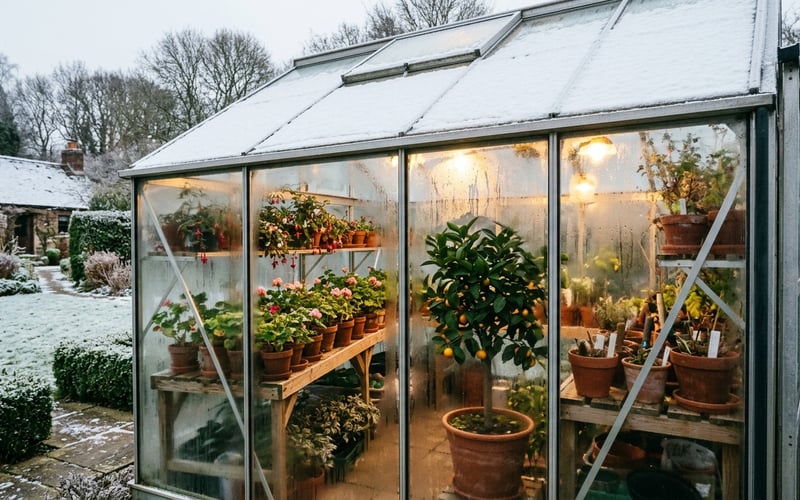
Every autumn we get calls from customers who lost an entire greenhouse collection to one unexpected frost. The pattern is always the same: no thermometer, no insulation, and the vents left open overnight. When we prepare customer greenhouses for winter, insulation is the first job. A single layer of bubble wrap on every interior glass panel cuts heat loss by 30-40%. We check every glazing clip and door seal before October. Draughts kill more overwintering plants than cold temperatures ever do.
Why Is a Greenhouse the Best Overwintering Solution?
A greenhouse is the most effective winter shelter for tender plants. Glass and polycarbonate panels trap solar radiation during the day and release it slowly at night. Even without heating, a greenhouse stays 2-5C warmer than outside overnight. On a sunny December day, interior temperatures can reach 15-20C when the outside air sits at 5C.
Twin-wall polycarbonate retains 38% more heat overnight than single-pane glass. Glass warms up faster during sunny spells but loses heat quicker after dark. Both work well for overwintering when combined with insulation.
The real advantage is wind protection. Wind chill strips heat from plant tissue faster than still cold air at the same temperature. A greenhouse eliminates wind chill entirely. A plant that would suffer at -3C in an exposed garden survives comfortably at the same air temperature inside glass. Our guide on whether greenhouses stay warm in winter explains the temperature science in detail.
Which Plants Need Overwintering and at What Temperature?
The RHS hardiness scale runs from H1a (heated glasshouse all year) to H7 (survives below -20C). Most UK garden plants sit between H3 and H6. Plants rated H3 or below need winter protection in all but the mildest coastal areas.
| Plant | RHS Rating | Minimum Temp | Overwintering Method | Bring In | Move Out |
|---|---|---|---|---|---|
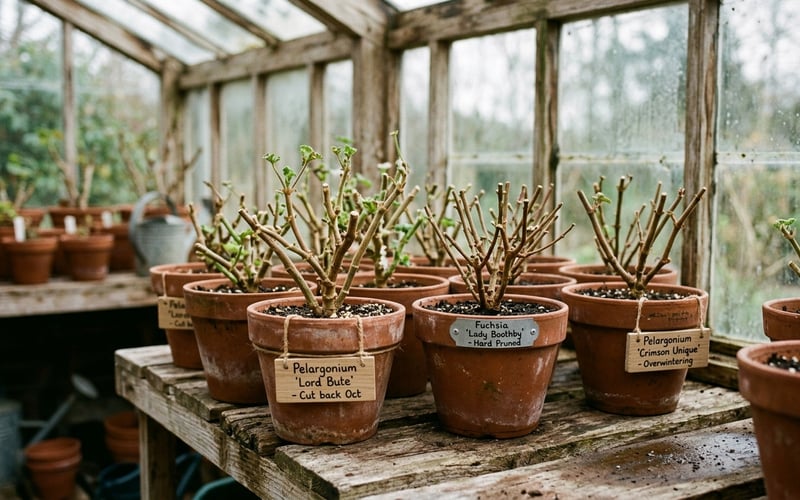
| Pelargoniums (geraniums) | H1c | 2C | Pot up, cut back to 100mm, store on greenhouse bench | Late September | Late May |
| Fuchsias (tender) | H2 | 2C | Cut back by half, keep barely moist in frost-free greenhouse | Early October | Late May |
| Dahlias | H3 | 5C (stored) | Lift tubers after first frost, store in dry compost | After first frost | Late April (pot up) |
| Cannas | H3 | 5C (stored) | Lift rhizomes, dry off, store in vermiculite | After first frost | April (pot up) |
| Citrus trees | H2 | 5-7C | Move pot to greenhouse, water sparingly, no feeding | Early October | Late May |
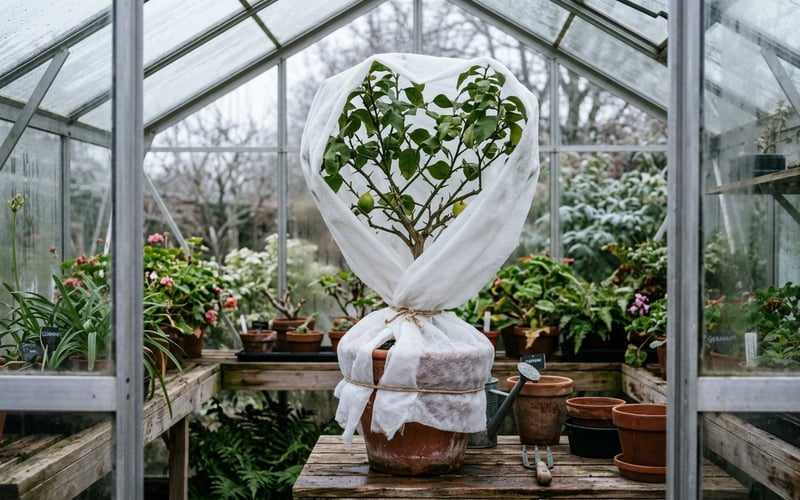
| Olive trees | H4 | -5C | Wrap pot and trunk with fleece, or move small trees to greenhouse | November | April |
| Agapanthus | H4 (evergreen) / H5 (deciduous) | -5C | Evergreen types: greenhouse. Deciduous types: mulch in situ | October | April |
| Banana plants (Musa basjoo) | H4 | -5C | Cut stem to 300mm, wrap stump with fleece and straw | After first frost | May |
| Gladioli | H3 | 5C (stored) | Lift corms 6 weeks after flowering, dry and store | October | March (pot up) |
| Begonias (tuberous) | H2 | 5C (stored) | Let foliage die back, lift tubers, store dry | October | March (pot up) |
The biggest mistake is treating all tender plants the same way. Citrus trees need light all winter and prefer 5-7C with occasional watering. Dahlias need total darkness at 5C with no water at all. Pelargoniums want a cool, bright shelf with water once a month. Understanding each plant's specific needs is the difference between success and a compost heap in April.
How Do I Prepare Plants for Overwintering?
Preparation starts in September, well before the first frost. The process is the same for most tender plants: reduce watering, stop feeding, check for pests, prune back excess growth, and clean pots.
Step 1: Stop feeding. No fertiliser from September onwards. Feeding encourages soft new growth that frost kills instantly. You want plants to harden off naturally as days shorten.
Step 2: Reduce watering. Cut watering by half from mid-September. By October, most tender plants should be on a regime of once every 2-3 weeks. Overwatering is the number one killer of overwintering plants.
Step 3: Check for pests. Inspect every plant before bringing it inside. Aphids, whitefly, vine weevil larvae, and red spider mite all thrive in a warm greenhouse. One infested plant spreads pests to your entire collection within weeks. We recommend a thorough check of the undersides of all leaves and the surface of compost.
Step 4: Prune back. Cut pelargoniums to 100-150mm above the compost. Cut tender fuchsias back by half. Remove all dead and yellowing foliage from every plant. Dead leaves harbour fungal spores that cause botrytis in damp greenhouse conditions.
Step 5: Clean pots. Wipe down the outside of each pot with diluted disinfectant. Remove any moss or algae. This reduces fungal spore counts significantly.
Shop the Elite Min E Lite Cold Frame →
Heated vs Unheated Greenhouse: What Can You Overwinter in Each?
An unheated greenhouse is enough for most half-hardy plants rated H3-H4. It protects from wind, rain, and the worst of the frost. On a clear night at -5C outside, an unheated greenhouse typically holds 0 to -2C inside. That is enough for olives, hardy fuchsias, agapanthus, and Mediterranean herbs.
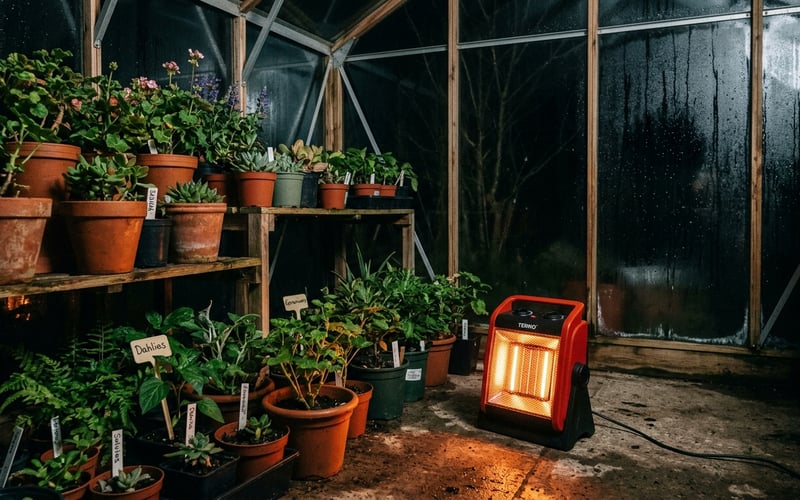
Tender plants rated H1c-H2 need a heated greenhouse. Pelargoniums, tender fuchsias, citrus, and tuberous begonias all need temperatures that never drop below 2C. A small electric heater with a thermostat set to 2C is all you need. It only fires when the temperature actually drops, which keeps running costs low.
Our article on what to grow in an unheated greenhouse covers the full range of winter crops that thrive without any heating.
| Temperature Zone | Greenhouse Setup | Monthly Cost (6x8ft) | Plants You Can Overwinter |
|---|---|---|---|
| Unheated (0 to -2C min) | Insulated with bubble wrap only | £0 | Olives, hardy fuchsias, rosemary, agapanthus, overwintering veg |
| Frost-free (2C min) | Bubble wrap + electric heater on thermostat | £8-12 | Pelargoniums, tender fuchsias, begonias, salvias |
| Cool (5-7C min) | Bubble wrap + electric fan heater | £30-45 | Citrus, orchids, bougainvillea, tender exotics |
| Warm (10-13C min) | Insulation + large fan heater or radiator | £60-90 | Tropical houseplants, rare orchids, tropical fruit |
Most UK greenhouse gardeners only need the frost-free tier. Keeping a 6x8ft greenhouse at 2C costs £8-12 per month with a thermostat-controlled heater and bubble wrap insulation. Our detailed breakdown of greenhouse heating costs shows exactly how these figures are calculated at current electricity prices.
|
Matt's Pick for Overwintering HeatingBest For: Frost-free protection in greenhouses up to 14 sq metres Why I Recommend It: I have tested every heater we sell and this one stands apart. The external digital thermostat with dual sensors reads the actual plant temperature, not the warm air next to the fan. It cycles on and off to hold your target precisely. The IPX4 splash rating means it handles greenhouse humidity safely. One night of hard frost costs about 80p to run. Price: £199 |
What Are the Best Greenhouse Heating Options for Overwintering?
Three types of heater suit greenhouse overwintering: electric fan heaters, propane gas heaters, and paraffin heaters. Each has trade-offs on cost, convenience, and safety.
| Heater Type | Model | Output | Coverage | Running Cost | Price | Matt's Verdict |
|---|---|---|---|---|---|---|
| Electric fan | Palram Canopia 2400W | 2.4kW | Up to 14 sq m | £8-12/month frost-free | £199 | Matt's Pick - best thermostat control |
| Gas (propane) | Eden 2KW | 2kW | Up to 60 sq ft | £15-25/month (propane) | £140 | Best for greenhouses with no mains power |
| Gas (propane) | Eden Pro 4.2kW | 4.2kW | Up to 200 sq ft | £25-40/month (propane) | £199 | Best for large greenhouses off-grid |
| Gas (propane) | Elite Blue Flame 1.9kW | 1.9kW | Up to 200 sq ft | £20-35/month (propane) | £249 | Quietest gas option - no fan noise |
| Paraffin | Elite Super Warm 5 | ~0.5kW | Up to 5 sq m | £7-10/week (paraffin) | £110 | Emergency backup only - high running cost |
Electric fan heaters are the best option for most overwintering setups. They offer precise thermostat control, fire only when needed, and cost the least to run. The Palram Canopia 2400W uses dual sensors mounted away from the heater for accurate readings. At 25p per kWh (2026 Ofgem price cap), running a 2kW heater overnight for 8 hours with a thermostat costs roughly 80p-£1 per hard frost night.
Gas heaters are essential where mains electricity is not available. The Eden 2KW suits small greenhouses up to 60 sq ft. For larger structures, the Eden Pro 4.2kW or Elite Blue Flame 1.9kW cover up to 200 sq ft. Always crack roof vents by 10-15mm when running gas heaters. They produce CO2 and moisture during combustion.
Paraffin heaters work as emergency backup during power cuts but are expensive to run continuously. Paraffin costs roughly £12-15 for 4 litres. A small paraffin heater burns through that in 3-4 days. Use them as insurance, not as your primary heat source.
Matt's Installation Tip
Always insulate before you buy a heater. I have seen customers spend £200 on a heater when £15 worth of bubble wrap would have been enough. Bubble wrap on the interior glass panels cuts heat loss by 30-40%. In a 6x8ft greenhouse, that is the difference between needing a heater and not needing one at all. Use our Elite Insulation Clips (from £22) to secure bubble wrap without damaging the frame.
Why Does Ventilation Matter During Winter?
Ventilation is the most overlooked part of overwintering. Closing every vent and door seems logical, but sealed greenhouses trap moisture. That moisture condenses on glass overnight and drips onto leaves. Within days, grey mould (botrytis) takes hold.
Open vents or the door for 2-3 hours on every day the temperature rises above 8C. Morning is best. This lets stale damp air escape and fresh dry air circulate. Close everything by mid-afternoon to trap warmth for the night.
In prolonged wet spells when you cannot open vents, a small circulation fan helps. The Palram Canopia 2400W has a fan-only mode for exactly this purpose. Running the fan without heat circulates air and reduces humidity. Our greenhouse ventilation guide covers airflow management in detail.
Shop the Eden 2KW Greenhouse Heater →
Month-by-Month Overwintering Calendar
This calendar covers the full overwintering cycle from September preparation through to April hardening off. Timings are for the Midlands. Northern gardeners should start 1-2 weeks earlier. Southern gardeners can delay by a week.
| Month | Key Tasks | Temperature Notes |
|---|---|---|
| September | Stop feeding all tender plants. Reduce watering. Check for pests. Clean greenhouse glass inside and out. Order insulation materials. | Night temps: 8-12C. No frost risk yet. |
| October | Bring in pelargoniums, tender fuchsias, citrus. Lift dahlia tubers after first frost. Install bubble wrap insulation. Check door seals and glazing clips. | First frosts: mid-Oct (north) to late Oct (south). Night temps: 2-8C. |
| November | All tender plants inside. Set heater thermostat to 2C. Begin minimal watering regime. Remove dead foliage weekly. Check stored tubers for rot. | Night temps: -2 to 4C. Hard frosts become regular. |
| December | Water sparingly. Ventilate on mild days. Monitor min-max thermometer daily. Remove condensation from leaves if possible. Check heater function. | Night temps: -5 to 2C. Shortest days - minimal plant growth. |
| January | Coldest month. Keep heating running. Inspect all plants for mould. Remove any affected material immediately. Keep ventilating on days above 8C. | Night temps: -8 to 1C. Highest heating demand. |
| February | Light levels improve. Increase watering slightly for citrus and evergreens. Pot up dahlia tubers indoors to start growth. Check for vine weevil grubs. | Night temps: -5 to 3C. Late frosts still common. |
| March | Resume light feeding for citrus and evergreens. Begin hardening off hardy plants on mild days. Sow early seeds in heated propagator. | Night temps: -2 to 5C. Risk of hard late frosts remains. |
| April | Gradually move hardier plants outside on warm days. Bring back in at night until mid-May. Remove bubble wrap insulation by month end. | Night temps: 2-8C. Last frost date: mid-April (south) to early May (north). |
Matt's Tip: The £8 Tool That Saves Hundreds
Buy a min-max thermometer before you buy anything else. I tell every customer the same thing. A min-max thermometer records the lowest overnight temperature in your greenhouse. That single number tells you whether you need a heater, how low to set the thermostat, and whether your insulation is working. Our Vitavia Thermometer (from £24) does the job. Without it, you are guessing. And guessing costs plants.
What Are the Most Common Overwintering Mistakes?
Overwatering is the number one killer. Dormant plants need almost no water. Wet compost in cold conditions causes root rot within weeks. Water only when the top 25mm of compost is completely dry. In December and January, most plants need water once every 3-4 weeks at most.
No ventilation. Sealed greenhouses breed botrytis. Even in December, open a vent for 2-3 hours on any day above 8C. Damp stagnant air is more dangerous than a brief blast of cold.
Bringing in infested plants. One plant carrying whitefly or aphids spreads pests to everything inside. Check every plant thoroughly before it crosses the greenhouse threshold.
Leaving bubble wrap from last year. Old bubble wrap degrades in UV light and loses its insulating properties. Replace it every season. Fresh bubble wrap is cheap and the insulation difference is significant.
Pruning at the wrong time. Never cut back spring-flowering shrubs (camellia, forsythia, lilac) before winter. They set their flower buds in autumn. Pruning now means no flowers next year. Wait until immediately after they bloom.
Heating without insulating. Running a heater in an uninsulated greenhouse is like heating a house with the windows open. Always insulate first. Bubble wrap reduces heating costs by 30-40% and often eliminates the need for a heater entirely.
How Do I Overwinter Dahlias, Gladioli, and Begonias?
Bulbs and tubers follow a different process to potted plants. They need lifting, drying, and storing rather than keeping in active growth.
Dahlias: Wait until the first frost blackens the foliage. Cut stems back to 150mm above the tuber. Fork around the plant carefully and lift the entire rootball. Shake off excess soil but do not wash. Dry upside down for two weeks in a frost-free shed to drain water from hollow stems. Store in trays of dry compost or vermiculite at 5C. Check monthly for mould or soft rot.
Gladioli: Lift corms six weeks after the last flower fades. Cut foliage to 25mm above the corm. Dry in a warm room for 2-3 weeks. Remove the old shrivelled corm from beneath the new one. Store in paper bags in a cool, frost-free spot at 5-10C.
Begonias (tuberous): Let the foliage die back naturally after the first frost. Lift the tuber, brush off soil, and dry for a week. Store in dry peat or vermiculite at 5-7C. Do not water stored begonia tubers at all.
Shop the Palram Canopia 2400W Heater →
Is It Cheaper to Overwinter Plants or Replace Them?
The maths strongly favours overwintering. A collection of 20 tender plants (pelargoniums, fuchsias, dahlias, a citrus tree) costs £100-250 to replace at garden centre prices each spring. Some specimen plants cost far more. A mature lemon tree runs £40-80. Large established fuchsia standards cost £25-40 each.
A winter's worth of frost protection costs £50-80 in electricity for a heated 6x8ft greenhouse. Bubble wrap insulation costs £15-20. A thermometer costs £24-44. After the first year, your only recurring cost is electricity and replacement bubble wrap.
Beyond the money, overwintering preserves mature root systems. A three-year-old pelargonium produces far more flowers than a new plug plant. Established dahlia tubers give bigger, earlier blooms. You cannot buy that maturity off the shelf.
Browse All Greenhouse Heaters →
"I have been overwintering plants in greenhouses for over 16 years now, both in customer builds and my own. The ones who get it right every year all do the same thing: insulate in September, set the thermostat to 2C, and leave the plants alone. The ones who lose plants are always the ones who overwater. A cold greenhouse is not a death sentence. A wet one is."
- Matt W, Greenhouse Stores
Frequently Asked Questions
When should I start overwintering plants in the UK?
Start preparation in September, move plants inside by mid-October. Stop feeding tender plants in September and reduce watering. The first UK frosts arrive between mid-October (northern England, Scotland) and early November (southern England). All tender plants rated H1c-H3 should be inside a greenhouse before the first forecast frost. Leaving it even one night too late can destroy an entire collection.
What temperature should I keep my greenhouse at in winter?
Between 2C and 7C, depending on your plant collection. Most tender perennials (pelargoniums, fuchsias) survive at 2C. Citrus trees prefer 5-7C. Set your thermostat to the minimum your most tender plant requires. A thermostat-controlled heater at 2C in a 6x8ft insulated greenhouse costs £8-12 per month at current electricity prices.
Can I overwinter plants in an unheated greenhouse?
Yes, for plants rated H3 and above on the RHS scale. An unheated greenhouse with bubble wrap insulation stays 4-8C warmer than outside. That protects olives, hardy fuchsias, agapanthus, Mediterranean herbs, and many shrubs. Plants rated H1c-H2 (pelargoniums, tender fuchsias, citrus) need at least frost-free conditions with a heater.
How often should I water overwintering plants?
Water only when the top 25mm of compost is dry. For most dormant plants, that means once every 2-4 weeks through winter. Overwatering is the single biggest cause of overwintering plant death. Always water in the morning so excess moisture can evaporate before temperatures drop at nightfall. Citrus needs slightly more water than dormant perennials.
Is it worth heating a greenhouse just for overwintering?
Yes, if replacing your plant collection costs more than a winter's electricity. A frost-free 6x8ft greenhouse costs £8-12 per month to heat. Replacing 20 tender plants costs £100-250 at garden centre prices. Over a typical October-to-April heating season, you spend roughly £50-80 to protect plants worth several times that amount. The saving is even greater with established specimen plants.
Do I need to ventilate my greenhouse in winter?
Yes, open vents for 2-3 hours on every day above 8C. Stagnant damp air causes grey mould (botrytis) faster than frost damages roots. Even in December, ventilate on mild days. Close vents by mid-afternoon to trap warmth for the night. If you cannot open vents during wet spells, run a circulation fan to keep air moving.
Should I use bubble wrap or polycarbonate for greenhouse insulation?
Bubble wrap is the cheapest and most effective retrofit insulation. A single layer on interior glass panels cuts heat loss by 30-40%. Polycarbonate glazing (twin-wall) is better long-term but requires re-glazing the greenhouse. For overwintering, bubble wrap at £15-20 per season is the best value option. Replace it annually because UV light degrades the plastic over summer.