How to Dry Apples and Pears at Home: 3 UK Methods Compared
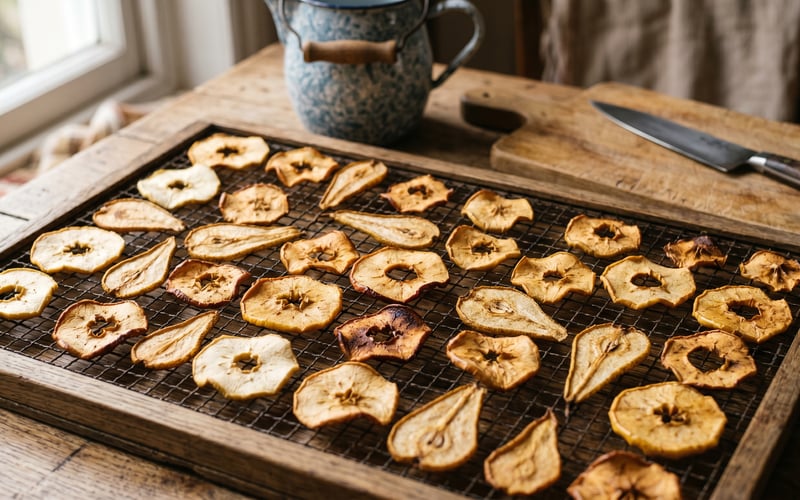
Drying apples and pears at home is the simplest way to preserve a glut. The three UK-tested methods are air drying (5-7 days on twine, free, traditional), oven drying (8-12 hours at 60C, moderate electric cost), and dehydrator drying (8-10 hours at 57C, most reliable). Each finishes with the same shelf-stable result — rings, slices, or leathery strips that keep 12 months in airtight glass jars. From our work with Greenhouse Stores customers since 2012, dehydrator drying is the method we recommend for consistent results; air drying is the right choice for small batches and no-electric crofts.
Key takeaways
- Three UK methods, same outcome. Air drying (slow, free), oven drying (medium speed, low cost), dehydrator (fastest, most consistent). Pick by the kit you already own and the size of your harvest.
- Best apples for drying: Cox, Bramley, Discovery, Egremont Russet. Firm flesh and a little tartness dry better than soft eaters.
- Best pears for drying: Conference and Comice. Conference holds its shape, Comice carries the most flavour through to the dried slice.
- Always pre-treat with acidulated water. 30 seconds in 1 litre water + 1 tbsp lemon juice (or 1g vitamin C powder) stops oxidation and keeps the fruit golden, not grey-brown.
- Dry to leather, not crunch. Properly dried apple rings bend without snapping. Snap-dry is overdone and will shatter in storage.
- Store in glass jars in a dark cupboard. Plastic tubs sweat. Glass keeps fruit dry for 12 months at room temperature.
Expert Tip
I have been fitting greenhouses across the UK for many years and the question that comes up every September is the same: “What do I do with all this fruit?” A productive apple tree drops 30-60kg in a good year, a Conference pear another 20-30kg, and freezer space runs out fast. Drying is the answer we keep coming back to. It uses no permanent space, the kit pays for itself in one season, and the dried rings taste better than supermarket sultanas in autumn porridge. I run my own batches every September using a 17-year-old Excalibur dehydrator that has paid for itself many times over.
Why dry apples and pears at home?
Three things tip the balance in favour of drying over freezing or jam-making:
Storage footprint. 5kg of fresh apples reduces to roughly 800g of dried rings. A glut that filled three crates fits in two 1.5L jars on a pantry shelf. Freezers cannot match that compression.
Energy cost over the year. Drying is a one-off energy spend (or none at all, for air drying). A freezer full of fruit runs at 100-150kWh a year just to stay frozen — £27-£41 at 27.5p/kWh. Dried fruit costs nothing to store.
Taste. Drying concentrates flavour the way freezing never will. A Cox apple is good fresh; dried Cox rings are extraordinary — sweet, slightly caramel, with the underlying acid still intact. Pears do something similar — the Conference loses its grit and tightens into chewy honeyed strips.
For a wider view of how growing your own changes the food economics of a household, see our greenhouse ROI guide.
Choosing apples and pears for drying
Not every variety dries well. Soft eaters that taste lovely fresh turn to mush in a dehydrator. The traits to look for: firm flesh, balanced acidity, and good keeping quality on the tree.
| Variety | Type | Dried texture | Best use |
|---|---|---|---|
| Cox’s Orange Pippin | Apple, dessert | Chewy, golden | Snacking, porridge, granola |
| Bramley’s Seedling | Apple, cooker | Tart, leather-like | Fruit leather, baking |
| Discovery | Apple, dessert | Pink-blushed rings | Snacking, gift jars |
| Egremont Russet | Apple, dessert | Nutty, dense | Cheeseboards |
| Howgate Wonder | Apple, dual-purpose | Soft, sweet | Apple leather |
| Conference | Pear, dessert | Honeyed, chewy | Snacking, salads |
| Comice | Pear, dessert | Soft, intense | Cheeseboards, baking |
| Williams’ Bon Chrétien | Pear, dessert | Slightly grainy | Fruit leather |
Ripeness matters as much as variety. Apples should be firm and freshly picked — over-ripe fruit dries with a tacky surface that picks up dust. Pears should be just-ripe (yielding gently at the stem end) — rock-hard pears dry into woody slices, fully soft pears slump and stick to trays.
If you are growing your own under glass, our guide to growing fruit at home covers the productive UK varieties that suit greenhouse and cold-frame culture.
Preparation: the part that determines the result
Preparation takes longer than people expect and matters more than the drying method itself. The four steps:
1. Wash and core. A cold-water rinse, no soap. Core apples with a corer if making rings; leave whole if making leather. For pears, halve lengthwise and scoop the seed cavity with a teaspoon.
2. Slice evenly. Aim for 4-5mm thick slices. Thinner pieces dry to crisps and shatter; thicker pieces stay leathery in the middle for weeks. A mandoline gives the most consistent result — a sharp paring knife works fine for small batches.
3. Acidulated water bath. Mix 1 litre cold water with either 1 tablespoon lemon juice or 1g vitamin C powder. Drop the slices in as you cut them and leave for 30 seconds before lifting onto a tray. This stops the enzymatic browning that turns apples grey within minutes of cutting.
4. Pat dry. Surface water slows the drying process by 30-40%. Use a clean tea towel or a wire rack with a fan running underneath for 10 minutes before transferring to your chosen drying method.
Optional pre-treatments worth knowing:
- Cinnamon dust: Sprinkle each slice with cinnamon before drying. Brilliant on Cox and Discovery; overpowering on Conference pear.
- Sugar syrup dip: 30 seconds in a 1:4 sugar-to-water syrup before drying gives the candied-fruit effect. Best for gift jars and cheeseboards.
- Salt-water dip: 30 seconds in 1 tsp salt to 1 litre water keeps the bright colour without the lemon flavour. Useful for fruit leather where you want a clean apple taste.
Method 1: air drying on twine
Air drying is the oldest UK preservation method and still works in a dry warm kitchen, an airing cupboard, or a south-facing greenhouse in late summer. No electricity needed. The catch is time and humidity — air drying takes 5-7 days and only works if the room stays below 60% relative humidity.
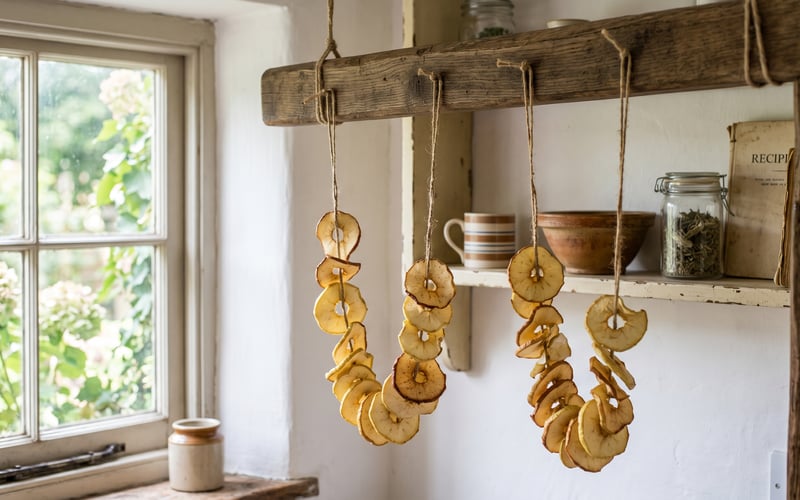
The method:
- Thread cored apple rings onto natural garden twine using a darning needle, leaving 1cm of clear twine between each ring. Pear half-slices can be threaded through the stem end.
- Hang the loops from a wooden rail, beam, or curtain pole in a warm, ventilated room. Airing cupboards work brilliantly; kitchens above an Aga work even better.
- Turn the rings once a day to even out drying. Cover loosely with muslin if dust is an issue.
- Check daily after day four. The rings are ready when they bend without snapping and have shrunk to roughly one-third of their original diameter.
- If the room is humid, run a fan on low aimed across the rings — this drops drying time to 3-4 days.
When air drying makes sense: small batches (1-2kg), no electricity available, want the traditional finish, garden twine sized for the airing cupboard.
When it does not: large gluts (over 3kg), humid kitchens, anyone in a hurry. A wet September afternoon stalls air drying completely.
Method 2: oven drying
An oven set to its lowest temperature is the second-easiest method. Most domestic ovens dial down to 50-70C, and many fan ovens have a dedicated “dehydrate” or “pizza-defrost” setting at 50C. Oven drying takes 8-12 hours and uses 0.5-0.8kWh per hour at that temperature.
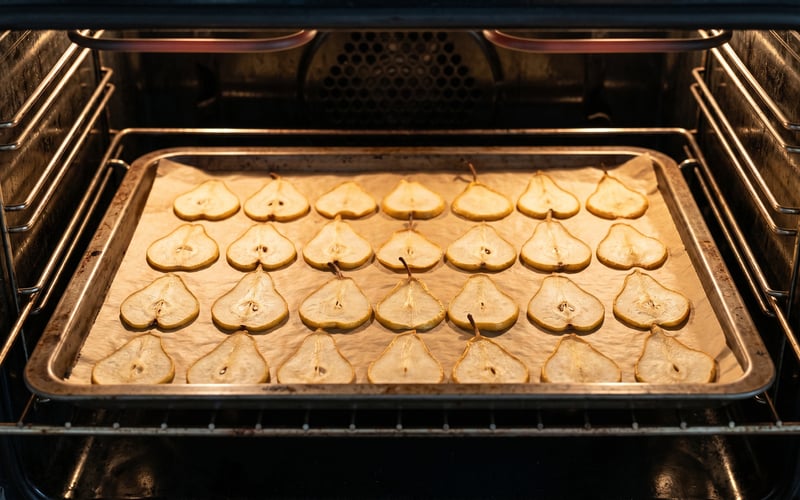
The method:
- Line two large baking trays with greaseproof paper or parchment. Wire racks set on the trays work even better — they let air circulate underneath the slices.
- Arrange apple rings or pear half-slices in a single layer with 1cm gaps between pieces. Overlapping slices weld together and stay damp in the middle.
- Set the oven to 60C (140F) on fan-bake. If your oven only goes as low as 80C, prop the door open with a wooden spoon to let moisture escape and lower the effective temperature.
- Dry for 8-12 hours, rotating trays every 2 hours and flipping each piece halfway through. Pears take 1-2 hours longer than apples.
- Check by bending a cooled slice — it should be pliable, not crisp, and feel dry to the touch but slightly tacky.
Power cost: A typical 60C fan-bake run for 10 hours draws about 5-7kWh — £1.40-£1.95 at 27.5p/kWh. Roughly the same energy as one full wash on a hot setting.
When oven drying makes sense: medium batches (2-5kg), no dehydrator, willing to give up the oven for a day. Many people set the oven going overnight and harvest the rings before breakfast.
Method 3: electric dehydrator
A dedicated dehydrator is the most consistent of the three methods. Stacking trays mean you can dry 4-6kg of fruit at once; the controlled airflow gives a uniform result that is hard to match in an oven; and the running cost is lower because you are heating only the cabinet, not a whole oven cavity.
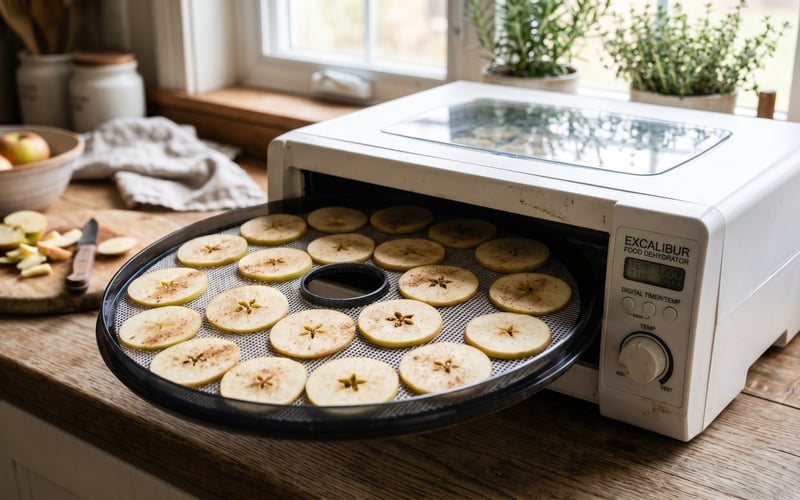
The method:
- Arrange slices on the mesh trays in a single layer with 5mm gaps. Stack trays as the model allows — typically 4-9 high.
- Set the temperature to 57C (135F) for apples and pears. Lower temperatures (40-50C) preserve more vitamin C but add hours; higher temperatures (above 60C) cook the fruit and you lose the fresh flavour.
- Dry for 8-10 hours, rotating the trays from top to bottom every 3 hours to even out air circulation.
- Check pieces from the top tray first — they dry fastest. Done when pliable but no longer wet to the touch.
- Cool the rings on a wire rack for 30 minutes before storing, or moisture will condense inside the jars.
Power cost: A standard 5-tray dehydrator draws 350-500W. A 9-hour run uses 3.1-4.5kWh — £0.85-£1.25 at 27.5p/kWh, for a much larger batch than an oven can hold.
Models worth knowing: Excalibur stacking dehydrators are the long-term workhorse (15-20 year lifespan). Cosori and Sage dehydrators dominate the under-£200 bracket with digital controls. Stockli (Swiss-made) is the premium choice if you plan to dry herbs and meat too.
Drying method comparison
| Method | Time | Batch size | Energy cost | Best for |
|---|---|---|---|---|
| Air drying | 5-7 days | 1-2kg | Free | Small harvests, traditional finish |
| Oven drying | 8-12 hours | 2-5kg | £1.40-£1.95 | One-off batches, no extra kit |
| Dehydrator (Matt’s Pick) | 8-10 hours | 4-6kg | £0.85-£1.25 | Annual harvest, gift jars, regular use |
Fruit leather: apple and pear leather UK method
Fruit leather is the same fruit reduced to purée, spread thin, and dried into rollable strips. It is the best use for Bramley apples (too tart for ring drying) and over-ripe Williams pears (too soft to slice). One 1.5kg bowl of apples makes a 30x40cm sheet of leather that rolls up and lasts 6 months.
Method:
- Peel, core, and chop 1-2kg of fruit. Cook gently in a covered pan with 2-3 tablespoons of water for 15-20 minutes until soft.
- Blend or sieve into a smooth purée. Sweeten if needed: 1 tablespoon honey per kilo of Bramley, none for Williams pear.
- Optional: stir in a teaspoon of cinnamon, mixed spice, or vanilla.
- Spread 3-4mm thick onto a baking tray lined with non-stick silicone mat or greaseproof paper. Smooth flat with a palette knife.
- Dry at 60C in the oven for 6-8 hours, or 57C in the dehydrator for 8-10 hours, until tacky but not sticky.
- While still warm, peel off the lining, place on greaseproof paper, and roll into a tight cylinder. Cut into 5cm sections.
Apple leather and pear leather store at room temperature for 4-6 months, wrapped in greaseproof and sealed in a jar.
Storage: where most home-dried fruit goes wrong
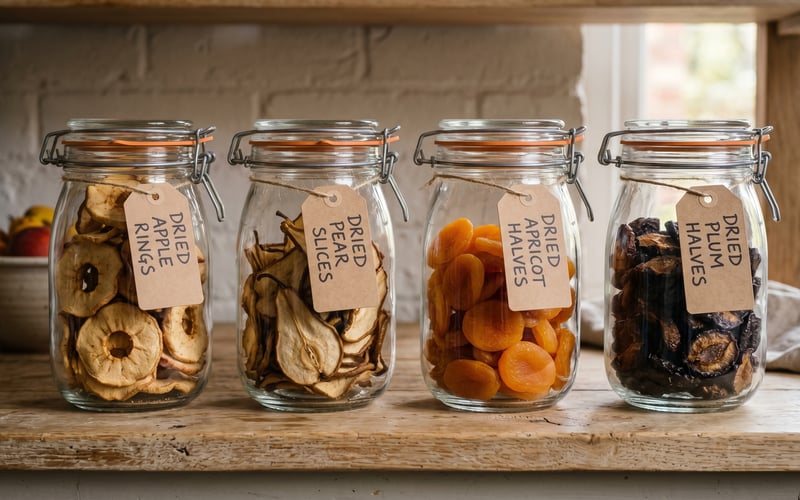
The single most common mistake is sealing dried fruit while it is still warm. Trapped moisture inside the jar creates a damp microclimate, mould follows within two weeks, and the whole batch is wasted. The fix is a 30-minute cool on a wire rack before any jar gets a lid.
Container choice:
- Glass Kilner-style jars with a rubber gasket: The right answer for room-temperature storage up to 12 months. Light-blocking cupboard ideal; on a sunny shelf the fruit oxidises within 4-6 weeks.
- Vacuum-sealed bags: Doubles the shelf life to 18-24 months. Worth doing for the first half of a big batch; eat the second half from glass within a year.
- Plastic tubs: Avoid. The plastic exchanges moisture with the air faster than glass and the fruit goes leathery-damp within 6 weeks.
- Paper bags: Fine for 2-3 weeks of snacking, useless for long-term storage.
Storage conditions: 5-15C is ideal. A pantry shelf, a north-facing cupboard, or a cold airing cupboard all work. Avoid above the radiator, beside the oven, or on a south-facing windowsill.
Label each jar with the date and variety. A Cox dried in September 2026 tastes noticeably different to one dried in 2027 — useful information when you find an old jar at the back of the cupboard.
Common problems and fixes
Fruit turned brown despite the lemon bath: The water-to-lemon ratio was too weak, or the fruit sat in air for over a minute before going into the bath. Use 1.5 tablespoons of lemon juice per litre, slice straight into the bath, do not stockpile cut slices on the chopping board.
Slices are crispy, not chewy: Dried too long or too hot. Re-hydrate by placing in a sealed jar with a slice of fresh apple for 24 hours — the moisture equalises.
Slices are still wet in the middle after 12 hours: Slice thickness too high (over 6mm) or trays overcrowded. Re-slice the worst offenders and run another 2-hour cycle with more spacing.
Mould appearing after a few weeks in storage: Either the fruit was not fully dried, or the jars were sealed warm. Throw the affected batch, sterilise the jars in boiling water, and re-dry the next batch for 1-2 hours longer.
White bloom on dried pears: Natural sugar crystallisation, not mould. Harmless and tastes fine. More common in Williams and Comice than Conference.
Matt’s Pick: where to grow your ownBest for: Households that want to grow the apples and pears they dry, rather than buy them. Why I recommend it: An 8x10 greenhouse extends the UK fruit-growing season by 6-8 weeks at each end, lets you grow heritage varieties supermarkets do not stock, and protects blossom from late frosts — the single biggest cause of failed apple crops in UK gardens. The Elite Belmont 8x10 has the 20-year frame warranty and the eave height for a wall-trained cordon apple or pear. Price: £1,339 |
Matt’s Tip: dry by the test, not the timer
Drying times vary by 20-30% with the moisture content of the original fruit, the room temperature, and how thick the slices are. A 10-hour timer is a starting point, not a finish line. Test by cooling a single piece for 5 minutes and bending it — pliable and dry to the touch is right, snappy is overdone, tacky-wet means another hour. Trust your fingers, not the clock.
Power cost: which method really is cheapest?
Per kilogram of dried fruit, the air-drying method costs nothing in energy but ties up airing-cupboard space for a week. Oven and dehydrator costs work out closer than people expect once you account for batch size.
| Method | Energy per batch | Cost per batch | Batch yield | Cost per kg dried |
|---|---|---|---|---|
| Air drying (no fan) | 0 | £0.00 | ~0.3kg dried | £0.00 |
| Air drying (with fan) | 0.3kWh | £0.08 | ~0.3kg dried | £0.27 |
| Oven drying (60C, 10hr) | 5-7kWh | £1.40-£1.95 | ~0.7kg dried | £2.00-£2.80 |
| Dehydrator (57C, 9hr) | 3.1-4.5kWh | £0.85-£1.25 | ~1.2kg dried | £0.71-£1.05 |
The dehydrator is cheaper per kilo than oven drying because it handles a larger batch on less power. For the casual one-batch-a-year preserver, the oven is the right answer. For anyone drying every September, the dehydrator pays back in 2-3 seasons against the supermarket price of equivalent dried fruit.
Frequently asked questions
How long do dried apples and pears keep?
Dried apple and pear rings keep 12 months in airtight glass jars at room temperature. Vacuum-sealed bags double the shelf life to 18-24 months. Store in a dark, cool cupboard between 5-15C. Avoid plastic tubs — they let in moisture and shorten storage to about 6 weeks.
What is the best apple variety for drying in the UK?
Cox’s Orange Pippin is the best UK apple for dehydrator drying. The firm flesh holds its shape, the balanced acidity carries flavour through to the dried ring, and the sugars caramelise gently rather than going sticky. Bramley is the best choice for fruit leather; Discovery makes pretty pink-blushed rings for gift jars.
Do you need to peel apples and pears before drying?
No — the skin holds vitamins and dries to a chewy texture that adds character. Wash thoroughly first and remove the core. Peel only if the fruit has been waxed (supermarket apples often are) or if you are making fruit leather, where the skin produces a gritty finish in the blended purée.
What temperature should I dry apples at in a dehydrator?
57C (135F) is the standard temperature for apples and pears in a dehydrator. Lower (40-50C) preserves more vitamin C but adds 2-4 hours. Higher (above 60C) cooks the fruit and dulls the fresh-apple flavour. Most digital dehydrators have a fruit preset at this temperature.
Can I dry apples in an Aga or Rayburn?
Yes — the simmering oven of a 2-oven Aga or the lower oven of a Rayburn dries apples and pears overnight in 8-10 hours. The dry radiant heat works the same way as a low electric oven, but with no extra cost since the stove is running anyway. Use the slow oven, not the roasting oven.
Why are my dried apples chewy in the middle and crisp at the edge?
The slices are too thick or the air circulation is poor. 4-5mm is the optimal thickness. In an oven, raise the slices off the tray on a wire rack so air can circulate underneath. In a dehydrator, rotate trays from top to bottom every 3 hours and never overlap slices.
Is home-dried fruit safe to eat without further cooking?
Yes, properly dried fruit is shelf-stable and safe to eat directly. Drying reduces water content below 20%, the level at which bacteria and mould cannot grow. If you see any mould, sponginess, or off-smell on a stored batch, discard it — this means the fruit was not dried fully or was sealed warm.
How much fresh fruit do I need to make 1kg of dried apple rings?
You need 5-6kg of fresh apples to make 1kg of dried rings. Pears reduce slightly more — expect 6-7kg of fresh pears per 1kg of dried slices. A productive 5-year-old Cox tree drops around 30kg of fruit a year, which dries down to roughly 5-6kg — enough for a year of porridge and gift jars.