May Gardening Jobs
May is the single most decisive month for a UK garden. Get five jobs right and your greenhouse, vegetable beds and borders will carry you through summer. Miss them and you spend July chasing problems you could have stopped in one weekend. This guide ranks the ten May jobs that matter most, based on our work fitting greenhouses and listening to customers since 2012.
Key Takeaways
- Fit an automatic vent opener before temperatures hit 25°C. Vent failure is the single biggest cause of seedling loss we see.
- Harden off every tender plant for 7-10 days. Skipping this step is the second biggest cause of planting-out losses.
- Tender crops go outside after May 15th. That is the average last frost date for southern and central England; Scotland waits until late May.
- Pinch cordon tomato side shoots at 2cm. Any bigger and you need secateurs, risking stem damage.
- Apply the Chelsea chop in late May. A third off heleniums, sedums and asters extends flowering into October.
- Soil temperature dictates sowing. Wait for 10°C before direct-sowing beans, courgettes and sweetcorn outside.
Expert Tip
Every May for many years I have had the same phone calls from customers: wilted seedlings, lost tomatoes, overheated peppers. Almost every one traces back to the same problem. The vents were shut. We now fit an automatic roof vent opener as standard on every new greenhouse we install because the difference between 20°C and 35°C inside is measured in ruined plants. If you take one job from this guide, make it the auto vent.
The 10 May gardening jobs that matter most
Not every May task has equal weight. A missed feed in May costs you nothing. A missed auto-vent fitting costs you a tray of tomatoes. Here is the ranking we use when setting up a new customer's greenhouse, based on the real-world failures we see each summer.
| Rank | Job | Why it matters | Best window |
|---|---|---|---|
| 1 | Fit an auto vent opener | Prevents 30°C+ greenhouse spikes | Before May 1st |
| 2 | Harden off tender plants | Stops leaf scorch and transplant shock | May 8-15 |
| 3 | Plant out tomatoes and peppers | Gets crops into fruiting mode by July | May 15-25 |
| 4 | Pinch out tomato side shoots | Channels energy into fruit trusses | Every 3 days from May 20 |
| 5 | Damp down the greenhouse floor | Cools air by 3-5°C on hot days | Every warm afternoon |
| 6 | Apply the Chelsea chop | Extends perennial flowering by weeks | May 22-31 |
| 7 | Direct-sow beans and courgettes | Catches up outdoor crops for summer | May 15-31 |
| 8 | Earth up potatoes | Produces more tubers, prevents greening | Every 2 weeks |
| 9 | Net strawberries | Birds strip fruit the day it turns red | As fruit starts to blush |
| 10 | Start weekly mowing | Dense growth now prevents weeds later | From May 1st |
Job 1: Fit an automatic roof vent opener
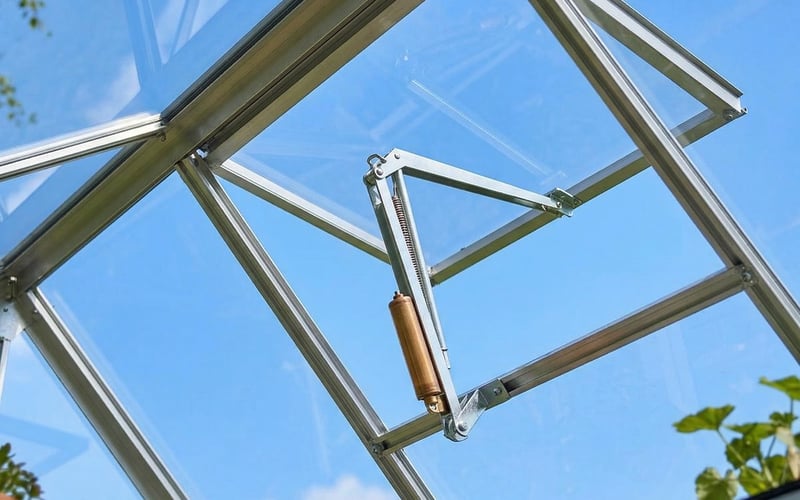
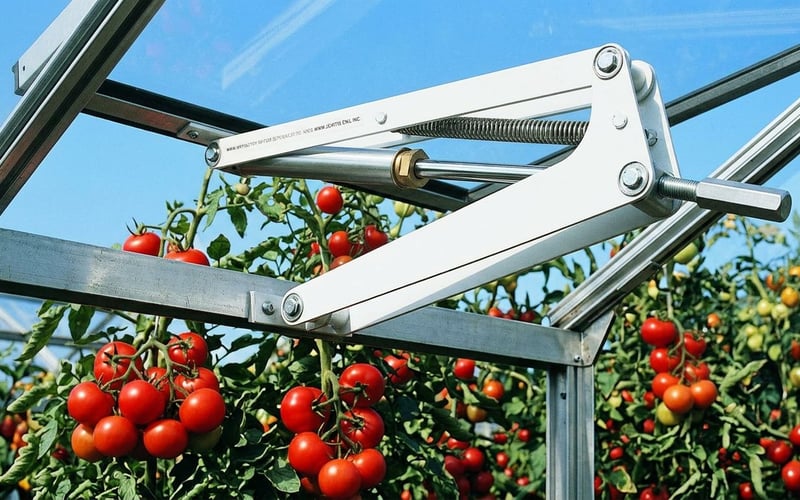
Manual vent opening fails the moment your plans change. A customer who planned a quiet Saturday in the greenhouse gets dragged into something else, forgets the vent, and returns to 35°C inside and wilting plants. An automatic opener uses a wax-filled piston that expands as it warms, lifting the vent open without any electricity.
Fit it before the end of April if you can, and definitely before mid-May. Installation takes around twenty minutes with the basic hand tools that came with your greenhouse kit. The piston sits between the vent frame and the ridge bar, clipped into slotted brackets on both ends.
One opener covers a single roof vent. Larger greenhouses with two vents need two openers. Louvre vents in the gable end often need a separate louvre-specific opener; check the product page before ordering if your greenhouse has side vents.
Job 2: Harden off tender plants properly
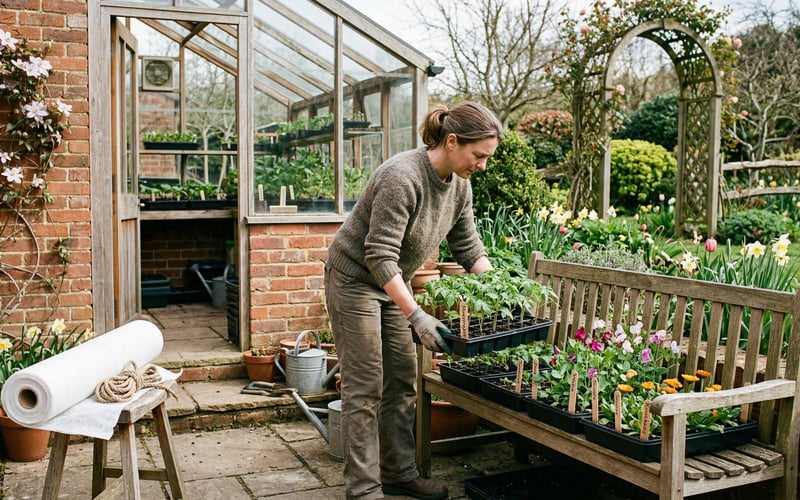
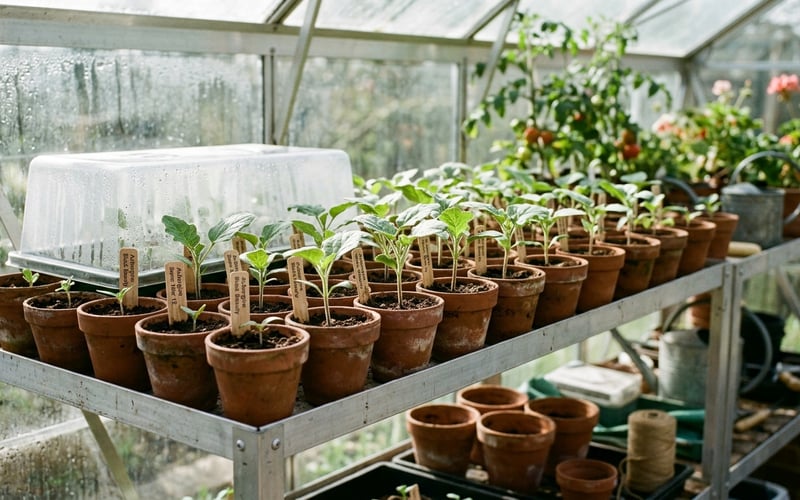
Hardening off sounds fussy but the rule is simple: give plants a week of day-trips outside before they move out permanently. Days one to three, place trays outside in dappled shade for three to four hours, then back inside. Days four to six, leave them out all day in full sun. Day seven onwards, leave them out overnight in a sheltered spot.
Skipping this week kills more young plants in May than any single pest. Greenhouse-raised seedlings have thin, soft leaves adapted to still, warm air. Move them straight outside and the first cold night or windy afternoon scorches them into dormancy. Even healthy plants lose two to three weeks of growth.
A mini greenhouse on wheels solves the space problem if your main greenhouse is already full. Roll it out on dry days to a sheltered corner, push it back under cover at night. The 2x3 Access Mini Greenhouse on Wheels at £816 handles the full hardening-off rota for a row of tomatoes plus summer bedding.
Job 3: Plant out tomatoes, peppers and courgettes
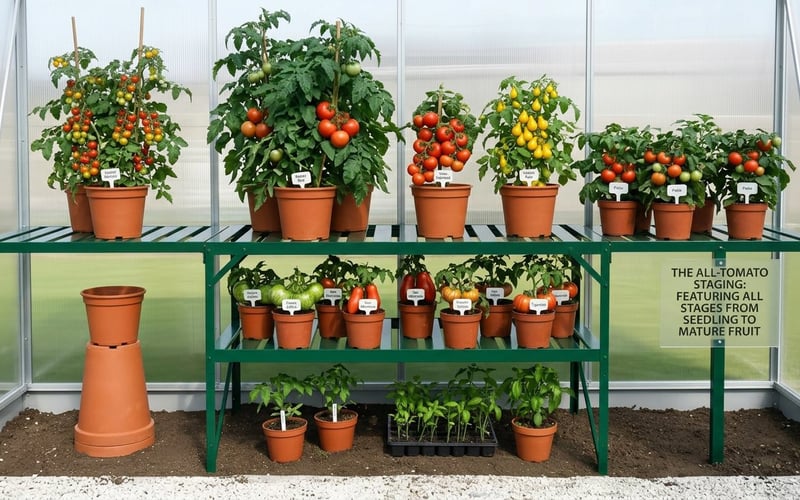
The average last frost date is May 15th in southern England, May 20th in the Midlands and late May in Scotland and northern England. Work backwards from this: hardened-off tomatoes that moved outside on May 8th will be in the ground by May 18th, planted deep with their lowest leaves removed. Tomatoes grow roots along a buried stem, giving the plant a stronger anchor.
Peppers and aubergines prefer to stay in the greenhouse all season in the UK. They need night temperatures above 12°C to set fruit, and most UK gardens do not reliably deliver that outdoors until late June. Pot them on into 10-litre containers or grow bags in the greenhouse rather than trying to plant out.
Courgettes go outside from late May in sheltered gardens. Plant through a sheet of black plastic mulch to warm the soil and keep fruit off the ground. One plant per square metre; they get enormous.
Job 4: Pinch out and support cordon tomatoes
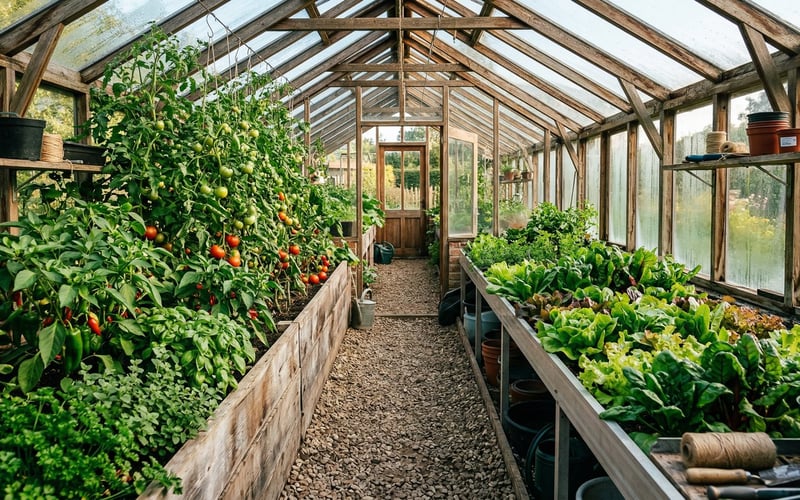
Cordon tomatoes produce side shoots in the 45-degree angle between a leaf and the main stem. Each shoot wants to become a new branch with its own flower trusses. Left alone, the plant turns into a sprawling bush with dozens of weak trusses. Pinch them out weekly from mid-May.
Do it at 2-3cm. Grip the shoot between thumb and forefinger, push sideways and snap. The wound is tiny and closes within an hour in dry weather. Leave shoots to grow beyond 5cm and you need secateurs, which risks tearing the main stem and inviting grey mould.
Supporting a mature cordon plant matters as much as the pinching. A single plant in full production carries 8-10kg of fruit. Overhead string beats canes for greenhouse tomatoes: tie a length of jute twine to a roof hook and twist it around the stem as the plant grows. The full stringing guide covers the technique step by step.
Job 5: Damp down the greenhouse floor
On hot May afternoons the greenhouse air dries out and temperatures spike. Damping down the floor solves both problems in thirty seconds. Tip a full watering can along the concrete or paving slabs and the evaporation drops the air temperature by 3-5°C while raising humidity to levels tomatoes and cucumbers love.
Do it mid-morning and again mid-afternoon on any day where the greenhouse maximum reading passes 25°C. A maximum-minimum thermometer fitted on the north wall tells you exactly when to act; the Vitavia Max Min Thermometer at £30 records overnight lows and daytime peaks so you can set your routine.
Avoid wetting the foliage directly. Wet leaves in high humidity invite botrytis and powdery mildew. Aim the watering can at the floor only. Shade netting on the south-facing roof glass adds another 3-5°C of cooling on the hottest days; combined with damping down, it keeps most UK greenhouses under 30°C even in June heatwaves.
Job 6: Apply the Chelsea chop to late perennials
The Chelsea chop is a late-May pruning technique named after the Chelsea Flower Show week. Cut late-flowering perennials back by a third and the plant responds by branching below the cut and producing more flower stems. Flowering delays by two to three weeks but lasts longer and looks fuller.
The plants that respond best are heleniums, sedums (now renamed Hylotelephium), asters, phlox, rudbeckia, echinacea and tall golden rod. Cut one clump at full height and a second clump by a third to stagger flowering across six to eight weeks rather than a single concentrated burst.
Do not chop anything that flowers before July. Early peonies, pulmonaria and early clematis have already set their flower buds for this year; chopping now removes them. Feed the chopped plants with liquid seaweed a week after cutting to fuel the fresh growth.
Job 7: Direct-sow beans, courgettes and sweetcorn
Soil temperature is the single variable that matters for May sowing. Below 10°C, bean and courgette seed rots in the ground. Above 12°C, it germinates in five to seven days. A soil thermometer costs around £15 and takes the guesswork out; push it 5cm into the bed at 9am and check the reading.
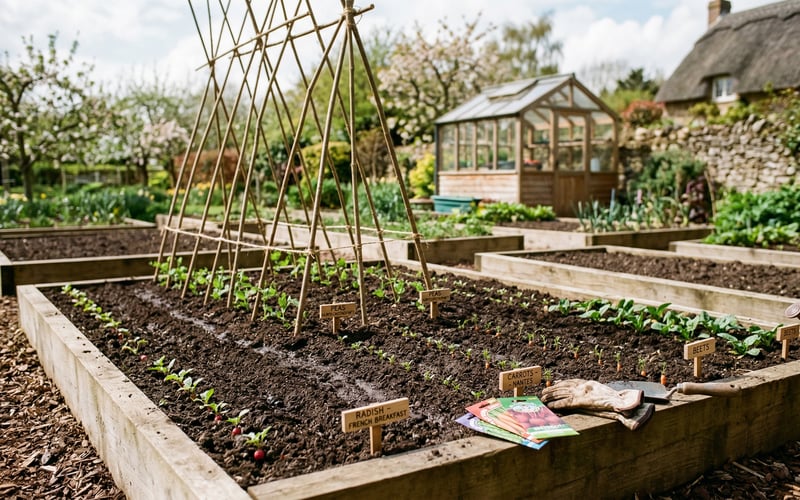
Sow runner beans, French beans, courgettes, squash and sweetcorn from May 15th onwards in southern gardens, May 22nd in the Midlands and late May in northern England. Sow two seeds per station and thin to the strongest seedling. Beans want a drill 3-5cm deep; courgettes and squash want individual stations 1m apart.
Sweetcorn grows in blocks, not rows. Plant in a grid of at least 4x4 plants spaced 45cm apart. This lets the wind pollinate each cob from multiple neighbours, producing full kernel rows rather than half-empty cobs.
Job 8: Earth up potatoes every fortnight
Potato shoots emerge through May and need earthing up as they grow. Draw soil from between the rows up around the stems with a draw hoe, leaving only the top two leaves exposed. The buried stem sections grow new tubers, so the more you earth up, the more potatoes you harvest.
Earth up when shoots reach 20-25cm, then again a fortnight later, and a third time in early June. Three mounding sessions usually get the ridge to around 30cm high. Any tubers that sit in sunlight turn green and develop solanine, a toxin that makes potatoes inedible.
Mulch the finished ridge with straw, grass clippings or composted bark to retain moisture. In a dry May and June this one job doubles the yield we see from unmulched trials. Water during dry spells once tubers start forming in late June and the flowers appear.
Job 9: Net strawberries the day the fruit turns
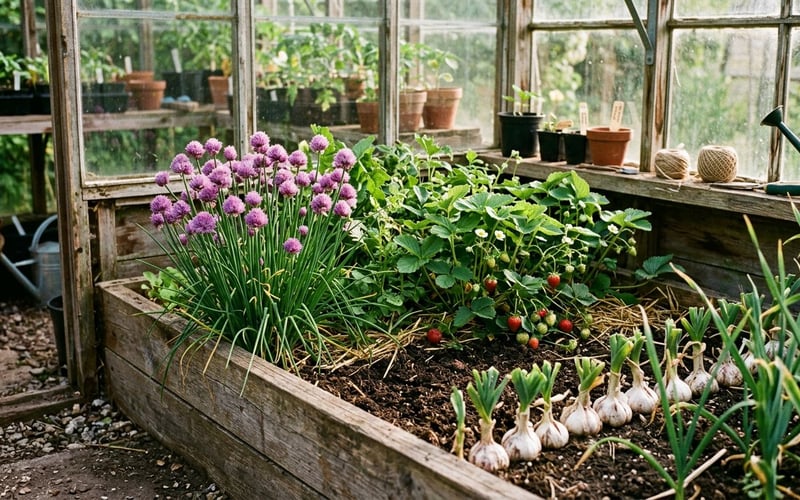
Blackbirds, pigeons and thrushes strip a strawberry bed in a single morning. The moment a berry starts to blush pink, a bird notices. Fit 1cm mesh netting on hoops over the whole bed, tuck the edges under bricks, and leave it in place until harvest ends.
Slip straw or woven fibre mats under the developing berries. This keeps fruit off the damp soil, reduces slug damage and stops grey mould (botrytis) spreading from touching leaves. Tuck the straw around the crown of each plant without burying the leaves.
Thin developing apple and pear clusters at the same time. Remove the king fruit (the largest central fruit) and leave two fruits per cluster spaced 10-15cm apart. This produces bigger, better-tasting fruit and prevents the tree going into biennial bearing where it skips a year.
Job 10: Start weekly lawn mowing
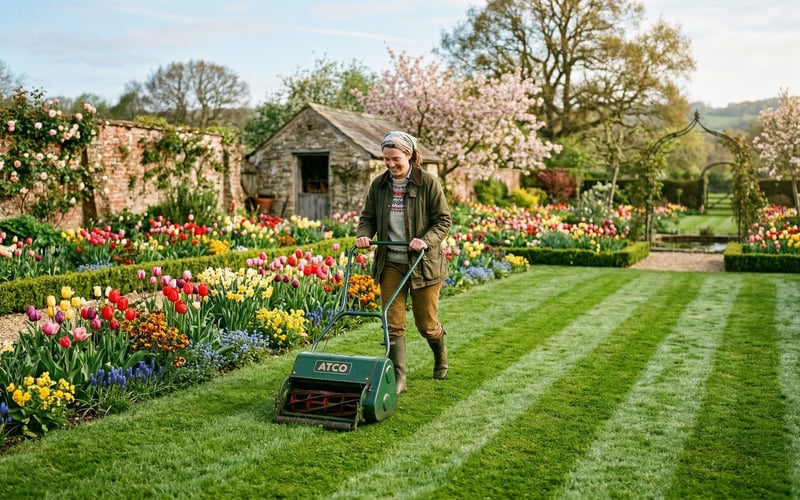
Grass grows fastest in May. Start a weekly mow from the first week and never remove more than a third of the blade height in a single cut. Set the mower blade to 30-40mm for the first three or four cuts, then drop to 25mm once growth is consistent.
Edge the borders every fortnight with a half-moon edging iron or long-handled edging shears. Sharp edges make everything else in the garden look tidier for minimal effort. Collect the clippings and compost them in thin layers alternated with brown material (cardboard, autumn leaves, shredded woody prunings).
Apply a spring lawn feed only if the grass looks yellow or thin. Balanced NPK products work better than pure nitrogen, which pushes soft growth that falls to disease. Water after feeding if no rain is forecast within 48 hours. A fed lawn crowds out moss and daisies without chemical weedkillers.
Matt's Tip: The Twenty-Minute Rule
May feels overwhelming because every job wants doing at once. The trick I use is a twenty-minute daily round. One job at a time, timer on, stop when it rings. Pinch tomatoes one day, damp down the next, harden off the next, net strawberries the next. By the end of a fortnight every May job is either done or well under way, and the garden has never taken more than twenty minutes in a day.
May greenhouse workspace: the setup that pays off
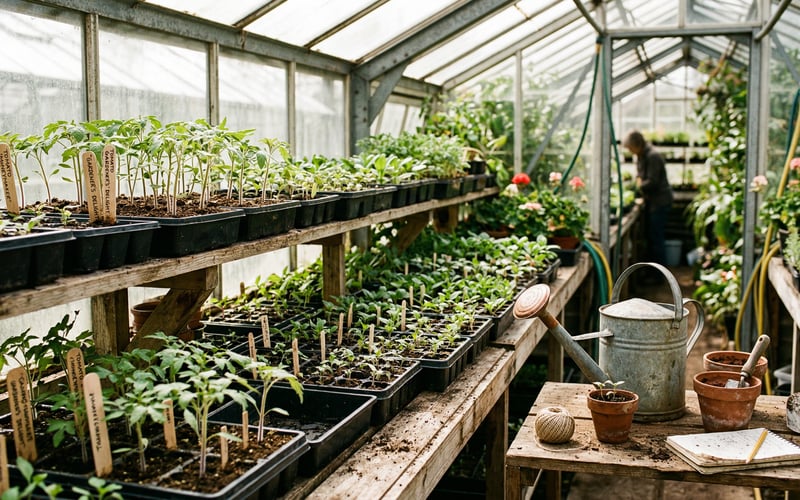
A sturdy potting bench at waist height saves hours across the month. Seed tray mixing, pricking out, cleaning pots, feeding plants and labelling seed packets all go faster when you are not bent over a flagstone or kneeling on cold concrete. The Elite Potting Bench at £179 has a galvanised steel top that wipes clean and a slatted lower shelf for pot storage.
Extend your staging upwards if you are short of floor space. A top-tier staging extension uses the wall space above the main bench for seedlings hardening off or young chilli plants that need proximity to glass for light. The Vitavia Silver Top Tier Staging Extension at £69 clips onto most standard staging and doubles the growing area without enlarging the greenhouse.
Keep the following within arm's reach of the bench: secateurs, jute twine, bamboo canes, a soft hand brush, a spray mister, labels and a permanent marker. Moving back and forth across the greenhouse burns the twenty minutes you budgeted for a single task.
|
Matt's Pick for the single most important May jobBest For: Any UK greenhouse that gets direct sun between April and September Why I Recommend It: I have fitted over a thousand of these across customer installs over the years. The wax piston opens the vent from about 13°C and closes it as the air cools. No electricity, no moving parts beyond the piston, and no plant loss to forgotten vents on a sunny Saturday. Price: £59 |
Regional soil temperature guide for May sowing
The Met Office records soil temperature at 10cm depth across its network of UK weather stations. These figures track roughly one to two weeks behind air temperature. Use them as a sowing benchmark rather than the calendar.
| Region | Soil temp early May | Safe to sow | Plant out window |
|---|---|---|---|
| South-East England | 11-13°C | Beans, peas, chard from week 1 | Tender crops after May 15 |
| South-West England | 11-13°C | Beans, peas, chard from week 1 | Tender crops after May 10 |
| Midlands | 9-11°C | Peas, chard, lettuce from week 1; beans from week 3 | Tender crops after May 20 |
| Wales | 9-11°C | Peas, chard from week 1; beans from week 3 | Tender crops after May 18 |
| Northern England | 8-10°C | Peas, chard from mid-May; beans from week 4 | Tender crops after May 25 |
| Scotland | 7-9°C | Peas, chard from mid-May; beans from June 1 | Tender crops late May to early June |
Frequently asked questions
What is the single most important May gardening job?
Fit an automatic roof vent opener before temperatures reach 25°C under glass. Greenhouse temperatures hit 30-35°C in minutes on a sunny May day and seedlings wilt within the hour. An auto vent opener uses a wax piston that needs no electricity and installs in twenty minutes.
How long should I harden off my seedlings?
Seven to ten days of gradual exposure is the standard hardening-off window. Days one to three: three hours outside in dappled shade. Days four to six: full day in sun. Day seven onwards: overnight in a sheltered corner before permanent planting out.
When can I plant tomatoes outside in the UK?
Plant tomatoes outdoors after May 15th in southern England and after May 25th in Scotland. Check the ten-day forecast before you commit; a cold snap after mid-May can still damage plants. Most UK growers do better keeping tomatoes inside a greenhouse all season.
Why are my greenhouse seedlings leggy in May?
Leggy seedlings in May mean too little light, too much warmth or both. Move them to the brightest spot in the greenhouse, drop the day temperature to around 20°C with more ventilation, and consider a grow light if your greenhouse is north-facing.
Should I feed tomato plants in May?
Start a weekly tomato feed from the first flower truss, usually mid to late May. Use a potassium-rich liquid tomato feed diluted to manufacturer instructions. Feeding earlier encourages leaves at the expense of fruit. Reduce frequency if leaves start curling or turning pale.
What soil temperature do I need for direct sowing?
Aim for 10°C soil at 10cm depth before direct-sowing beans, courgettes or sweetcorn. A soil thermometer costs around £15 and takes the guesswork out. Cold, wet soil rots seed before it germinates.
How often should I water the greenhouse in May?
Water greenhouse plants once daily in the morning from mid-May, twice on hot days. Check compost moisture by pushing a finger 2cm into the pot; if it feels dry, water. Evening watering in cool weather invites mildew.
Can I still sow tomatoes from seed in May?
Yes, early to mid-May is the last window for sowing tomato seed in a heated greenhouse. Expect fruit from late July rather than June. Choose fast-maturing varieties like Sungold, Moneymaker or Tumbling Tom for a shorter season.