Japanese Knotweed UK Guide
Japanese knotweed (Reynoutria japonica) is the UK's most destructive invasive plant. Its rhizomes extend 3 metres deep and 7 metres laterally, damaging foundations, driveways, and drainage systems. UK law under the Wildlife and Countryside Act 1981 makes it an offence to cause knotweed to grow in the wild. Professional removal costs £2,000-£5,000 per property. Sellers must declare its presence on the TA6 property information form.
Japanese knotweed (Reynoutria japonica) is the UK's most destructive invasive plant. Its rhizomes extend 3 metres deep and 7 metres laterally, damaging foundations, driveways, and drainage systems. UK law under the Wildlife and Countryside Act 1981 makes it an offence to cause knotweed to grow in the wild. Professional removal costs £2,000-£5,000 per property. Sellers must declare its presence on the TA6 property information form.
Key Takeaways
- Identification: Zigzag stems with purple speckles, shovel-shaped leaves up to 200mm, hollow bamboo-like canes
- Root system: Rhizomes extend 3m deep and 7m outward — can damage foundations, drains, paths, and greenhouse bases
- UK law: You must prevent spread to neighbouring properties. Fines up to £5,000 or 2 years imprisonment for breaches
- Removal cost: Professional herbicide treatment costs £2,000-£5,000 and takes 2-3 years minimum
- Property sales: Must be declared on the TA6 form — most lenders refuse mortgages on untreated properties
- Disposal: Classified as controlled waste — licensed carriers and approved landfill sites only
Installer's Note
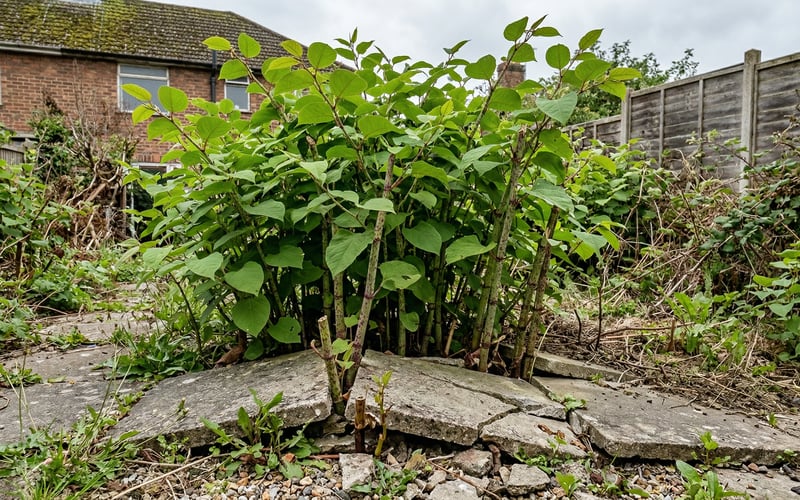
We have encountered Japanese knotweed on greenhouse installation sites more times than we would like. When we survey a garden before fitting a greenhouse base, knotweed is one of the first things we check for. Rhizomes growing beneath a concrete pad can crack it within two seasons. On one job in South Wales, we found knotweed shoots pushing through a 100mm concrete slab that was only three years old. If you spot it anywhere near where you plan to build, get professional treatment started before laying any foundations.
Japanese knotweed costs UK homeowners millions every year in property damage, removal bills, and lost property value. Originally brought to Britain as a Victorian ornamental plant, it has become the most aggressive invasive species in the country. This guide covers how to identify it by season, your legal obligations, removal costs, and what happens when you try to sell a property with knotweed on it.
What does Japanese knotweed look like?
Japanese knotweed changes appearance dramatically through the year. Knowing what to look for in each season helps you catch it early before the root system becomes established.
Spring identification (March – May)
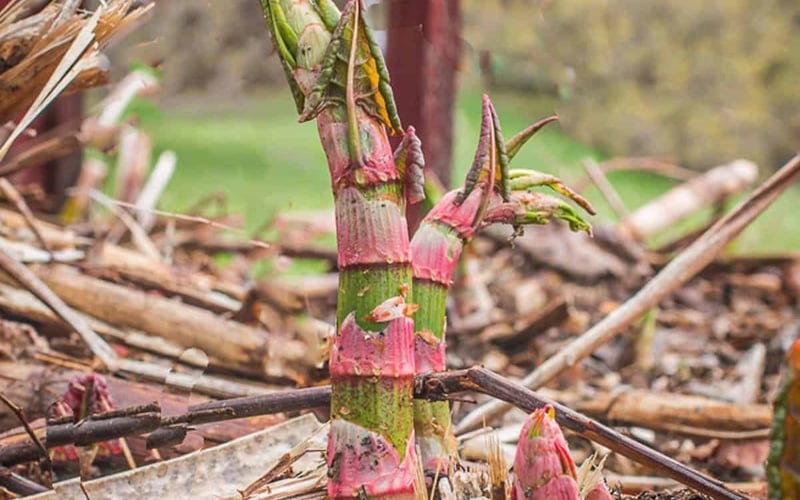
Red-purple shoots push through the soil looking like fat asparagus spears. These grow at up to 100mm per day once established. Within weeks, the shoots develop into hollow bamboo-like canes with distinctive purple speckles. New leaves unfurl dark red before turning green as they expand.
Summer identification (June – August)
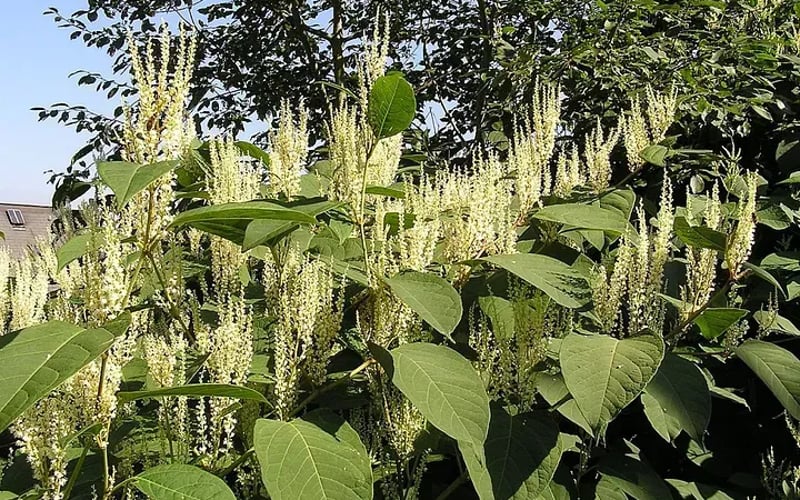
Summer is the easiest season for identification. Stems reach 2-3 metres tall with a distinctive zigzag pattern where each leaf joins the cane. Leaves are shovel-shaped with pointed tips, up to 200mm long, growing in an alternating pattern (not opposite pairs). Dense clusters of creamy-white flowers appear in late August and September, measuring 80-120mm long.
Autumn identification (September – November)
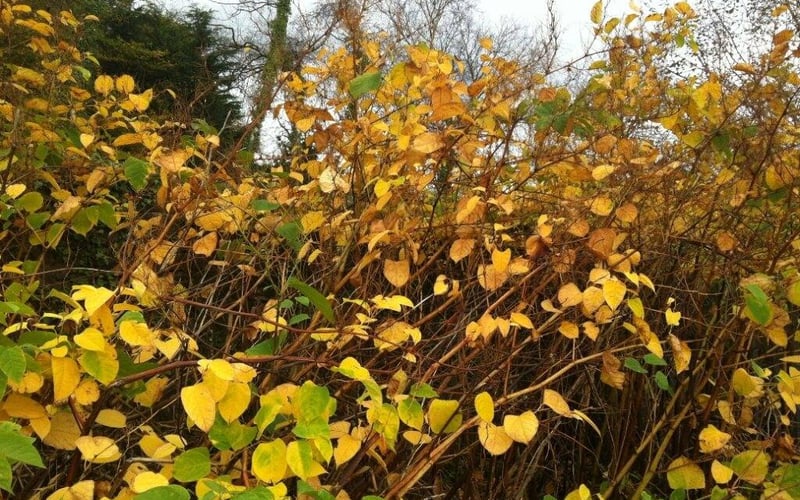
Leaves turn yellow then brown before dropping. The stems dry to a chocolate-brown colour and become brittle. The plant looks like it is dying off, but the underground rhizome network is very much alive and storing energy for next spring. This is actually one of the best times to apply herbicide treatment — the plant draws chemicals down into the root system as it prepares for dormancy.
Winter identification (December – February)
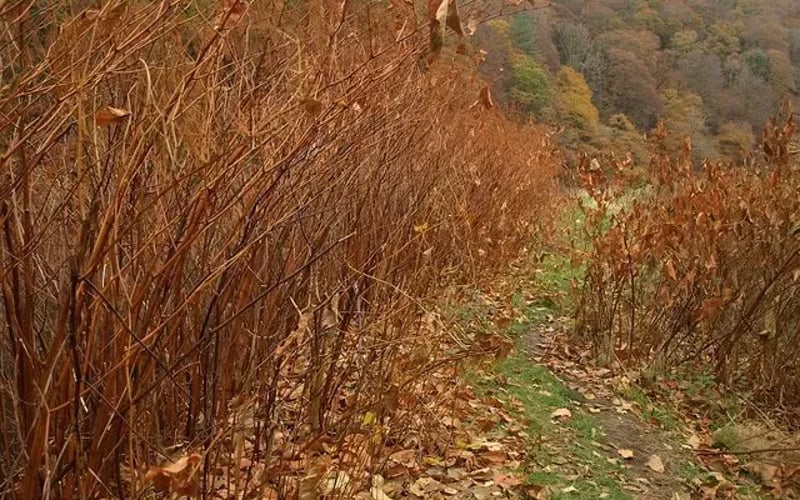
Dead brown canes remain standing through winter. They snap easily and show the characteristic zigzag pattern even without leaves. At ground level, look for pinkish-red crown buds — these are next year's growth points. The canes can persist for 2-3 years if not cleared, making winter identification straightforward once you know what to look for.
Seasonal identification at a glance
| Season | Key features | Height | Action to take |
|---|---|---|---|
| Spring | Red-purple asparagus-like shoots, purple-speckled stems | 0-1m | Photograph and get professional survey |
| Summer | Zigzag stems, shovel leaves (200mm), white flowers | 2-3m | Begin herbicide treatment programme |
| Autumn | Yellowing leaves, brown brittle stems | 2-3m (dying) | Best time for herbicide application |
| Winter | Dead brown canes, pink crown buds at ground level | Dormant | Map extent and plan spring treatment |
Plants commonly confused with Japanese knotweed
Several common garden plants look similar to knotweed at first glance. The key identifier is always the combination of zigzag stems, hollow canes, and alternating shovel-shaped leaves. No other UK plant has all three.
| Look-alike plant | How it differs from knotweed | Quick test |
|---|---|---|
| Bindweed | Climbs and twines around supports. Smaller heart-shaped leaves. | Pull gently — bindweed wraps; knotweed stands rigid |
| Bamboo | Solid woody stems. Narrow lance-shaped leaves. | Cut a stem — bamboo is solid; knotweed is hollow |
| Russian vine | Climbs with thin flexible stems. Similar white flowers. | Check stems — Russian vine is thin and wiry; knotweed is thick and rigid |
| Himalayan honeysuckle | Similar hollow stems but opposite leaf pairs, not alternating. | Check leaf pattern — opposite pairs means it is not knotweed |
| Lilac | Heart-shaped leaves but woody permanent stems, not annual canes. | Stems are woody and do not die back in winter |
If you are unsure, take a clear photograph showing the stem pattern, a close-up of a leaf, and the overall plant shape. The Environment Agency or a PCA-accredited surveyor can confirm identification from photos.
How does Japanese knotweed spread?
Japanese knotweed in the UK spreads entirely through its root system and stem fragments. It does not produce viable seed in Britain because almost all UK plants are female clones of a single introduction. This means every new infestation comes from a piece of root or stem being moved.
- Rhizome growth: The underground root network extends 3m deep and 7m outward from the visible plant. Even a fragment weighing less than 1 gram can regenerate into a new plant.
- Construction and earthworks: Moving contaminated soil is the most common cause of new infestations. One bucket of soil containing rhizome fragments can start a colony.
- Flooding and waterways: Rivers carry broken stem and root pieces downstream, which is why knotweed is so common along riverbanks.
- Garden waste: Dumping knotweed cuttings in hedgerows, on waste ground, or in household green waste bins spreads it to new sites. This is illegal under the Environmental Protection Act 1990.
- Fly-tipping: Contaminated soil dumped illegally has started many of the UK's worst infestations on public land.
Similar to plants that damage greenhouse frames, knotweed exploits any weakness in hard surfaces. The rhizomes do not punch through concrete — they find existing cracks, expansion joints, and drainage channels, then expand as they grow, widening the damage.
Is Japanese knotweed illegal in the UK?
Owning a property with Japanese knotweed is not illegal. Growing it in your garden is not illegal. But causing it to spread — whether deliberately or through negligence — breaks two key laws.
Wildlife and Countryside Act 1981
Section 14(2) makes it an offence to plant or cause Japanese knotweed to grow in the wild. This covers anyone who dumps knotweed waste, moves contaminated soil, or allows it to spread from private land into the wider environment. Penalties include fines up to £5,000 in a magistrates' court or an unlimited fine plus up to 2 years imprisonment in a Crown Court.
Environmental Protection Act 1990
All Japanese knotweed material — stems, leaves, roots, and any soil within 7 metres of the plant — is classified as controlled waste. This means:
- You cannot put it in household garden waste bins or take it to a standard recycling centre
- It must be transported by a licensed waste carrier
- It must go to an approved landfill site with a permit for controlled waste
- You need a waste transfer note documenting the chain of disposal
- All material must be double-bagged in heavy-duty sacks before transport
Anti-Social Behaviour, Crime and Policing Act 2014
Since 2014, local authorities can issue Community Protection Notices to property owners who fail to control knotweed that is affecting neighbours. Breach of a CPN is a criminal offence with fines up to £2,500 for individuals.
Matt's Tip: Get a Survey Before Buying
I have seen too many buyers discover knotweed after completion. Before exchanging contracts on any property, walk the boundaries in summer (June-August) when knotweed is at full height and easiest to spot. Check within 7 metres of all boundaries. If you see anything suspicious, pay for a PCA-accredited knotweed survey before you commit. The £300-£500 survey cost is nothing compared to £5,000+ in removal bills after you have signed.
How much does Japanese knotweed removal cost?
Removal costs depend on the size of the infestation, proximity to structures, and which method you use. Here are typical UK prices for a standard residential garden.
| Treatment method | Typical cost | Timeframe | Best for |
|---|---|---|---|
| Herbicide programme | £2,000-£5,000 | 2-5 years | Most residential gardens. Cheapest option. Accepted by most mortgage lenders with a management plan. |
| Excavation and removal | £5,000-£15,000+ | 1-2 weeks | Urgent removal needed (e.g. before construction). Fast but expensive due to contaminated soil disposal. |
| Root barrier installation | £3,000-£8,000 | 1-2 weeks | Preventing spread from neighbouring land. Often combined with herbicide treatment. |
| On-site burial | £8,000-£20,000 | 2-4 weeks | Large sites where contaminated soil cannot be removed economically. Requires 5m+ depth burial cell. |
Most mortgage lenders accept a professional herbicide treatment plan backed by a 10-year insurance-backed guarantee (IBG). The IBG typically costs £1,000-£2,000 on top of treatment costs but satisfies lender requirements and protects the next buyer.
How to sell a house with Japanese knotweed
Selling a property with knotweed is legal and straightforward if you handle it correctly. Hiding it is illegal and will cost you far more than being upfront.
Step 1: Declare on the TA6 form
The TA6 Property Information Form asks directly about Japanese knotweed. Answering dishonestly exposes you to misrepresentation claims and potential court action from the buyer. Declare honestly and provide your treatment records.
Step 2: Get a professional management plan
Commission a PCA-accredited surveyor to assess the infestation and produce a formal management plan. This document shows buyers and their mortgage lenders that the problem is being handled professionally. Most plans include a treatment schedule, monitoring visits, and an insurance-backed guarantee.
Step 3: Provide an insurance-backed guarantee
A 10-year IBG transfers the financial risk to an insurer. If the knotweed returns during the guarantee period, the insurer covers retreatment costs. This is the single most important document for getting a buyer's mortgage approved.
Property sale impact by knotweed status
| Knotweed status | Impact on sale price | Mortgage availability |
|---|---|---|
| Untreated, on property | 10-15% reduction typical | Most lenders refuse |
| Under active treatment with plan | 5-10% reduction | Available with IBG |
| Treatment complete with IBG | 0-5% reduction | Widely available |
| Within 7m on neighbouring land | 2-5% reduction | Available with monitoring plan |
Can Japanese knotweed damage a greenhouse?
Yes. Knotweed rhizomes can crack concrete greenhouse bases, push through gravel hardstandings, and displace ground-anchored frames. We have seen it buckle aluminium base rails on two separate installation jobs where the customer did not know knotweed was present underground.
If you are planning a greenhouse installation, check within 7 metres of the proposed site for any signs of knotweed before laying the base. Even dormant crown buds at ground level in winter are a warning sign. If knotweed is present, get professional treatment underway and wait at least one full growing season before building. Rushing the base installation over active rhizomes will cost more to fix than the delay.
For gardeners dealing with knotweed-contaminated ground, raised beds filled with fresh topsoil give you a clean growing space above the rhizome zone while treatment continues below. Our raised beds guide covers setup options.

|
Matt's Pick for Knotweed-Affected GardensBest For: Growing above contaminated soil while knotweed treatment continues underground Why I Recommend It: The 4x4 raised bed sits 300mm above ground level, keeping root vegetables and salads completely clear of contaminated soil. Fill with fresh topsoil and compost for a clean growing space. Price: £129 |
How to dispose of Japanese knotweed legally
Every part of the plant — stems, leaves, roots, and soil within 7 metres — is controlled waste. Getting disposal wrong is a criminal offence.
- Double-bag all material in heavy-duty rubble sacks or specialist knotweed bags
- Use a licensed waste carrier — check their licence number on the Environment Agency public register
- Transport to an approved landfill site with a permit for controlled/hazardous waste
- Obtain a waste transfer note documenting what was removed, where it went, and who carried it
- Keep records for at least 2 years — you may need to prove lawful disposal if questions arise
Never put knotweed material in household green waste, compost heaps, or bonfires (burning does not kill rhizome fragments reliably). If your garden pest control routine turns up suspicious plant material, bag it separately and get it identified before disposing of it.
Frequently asked questions
How invasive is Japanese knotweed?
Japanese knotweed grows up to 100mm per day and roots reach 3 metres deep. The rhizome network spreads up to 7 metres outward from the visible plant. It exploits cracks in concrete, expansion joints, and drainage channels, widening existing weaknesses rather than punching through solid material. A single rhizome fragment weighing less than 1 gram can regenerate into a new plant, which is why contaminated soil movement causes most new infestations.
Do I have to remove Japanese knotweed from my garden?
No law forces complete removal, but you must prevent spread to neighbours. Under the Anti-Social Behaviour, Crime and Policing Act 2014, local authorities can issue Community Protection Notices if your knotweed is affecting neighbouring properties. Failure to comply is a criminal offence. Practically speaking, untreated knotweed also makes property sales extremely difficult because most mortgage lenders refuse applications on affected properties.
Can I use weedkiller on Japanese knotweed?
Professional-grade glyphosate works but standard garden weedkillers are ineffective. The concentration and application method matter. Glyphosate-based herbicides applied by injection or targeted spray in late summer (August-October) give the best results because the plant draws the chemical down into the root system as it prepares for dormancy. You will need repeated treatments over 2-3 growing seasons. Most mortgage lenders require treatment by a PCA-accredited contractor.
How long does Japanese knotweed treatment take?
Professional herbicide treatment takes 2-3 years of repeated applications minimum. Some severe infestations need 5 years of monitoring before they receive a certificate of completion. Excavation is faster (1-2 weeks) but costs 3-5 times more due to contaminated soil disposal. After the final treatment, a 2-year monitoring period confirms the knotweed has not regrown before an insurance-backed guarantee is issued.
Does Japanese knotweed affect my mortgage?
Most UK lenders refuse mortgages on properties with untreated Japanese knotweed. Lenders including Nationwide, HSBC, Barclays, and Santander all have knotweed policies. A professional management plan with a 10-year insurance-backed guarantee (IBG) satisfies most lenders. Without an IBG, buyers are typically limited to cash purchases only, which significantly reduces your pool of buyers and sale price.
Can I remove Japanese knotweed myself?
DIY removal is legal but rarely effective without professional-grade herbicides. Cutting, mowing, or digging out knotweed without herbicide treatment usually makes it worse — the rhizome responds to disturbance by sending up more shoots. Any material you remove is controlled waste and must go to a licensed landfill. For mortgage and insurance purposes, most lenders only accept treatment certificates from PCA-accredited professionals.
What does Japanese knotweed look like in winter?
Dead brown canes with a distinctive zigzag pattern remain standing through winter. The stems are hollow, brittle, and snap easily. At ground level, look for pinkish-red crown buds — these are next spring's growth points. Winter is a good time to map the full extent of an infestation because the dead canes show you exactly where the underground rhizome network reaches, without summer foliage obscuring the boundaries.