Black Bean Aphid: How to Spot, Stop and Save Your Crops
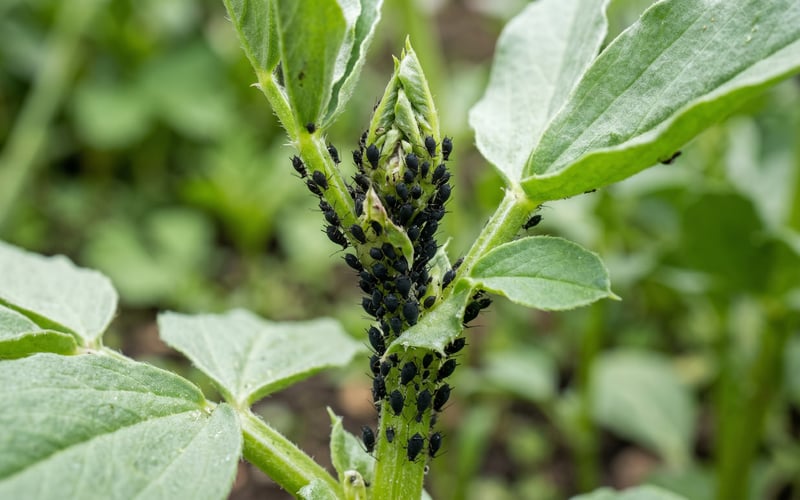
Black bean aphid (Aphis fabae) is the matte-black, slow-moving aphid that infests broad beans, runner beans, dahlias, beetroot tops, and spindle hedges across the UK every May-July. A single colony grows from 5-10 individuals to thousands in two weeks. The fastest control is to pinch off the affected growing tips and wash the plant with a strong jet of water; persistent infestations respond to soft-soap spray. Sowing broad beans in November rather than spring gives the strongest preventative effect — the autumn crop reaches its first flowers before the aphids arrive. From our work with Greenhouse Stores customers since 2012, this guide covers identification, life cycle, damage thresholds, and the seven control methods that actually work.
Key takeaways
- Black bean aphid is the matte-black aphid on broad beans. Not the same as the shiny black aphids on cherry trees or dock leaves — species identification matters for control choice.
- Pinch off the growing tip the moment you see them. Aphids cluster on the soft new growth; removing the top 5cm of stem (with the colony) buys you two weeks.
- A strong jet of water dislodges 90% of a colony in 30 seconds. Repeat for three consecutive days. No spray needed if you catch the infestation early.
- Soft-soap spray (5g per litre) for stubborn outbreaks. HSE-approved basic substance, safe on edible crops, repeat every 5-7 days.
- Encourage ladybirds, lacewings, hoverflies. A single ladybird larva eats 50 aphids a day. Plant calendula and alyssum near broad bean rows to attract them.
- November-sown broad beans escape the worst of it. The crop flowers in April; by the time aphid populations explode in late May, the beans are nearly mature.
Expert Tip
Broad beans are the single most aphid-magnetic crop in the UK kitchen garden. Customers ring me every June with the same panicked question: “The growing tips are covered in black, what do I do?” The answer is almost always the same three steps: pinch out the tips, hose hard, and check the rest of the row for ladybird larvae. Soft-soap spray is the fourth tool, not the first — if you reach for it before the others, you also kill the lacewing larvae and hoverfly larvae that would have done the work for you. Patience and a hose beat any spray on this pest.
Identifying black bean aphid
Black bean aphid (Aphis fabae) is one of around 50 UK aphid species. Six features distinguish it from look-alikes:
- Colour: Matte black or very dark olive-green. Never glossy.
- Body shape: Roughly 2mm long, plump, pear-shaped.
- Behaviour: Slow-moving. Clusters in dense colonies of 20-200 individuals on a single growing tip.
- Wings: Most individuals are wingless. Winged adults appear when the colony outgrows its host and disperse to new plants.
- Honeydew: Produces sticky honeydew on which sooty mould grows. The lower leaves of an infested plant turn matte-black where the mould settles.
- Ants: Often farmed by black garden ants, which protect the aphids in exchange for honeydew. An ant trail running up a broad bean stem is a reliable early warning.
Easily confused with: Cherry blackfly (Myzus cerasi, glossy black, on cherry leaves), black willow-carrot aphid (Cavariella aegopodii, on willow and carrot tops), and dock aphid (Aphis rumicis, on rumex). The crop the aphid is on is the strongest identification clue.
The life cycle that drives the May-July explosion
Black bean aphid has an unusual two-host life cycle that explains why infestations are so sudden:
Autumn (October-November): Adults lay overwintering eggs on the woody stems of spindle (Euonymus europaeus) and guelder rose (Viburnum opulus). One spindle bush can host millions of eggs.
Early spring (March-April): Eggs hatch into wingless females that feed on the buds of spindle. They reproduce asexually, producing live nymphs — no males needed at this stage.
Late spring (May): When spindle leaves harden and the food source declines, winged forms develop and disperse to summer hosts: broad beans, runner beans, dahlias, poppies, beetroot, spinach, and most ornamentals in the Polygonaceae and Chenopodiaceae families.
Summer (June-July): On the summer host, wingless females reproduce every 7-10 days. A single founder female produces 50-80 offspring; her granddaughters produce hundreds. By mid-June a 10-individual colony becomes a 5,000-individual outbreak.
Late summer (August): Crowding triggers winged forms. Aphids disperse to fresh hosts and back to spindle. Females and males appear for sexual reproduction. Eggs are laid on spindle for overwintering.
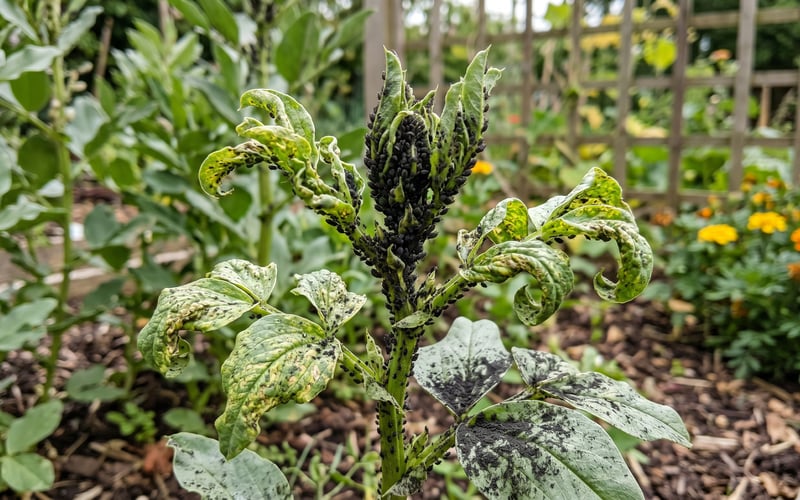
The take-home: the May-July outbreak is not a sudden invasion, it is a four-week colony explosion that started with 5-10 individuals dispersing from a spindle hedge in your area. Catch it in the first week and the response is trivial. Catch it in week four and you are spraying.
The damage threshold: when to act
Not every aphid is worth controlling. A small population on a mature plant rarely causes economic damage. Three damage thresholds worth knowing:
- 5-20 aphids per plant: No action needed. Watch and wait. Predators usually arrive within a week.
- 20-100 aphids per plant: Pinch out the affected growing tip and dispose of it. Buys you two weeks while you assess.
- 100+ aphids per plant, multiple plants affected: Hose hard once, repeat next day. If the colony is still expanding after three days of hosing, switch to soft-soap spray.
- Sooty mould on lower leaves, ants farming the colony, leaves distorted: Full intervention — pinch tips, hose, spray, every 5 days for three weeks.
For broad beans specifically: pinch out the top 5cm of every plant the moment the first flower truss opens. The aphids cluster on the soft new growth above the flowers; removing it both takes the colony with you and triggers the plant to set seed into its existing trusses rather than putting energy into new top growth. This single technique cuts aphid damage on broad beans by 70% even without further intervention.
Seven control methods that work
1. Pinch out growing tips
The first and best intervention. Once broad bean plants start flowering, the tender top 5cm is what the aphids want. Pinch it off, drop it in a bucket of water (drowns the aphids), compost the soggy result. Costs nothing, takes 30 seconds per plant, removes the colony in one move.
2. Strong water jet
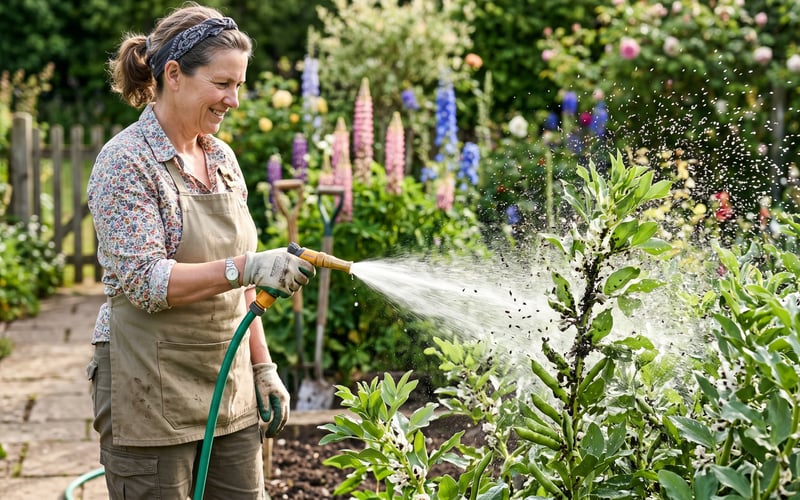
A hosepipe set to jet mode dislodges aphids without damaging the plant. The aphids cannot climb back up the stem fast enough to re-establish before the next predator finds them. Three consecutive mornings of hosing breaks most infestations. Best done before 10am so leaves dry in the sun and reduce fungal risk.
3. Soft-soap spray
The fall-back when hosing is not enough. 5g of pure soft soap (NOT washing-up liquid) in 1 litre of water, sprayed directly on the cluster. Soft soap breaks the waxy outer layer of soft-bodied insects, causing dehydration within minutes. HSE-approved basic substance, legal on edible crops. Repeat every 5-7 days until the colony breaks. See our homemade pesticides UK guide for the full recipe.
4. Biological control
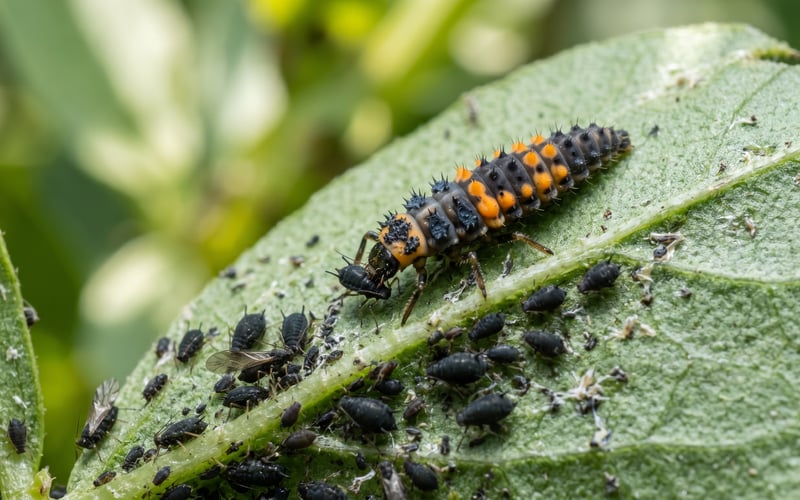
Three native UK insects eat black bean aphid:
- Ladybird larvae: Look like tiny alligators with orange spots. Eat 50 aphids per day. Adult 7-spot ladybirds eat 20 aphids per day.
- Lacewing larvae: Brown spindle-shaped grubs with sickle-shaped mouthparts. Eat 200 aphids per day.
- Hoverfly larvae: Translucent grey-green grubs. Eat 150 aphids per day.
All three appear naturally within 10-14 days of an aphid outbreak if you have not sprayed insecticide. They cannot fly into a greenhouse with closed vents, so prop the door open or fit louvre vents to let them in.
5. Companion planting
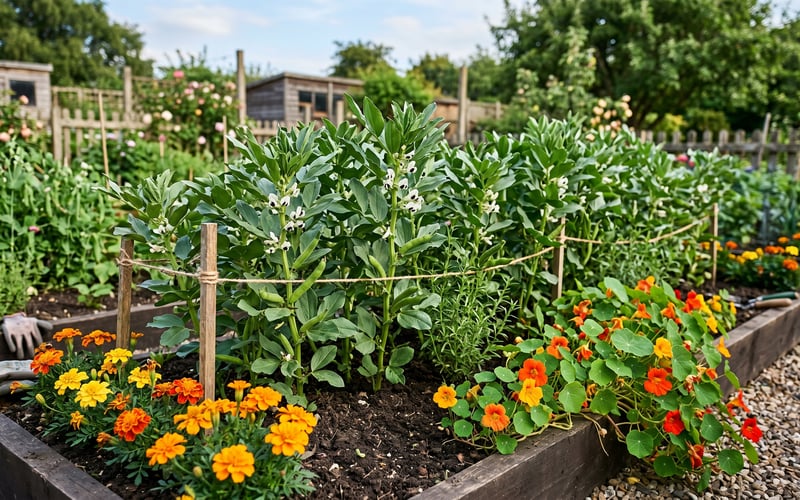
Three companion plants reduce black bean aphid pressure:
- Summer savory: Repels aphids by scent. Plant between broad bean rows in May.
- Nasturtiums: Act as a sacrificial trap crop. Aphids prefer nasturtium over broad beans — let the colony build on the nasturtium, then cut and compost the lot.
- Calendula and alyssum: Nectar plants that attract hoverflies and lacewings. Plant near the broad bean bed to recruit the predators that eat the aphids.
6. Sow at the right time
Broad beans sown in early November overwinter as 15-20cm plants and start flowering in April. By the time aphid populations explode in late May, the crop is already setting seed. Spring-sown broad beans (March-April) reach their first flowers in early June — exactly when aphid pressure peaks. The variety to use for November sowing: Aquadulce Claudia (hardy, reliable). For spring sowing: Imperial Green Longpod.
7. Cut the spindle hedge
If you have a spindle (Euonymus europaeus) or guelder rose (Viburnum opulus) in or near your garden, it is the overwintering host. Cutting it back hard in February removes 80% of the egg load. Not always practical (spindle is a useful native hedging plant) but worth considering on a small plot where black bean aphid is a perennial problem.
What not to do
Don’t use systemic insecticides on broad beans. Imidacloprid and similar systemic chemicals end up in the bean and the seed. Most consumer products with these actives have been withdrawn from amateur sale; what remains should not be used on edible crops.
Don’t spray the whole plant if only the tip is affected. You kill predators and friendly insects across the rest of the plant. Pinch the tip; spray only what you cannot pinch.
Don’t spray during flowering hours. Bees forage on broad bean flowers. Soft soap is low-risk to bees but not zero-risk. Spray in the evening after 6pm when bees are back at the hive.
Don’t leave infested debris on the plot. Pinched-out growing tips with live aphids should go in water (drowns them) or hot compost, not on a cold compost heap where the aphids walk back to your bean rows.
Matt’s Pick: where biological control thrivesBest for: Gardeners who want predators rather than sprays to handle aphid pressure. Why I recommend it: A well-ventilated greenhouse with two automatic louvre vents lets ladybirds, lacewings and hoverflies cycle freely. Combined with a nectar-flower border near the door, this is the natural-control setup that has handled aphids in our own greenhouse without spray for the last 8 years. Price: £59 |
Matt’s Tip: the bucket-of-water test
When pinching out infested growing tips, drop them straight into a bucket of plain water. The aphids cannot swim — they drown within 5 minutes. Empty the bucket onto the compost heap a few hours later; the aphids are dead and the plant material composts as normal. This stops the small but real risk of aphids walking out of a cold compost heap back to your bean rows the next week.
Frequently asked questions
What are the black bugs on my broad beans?
Almost certainly black bean aphid (Aphis fabae), the matte-black, slow-moving aphid that clusters on broad bean growing tips every May-July in the UK. Distinguishing features: 2mm long, plump, no glossy sheen, clustering in groups of 20-200 on the new growth, often farmed by black garden ants.
How do I get rid of black bean aphid?
Three steps in order: pinch out the affected growing tips, hose the rest of the plant with a strong jet of water, and spray soft-soap solution if the infestation persists. Repeat hosing for three days, repeat soft-soap spray every 5-7 days for three weeks. Encourage ladybirds and lacewings for long-term control.
Are black bean aphids harmful to humans?
No, black bean aphids are harmless to humans. They do not bite, sting, or carry diseases that affect people. The damage is purely to the plant — they suck sap, distort growth, and excrete honeydew that supports sooty mould. Beans from an infested plant are safe to eat after washing.
What plants do black bean aphids attack?
Black bean aphid attacks broad beans, runner beans, beetroot tops, spinach, dahlias, poppies, nasturtiums, and most plants in the Polygonaceae and Chenopodiaceae families. It overwinters on spindle (Euonymus) and guelder rose (Viburnum opulus) and disperses to these summer hosts in May.
When do black bean aphids appear in the UK?
Black bean aphid populations explode between late May and early July in the UK. Winged forms disperse from spindle hedges in May; colonies on broad beans peak in June; populations crash in late July as predators catch up. November-sown broad beans escape the worst because they flower in April, before the aphid wave.
Do ladybirds eat black bean aphids?
Yes, ladybirds and especially their larvae are the most effective natural control for black bean aphid. A single ladybird larva eats 50 aphids a day; an adult 7-spot ladybird eats 20 a day. They appear naturally within 10-14 days of an outbreak if no insecticide has been used.
Can you eat broad beans with aphids on them?
Yes, broad beans from an aphid-infested plant are safe to eat once washed and shelled. The pods often protect the beans from direct contact with aphids; rinsing under running water removes any residual honeydew or sooty mould. Aphids on the beans themselves are harmless if accidentally eaten.
What is the best companion plant for broad beans?
Summer savory is the traditional UK companion for broad beans and demonstrably repels black bean aphid. Plant a row of summer savory between broad bean rows in May. Add calendula and alyssum at the row ends to attract hoverflies and lacewings, and nasturtiums as a sacrificial trap crop nearby.