Homemade Pesticides UK: 7 Legal Options and the Law
Homemade pesticides are legal to make and use on your own UK garden if you stick to HSE-approved “basic substances” (vinegar, baking soda, soft soap, nettle and horsetail teas, beer) and avoid the grey areas (neem oil, garlic, chilli sprays). The Plant Protection Products Regulations 2011 make it a criminal offence to sell any homemade pesticide and to use products containing unauthorised active substances on edible crops. From our work with Greenhouse Stores customers since 2012, this guide covers the recipes that actually work, the law that governs what you can use, and the cultural practices that mean you need pesticides far less often.
Key takeaways
- The HSE regulates pesticides in the UK. Plant Protection Products Regulations 2011 cover everything from professional sprays to homemade recipes. Stick to approved basic substances and you are within the law.
- Soft-soap spray is the safest all-rounder. Kills aphids, whitefly, spider mite, and mealybug on contact. Works on edible and ornamental crops.
- Baking soda + soft soap controls powdery mildew. An approved basic substance — legal, effective, gentle on the plant.
- Neem oil is technically not approved as a pesticide in the UK. Sold as a “leaf shine” or “plant tonic”, it is widely used but not HSE-approved — use at your own discretion on non-edible crops.
- Never sell homemade pesticides. Selling an unapproved plant protection product is a criminal offence under the 2011 regulations, even at a village fete.
- Spray in the evening. Late-day spraying avoids bees, prevents leaf scorch from sun on wet foliage, and gives the spray hours to act before the morning dew washes it off.
Expert Tip
The question I get every summer is “how do I get rid of aphids without using something nasty?” The honest answer is that you usually don’t need to. A well-ventilated greenhouse with biological control (ladybirds, lacewing larvae, encarsia parasitic wasps) keeps most pest populations below the threshold that causes plant damage. When you do reach for a spray, the soft-soap-and-water recipe in this article is the one I keep coming back to — cheap, effective, and properly within the law. Avoid the temptation to mix “everything from the kitchen cupboard”: more potent does not mean more legal, and bleach-based home recipes are a fast route to dead plants and angry neighbours.
The UK law on homemade pesticides
The legal framework that covers garden pesticides in Great Britain is the Plant Protection Products Regulations 2011 (PPPR 2011) and the retained EU Regulation 1107/2009. The Health and Safety Executive (HSE) is the regulator. Three rules matter:
1. Any product used to control pests on plants is a Plant Protection Product (PPP). This is the case whether the product is bought, made from scratch, or sourced from your kitchen cupboard. The law does not distinguish between commercial and homemade once you spray it on a plant.
2. Every PPP must contain an authorised active substance. The HSE maintains the list of approved active substances on its website. Anything not on that list is not authorised. Using a non-authorised substance on edible crops is a criminal offence.
3. “Basic substances” are a special category of approved active substances that anyone can use legally. Article 23 of EU Regulation 1107/2009 (retained in UK law) lists everyday materials approved as basic substances: vinegar, sodium chloride, sodium bicarbonate, sucrose, lecithin, soft soap (potassium salts of fatty acids), nettle (Urtica), horsetail (Equisetum), beer, calcium hydroxide. Use any of these for plant protection and you are within the law.
Three things you cannot legally do, even in your own garden:
- Sell a homemade pesticide (criminal offence under PPPR 2011)
- Use an authorised commercial pesticide outside its label instructions (e.g. spraying tomatoes with a product approved only for ornamentals)
- Use neem oil as a pesticide on edible crops — despite being widely sold as “leaf shine”, neem is not an HSE-approved PPP
The grey area is using non-approved homemade sprays (garlic, chilli, neem) on your own ornamentals. The HSE has not historically prosecuted home gardeners for personal use of these recipes. The legal risk falls on producers and sellers, not amateur users.
The five legal homemade pesticide recipes
Each of these uses HSE-approved basic substances. Each option must be used only where current HSE guidance permits it. Check crop suitability and application instructions before use.
1. Soft-soap spray (aphids, whitefly, spider mite, mealybug)
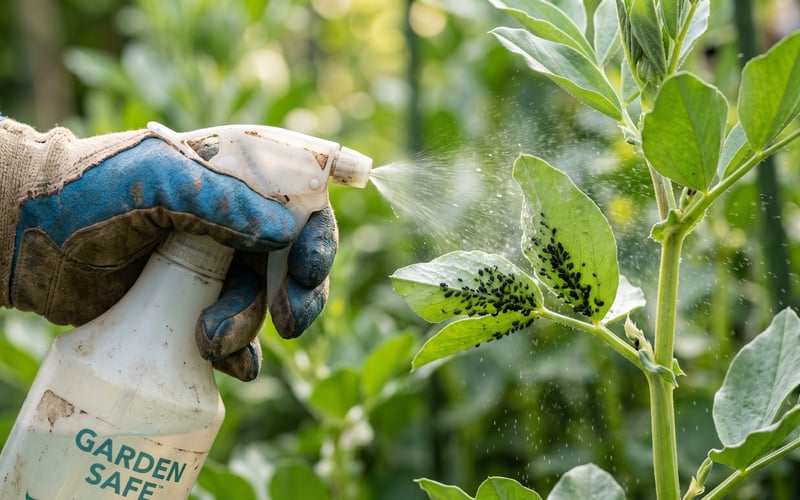
The single most useful homemade pesticide. Soft soap (potassium salts of fatty acids) breaks the waxy outer layer of soft-bodied insects, causing them to dehydrate within minutes. Harmless to plants, mostly harmless to beneficial insects with hard exoskeletons, and approved as a basic substance.
Recipe:
- 5g (1 teaspoon) soft soap or pure olive-oil soap (NOT washing-up liquid — it contains synthetic surfactants that are not approved)
- 1 litre lukewarm water
- Stir gently until the soap dissolves
- Fill a 1-litre garden sprayer
Application: Spray the affected plant thoroughly, especially the underside of leaves where aphids cluster. Direct contact is essential — the spray must hit the insect to work. Repeat every 5-7 days for three weeks during an active infestation.
Pro tip: Adding 5g of bicarbonate of soda gives a dual-purpose anti-fungal and anti-aphid spray.
2. Baking soda spray (powdery mildew, black spot, leaf rust)
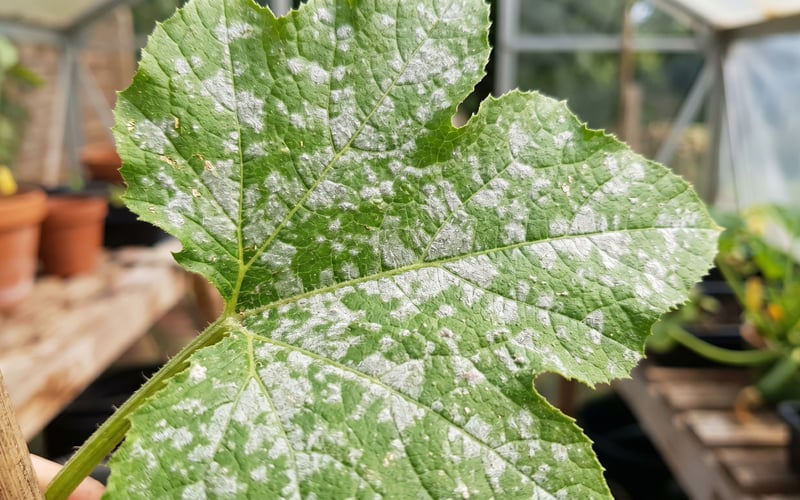
Sodium bicarbonate raises leaf-surface pH enough to inhibit fungal spores. Combined with soft soap (which helps the spray stick to leaves) it controls powdery mildew on courgettes, cucumbers, vines, and roses. An approved basic substance.
Recipe:
- 10g (1 heaped tablespoon) bicarbonate of soda
- 5g soft soap
- 1 litre water
- Mix thoroughly
Application: Spray weekly as a preventative once the weather turns muggy in July-August. For active infections, spray every 3-4 days for two weeks. Always spray in the evening to avoid leaf burn from sun-on-water.
For deeper coverage of powdery mildew, see our common greenhouse growing mistakes guide.
3. Beer traps (slugs, snails)
Slugs are attracted to the yeast in beer and drown in the liquid. Beer is an approved basic substance under the 2014 EU regulation (retained in UK law). Cheap supermarket bitter or stout works fine — the alcohol percentage does not matter.
Recipe:
- Sink a yoghurt pot or cut-down plastic bottle into the soil so the rim is 1cm above ground (stops ground beetles falling in)
- Fill with 200ml of beer
- Cover with a flat stone propped on small twigs to keep rain out
- Empty and refill weekly
Application: Place one trap per 4 square metres of vulnerable plants (hostas, lettuce, dahlias, brassica seedlings).
4. Nettle and horsetail tea (general plant tonic, anti-fungal)
Both nettle (Urtica) and field horsetail (Equisetum arvense) are approved as basic substances. The brewed teas work as foliar feeds with mild anti-fungal action. Nettle is high in nitrogen, iron and silica; horsetail is rich in silica, which strengthens cell walls against fungal attack.
Recipe:
- 500g fresh nettle tops or 100g dried horsetail
- 5 litres rainwater
- Steep in a bucket for 7-10 days, covered, in a cool corner
- Strain through muslin
- Dilute 1:10 with water before spraying
Application: Foliar spray every 14 days through the growing season. Be warned: the brew smells strongly of cabbage and is unpleasant to handle. Wear gloves and keep upwind.
5. White vinegar (path and patio weeds)
Acetic acid is an approved basic substance for non-selective weed control. Effective on annual weeds in cracks, gravel paths, and patios. Not approved for use on cultivated soil where you want plants to grow afterwards.
Recipe:
- 500ml white vinegar (5% acetic acid, household-grade)
- 5g soft soap (helps it stick)
- 10g salt (optional, increases potency — do not use on borders)
- Spray directly onto weed foliage on a dry sunny day
Application: Most annual weeds (chickweed, hairy bittercress) die within 24 hours. Perennial weeds (dandelion, dock) regrow from the root — repeat applications needed.
The grey areas: garlic, chilli and neem
Three popular “homemade pesticides” sit outside the approved basic-substance list. Whether to use them is a personal decision.
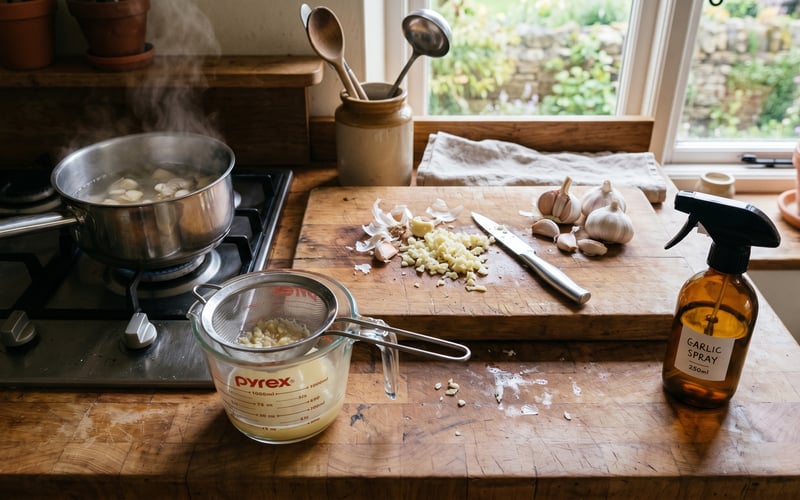
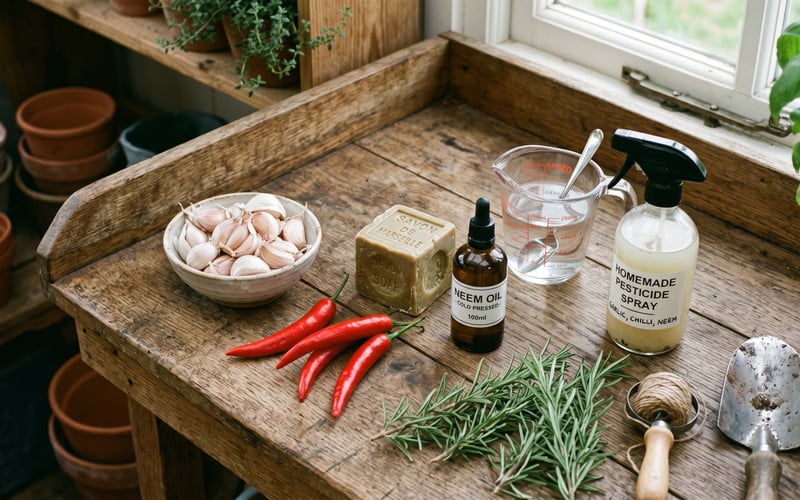
Garlic spray. Crushed garlic releases sulphur compounds that deter aphids, caterpillars and some fungi. Not an HSE-approved basic substance in the UK, though widely used. Recipe: crush 10 cloves of garlic, steep in 1 litre boiling water for 24 hours, strain, dilute 1:1 with water, add 5g soft soap, spray. Use on ornamentals; avoid edible crops to stay strictly within the regulations.
Chilli spray. Capsaicin from hot chillies deters mammals (squirrels, rabbits, cats) and some caterpillars. Not approved. Recipe: blend 6 hot chillies with 1 litre water, steep 24 hours, strain, add 5g soft soap, spray. Use on non-edible crops and rinse hands carefully.
Neem oil. Cold-pressed neem (azadirachtin) is a powerful insect growth regulator widely used worldwide. Not approved as a plant protection product by the HSE. Often sold in the UK as “leaf shine” or “plant tonic” with no pesticidal claim on the label. Effective against aphids, whitefly, scale and spider mite. Strict reading of the law makes neem off-limits for edible crops; many UK gardeners use it cautiously on ornamentals.
What never to use
Three categories of homemade “recipe” circulate online that you should not use under any circumstances:
- Bleach (sodium hypochlorite). Damages plants, kills soil microbiology, harms beneficial insects, and is illegal as a plant treatment.
- Detergent / washing-up liquid. Contains synthetic surfactants and fragrances not approved as basic substances. Strict reading of the law makes it illegal even on your own garden. Use proper soft soap instead.
- Industrial salt at high concentration. Sterilises the soil for years. The vinegar-and-salt recipe should only ever be used on hard surfaces (paths, patios), never on borders or beds.
Cultural practices that mean fewer sprays
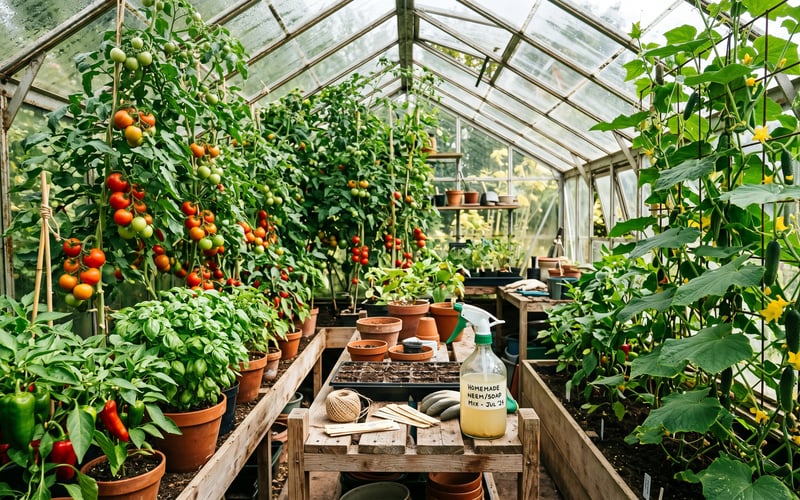
The greenhouse customers I see using the most homemade pesticides are usually fixing problems that better growing practice would prevent. Six cultural practices cut pest pressure by 60-80%:
- Ventilate aggressively. Most fungal diseases (powdery mildew, botrytis) thrive in stagnant humid air. Two automatic vent openers per 6x8 greenhouse is the minimum spec.
- Encourage predators. Ladybird larvae eat 50 aphids a day. Lacewing larvae eat 200. Plant nectar-rich flowers (calendula, alyssum, fennel) at the entrance of the greenhouse and the predators self-recruit.
- Companion plant. French marigolds emit a sulphur compound from their roots that deters whitefly. Basil under tomatoes confuses aphid detection. Garlic chives around brassicas mask their scent from cabbage white butterflies.
- Quarantine new plants. Most pest outbreaks arrive on bought-in plants. Keep new arrivals in a separate corner for two weeks and inspect before introducing them to the main collection.
- Hose hard. A strong jet of water dislodges 90% of an aphid population in 30 seconds. Repeat every two days for a week and the infestation breaks before it builds.
- Yellow sticky traps. Whitefly, fungus gnats and aphids fly into yellow sticky traps. Hang one per metre of staging from May to September. Acts as both monitor and trap.
Matt’s Pick: prevention over treatmentBest for: Gardeners who would rather avoid the pest problem than spray to fix it. Why I recommend it: A well-ventilated greenhouse with two automatic louvre vent openers and proper roof venting cuts powdery mildew and botrytis by half. The single biggest pest-prevention upgrade you can make is more ventilation, not stronger spray. The Elite louvre vent opener is the model I fit on every install. Price: £59 |
Matt’s Tip: always test on one leaf first
Even “safe” soft-soap sprays can scorch the leaves of sensitive species (some ferns, succulents, young seedlings). Before drenching a whole crop, spray a single test leaf and wait 24 hours. Brown spots or curling means the recipe is too strong — dilute the next batch by 50%. This 1-minute check has saved me from losing entire crops of seedlings to enthusiastic over-spraying.
Frequently asked questions
Are homemade pesticides legal in the UK?
Homemade pesticides made from HSE-approved basic substances are legal for personal use. These include soft soap, baking soda, vinegar, beer, nettle, horsetail, salt and sucrose. Recipes using non-approved substances (garlic, chilli, neem) are technically outside the regulations but rarely enforced against home gardeners on ornamentals. Selling any homemade pesticide is a criminal offence.
Can you use washing-up liquid as a pesticide in the UK?
Washing-up liquid is not an HSE-approved basic substance and is technically outside the regulations. Use proper soft soap (potassium salts of fatty acids), sold by garden centres or online, instead. Soft soap costs the same and is fully approved for plant use.
Is neem oil legal in the UK?
Neem oil is legal to buy and use as a “leaf shine” or “plant tonic”, but not as a pesticide on edible crops. The HSE has not approved neem (azadirachtin) as a plant protection product in the UK. Many gardeners use neem on ornamentals; using it on edible crops is technically outside the regulations.
What is the best homemade pesticide for aphids?
Soft-soap spray (5g soft soap in 1 litre water) is the most effective homemade aphid control in the UK. Direct contact is essential — spray the underside of leaves where aphids cluster. Repeat every 5-7 days until the infestation breaks. Approved as a basic substance under UK law.
How do you make natural pesticide for vegetables?
The safest natural pesticide for UK vegetables is soft-soap-and-water spray for soft-bodied pests, plus a baking-soda spray for fungal diseases. Both use HSE-approved basic substances and are legal on edible crops. Always spray in the evening, wash produce before eating, and observe a 24-hour interval between spray and harvest.
Will homemade pesticides kill bees?
Soft-soap and baking-soda sprays are low-risk to bees if used in the evening when bees are not foraging. Garlic and chilli sprays are also low-risk. Avoid spraying any active flowers and time applications for early evening (6-8pm). Never spray during bee foraging hours (10am-5pm).
Can I use vinegar as a pesticide?
Vinegar is approved as a basic substance for weed control, not as a pesticide on plants you want to keep. Spraying vinegar on plant leaves damages the foliage. Use vinegar only on path and patio weeds.
How long do homemade pesticides keep?
Most homemade pesticide sprays should be used within 24 hours of mixing. Soft-soap solutions separate over time; nettle and horsetail teas ferment further and the smell becomes unbearable. Garlic spray loses potency within 48 hours. Mix small batches and use them fresh.