Seed Germination Temperatures: The Complete UK Reference Table
Optimal seed germination temperature is the single biggest factor in seed-sowing success. Most UK garden crops germinate fastest between 18-22C, but heat-lovers (peppers, aubergines, melons) need 24-28C and cool-season crops (lettuce, peas, spinach) prefer 10-15C. The number that matters is soil temperature, not air temperature — a heated propagator at 21C with cool air around it works exactly as expected. After fitting greenhouses for many years across the UK, this reference table covers the 40 most-sown vegetable, herb and flower seeds with their proven germination ranges.
Key takeaways
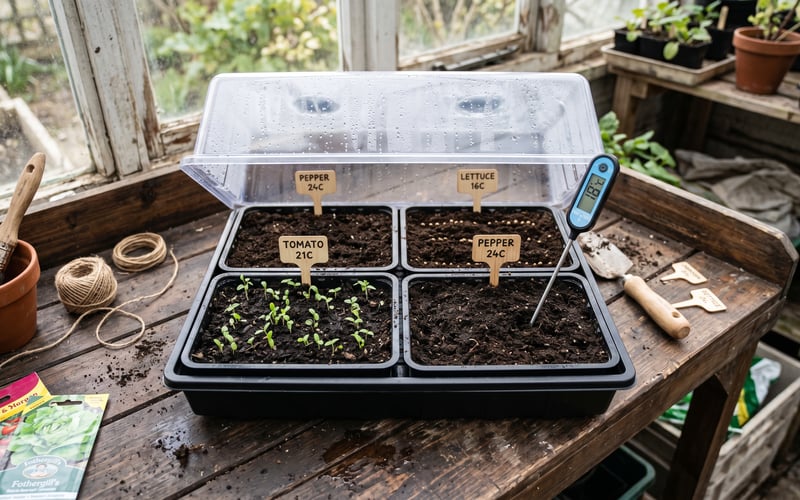
- Soil temperature is what matters — air temperature is a proxy. A digital probe thermometer pushed into the seed tray reads what the seed actually feels.
- Three temperature bands cover almost every UK seed: cool (10-15C, lettuce/peas/spinach), warm (18-22C, tomato/courgette/most flowers), hot (24-28C, pepper/aubergine/cucumber/melon).
- Heated propagators are the most reliable way to hit the right temperature. Bottom heat at 21C gives even germination across the tray in 7-14 days for most crops.
- Cold frames raise soil temperature 3-5C above ambient. Enough for hardier crops but not for tomatoes or peppers until late April.
- Too hot is worse than too cool. Above 30C most seeds enter dormancy or die outright. Below the minimum they just take longer.
Expert Tip
Three out of every four “why won’t my seeds germinate?” conversations I have with customers come down to the same issue: the temperature is wrong. Either the windowsill is colder than they think (the glass radiates heat away overnight), or the airing cupboard is too hot (some peak at 30C+), or the propagator is unplugged on a timer that runs out. The fix is a 6 cheap soil-probe thermometer pushed into the tray and checked at dawn before the heat of the day. The temperatures in the table below come from many years of doing exactly that.
Why soil temperature matters more than air temperature
Seeds germinate in response to the temperature of the medium they are sitting in — not the temperature of the air around the tray. The two diverge more often than people realise:
- Cold soil under warm air. A heated greenhouse warmed to 18C in late February still has compost at 10-12C if the trays sit on a cold stone floor. The seeds feel 12C, not 18C. Result: slow or failed germination.
- Warm soil under cool air. A heated propagator on its lowest setting runs the compost at 21C even if the room is 14C overnight. The seeds feel 21C and germinate normally.
- Fluctuating soil under steady air. A south-facing windowsill swings the tray from 24C at midday down to 8C overnight. Seeds tolerate fluctuation poorly — most need a steady temperature within 4C of the optimum.
The fix in every case is to measure the soil, not the air. A digital probe thermometer (the kind sold for cooking) costs £6-£12, lives permanently in one seed tray as your reference cell, and tells you the truth.
The master germination temperature table
Forty common UK garden seeds with their tested germination ranges. Temperatures are soil temperatures not air. Days-to-emerge assumes the soil is in the middle of the optimal range; cooler or hotter adds 2-4 days.
| Seed | Min | Optimal | Max | Days to emerge | Sowing notes |
|---|---|---|---|---|---|
| Aubergine | 22C | 24-27C | 30C | 10-14 | Heated propagator essential |
| Basil | 18C | 20-22C | 30C | 5-10 | Cover lightly, needs warmth |
| Beetroot | 10C | 15-22C | 28C | 7-14 | Soak seeds 4 hr before sowing |
| Broad bean | 5C | 10-18C | 22C | 7-14 | Direct sow Feb-Apr |
| Broccoli | 10C | 15-21C | 27C | 5-10 | Cool propagator |
| Brussels sprout | 10C | 15-21C | 27C | 5-10 | March-April under glass |
| Cabbage | 10C | 15-21C | 27C | 5-10 | Cool propagator |
| Calendula | 10C | 16-21C | 27C | 7-14 | Cover lightly with compost |
| Carrot | 7C | 10-20C | 25C | 14-21 | Direct sow, cover thinly |
| Cauliflower | 10C | 15-21C | 27C | 5-10 | Cool propagator |
| Celeriac | 15C | 18-21C | 24C | 14-21 | Light essential, do not cover |
| Celery | 15C | 18-21C | 24C | 14-21 | Same as celeriac |
| Chard | 10C | 15-22C | 28C | 7-14 | Soak seeds before sowing |
| Chilli | 22C | 24-28C | 32C | 10-21 | Heated propagator essential |
| Coriander | 10C | 15-22C | 27C | 7-14 | Likes cool weather |
| Courgette | 18C | 21-24C | 32C | 5-10 | Sow edge-on, warm propagator |
| Cucumber | 20C | 24-28C | 32C | 3-10 | Sow edge-on, warm propagator |
| Dill | 7C | 15-22C | 27C | 10-21 | Direct sow, cool tolerant |
| Fennel | 10C | 15-21C | 27C | 7-14 | Direct sow Apr-May |
| French bean | 15C | 20-25C | 30C | 7-14 | Warm propagator |
| Kale | 10C | 15-21C | 27C | 5-10 | Cool propagator |
| Kohlrabi | 10C | 15-21C | 27C | 5-10 | Cool propagator |
| Leek | 10C | 15-21C | 27C | 10-14 | Cool propagator, slow grower |
| Lettuce | 4C | 10-18C | 22C | 5-10 | Dormant above 22C, never warmer |
| Lobelia | 15C | 18-21C | 24C | 14-21 | Light required, very fine seed |
| Mangetout / sugar snap | 5C | 10-18C | 22C | 7-14 | Direct sow Mar-Apr |
| Marigold (French) | 15C | 18-22C | 27C | 5-10 | Warm propagator |
| Melon | 22C | 24-28C | 32C | 5-10 | Heated propagator essential |
| Nasturtium | 10C | 18-22C | 27C | 7-14 | Sow direct, do not over-water |
| Onion (seed) | 7C | 15-20C | 27C | 10-14 | Cool propagator |
| Pak choi | 10C | 15-21C | 27C | 5-10 | Cool propagator |
| Parsley | 10C | 15-22C | 27C | 14-28 | Slow; pre-soak overnight |
| Parsnip | 7C | 10-20C | 22C | 14-28 | Direct sow, fresh seed only |
| Pea | 5C | 10-18C | 22C | 7-14 | Direct sow Feb-May |
| Pepper (sweet) | 22C | 24-27C | 32C | 10-21 | Heated propagator essential |
| Petunia | 15C | 21-24C | 27C | 7-14 | Light required, do not cover |
| Pumpkin / squash | 18C | 21-24C | 32C | 5-10 | Sow edge-on |
| Radish | 7C | 15-22C | 27C | 4-10 | Fastest UK germinator |
| Rocket | 5C | 10-22C | 27C | 4-10 | Year-round under glass |
| Runner bean | 15C | 20-25C | 30C | 7-14 | Warm propagator |
| Spinach | 4C | 10-18C | 22C | 7-14 | Dormant above 22C |
| Sweetcorn | 15C | 21-24C | 32C | 7-14 | Warm propagator |
| Sweet pea | 10C | 15-21C | 27C | 10-21 | Pre-soak 12 hr |
| Tomato | 15C | 21-24C | 30C | 5-10 | Heated propagator ideal |
| Turnip | 7C | 15-21C | 27C | 5-10 | Cool propagator |
For the matching sowing calendar, see our month-by-month unheated greenhouse guide.
Three temperature bands explained
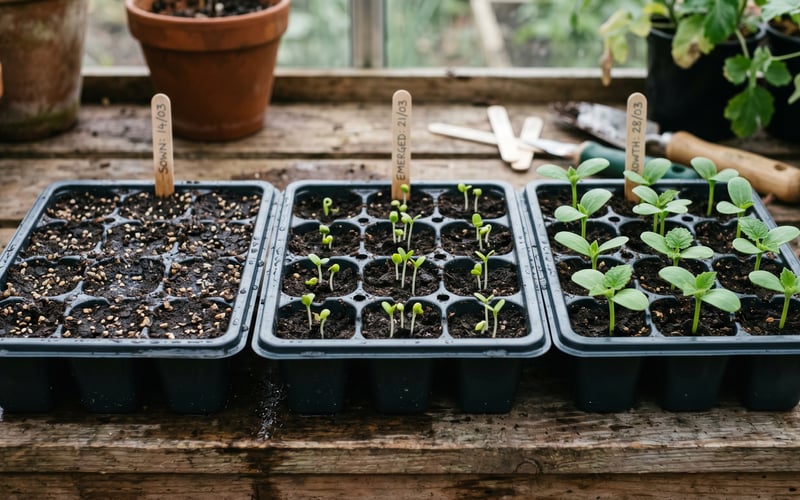
Cool band: 10-15C
Cool-season crops germinate at temperatures below the threshold that triggers most other plants. Lettuce, spinach, peas, broad beans, and the brassicas (cabbage, broccoli, cauliflower, kale) all fall into this band. Above 22C most of them enter thermo-dormancy — the seed survives but refuses to germinate until cooler conditions return. This is why supermarket lettuce often bolts in summer: the seed germinated in a cool spring, then the plant ran straight to flower in heat.
Practical implication: a heated propagator set to 21C is too warm for lettuce and spinach in midsummer. Sow these in a cool corner of the greenhouse or a north-facing windowsill instead.
Warm band: 18-22C
The middle band is where most UK garden crops sit. Tomatoes, courgettes, beans, sweetcorn, marigolds, petunias, basil — all germinate fastest between 18-22C. A heated propagator on its standard 21C setting hits this band perfectly. This is also the temperature an unheated greenhouse hits during a warm day in late April and May, which is why most UK gardeners can sow these crops without supplementary heat by Easter.
Hot band: 24-28C
The hot-loving crops need real warmth to germinate. Peppers, chillies, aubergines, melons, cucumbers, and some heat-loving annuals (cosmos, zinnias if sown early). These never germinate reliably on a UK windowsill without a heated propagator unless the room is consistently above 22C day and night. A standard propagator runs at 21C; a thermostatic propagator that can dial to 26-28C is the right tool for chillies and aubergines.
Controlling temperature: propagators and cold frames
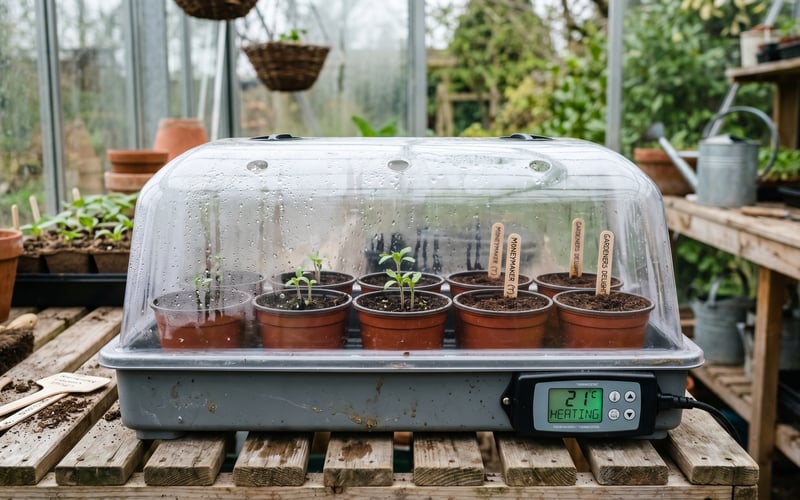
Four pieces of kit cover almost every UK germination scenario.
Heated propagator (electric, thermostatic). The standard kit. Bottom heat at 18-25C, clear plastic dome retains humidity. Sizes from 30x20cm (one tray) to 76x36cm (four trays). Look for thermostatic control if you want to grow chillies and peppers reliably. Stewart and Garland make the dominant UK ranges; Vitavia and Elite both stock their own own-brand kits that fit the matching greenhouse staging.
Heat mats. Flat electric mats that sit under standard seed trays. Cheaper than propagators per tray, but no dome — the warmth dissipates upwards faster. A heat mat plus a clear plastic lid does the same job as a propagator at half the price.
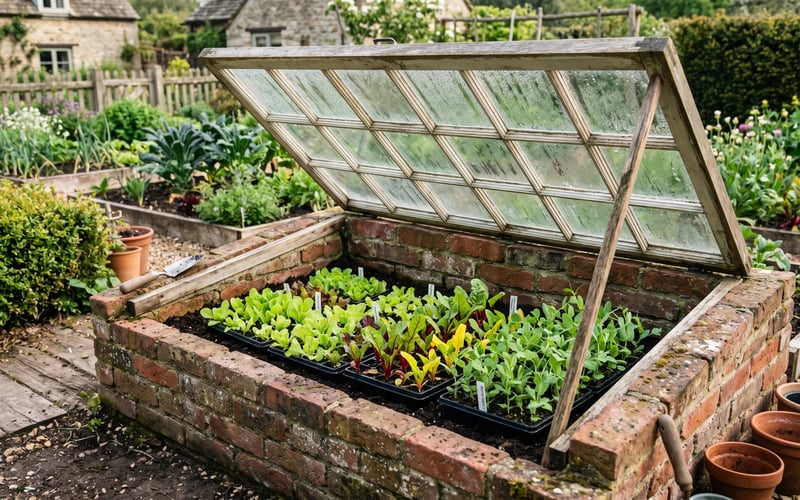
Cold frames. Unheated bottom-warm storage. A traditional UK cold frame raises soil temperature 3-5C above the surrounding ambient by trapping passive solar heat. Enough for cool-band crops from March onwards; not enough for hot-band crops until late April-May.
Soil warming cables. The serious-greenhouse option. Cables buried in sand under a staging bench give controlled bottom heat across a 1-2 metre area. Used to raise commercial brassica seedlings and now affordable for home greenhouses. Pair with a thermostat for hands-off operation.
For deeper kit choices, see our essential greenhouse accessories guide.
Light vs dark: does it matter?
Most seeds germinate equally well in light or dark, but a small group need light to break dormancy and another small group germinate only in darkness. Get this wrong and a tray of correctly-temperature-controlled seeds simply will not sprout.
Need light to germinate (do not cover with compost):
- Lettuce (most varieties)
- Lobelia
- Begonia
- Petunia
- Celery / celeriac
- Foxglove (digitalis)
- Snapdragon (antirrhinum)
Prefer darkness (cover with 5-10mm of compost):
- Calendula
- Cyclamen
- Larkspur
- Nasturtium
- Phlox
For light-requiring seeds, sow on the surface of damp compost and press gently. For dark-requiring, cover with 2-3 times the seed’s diameter in compost. The remainder of UK garden seeds are agnostic — cover lightly and they germinate fine either way.
Common mistakes that stop germination
Compost too cold. Cold compost taken straight from a shed in February is 4-6C even when the room is 18C. Bring the compost into the house for 24 hours before sowing, or warm with a kettle of warm (not hot) water just before filling trays.
Propagator over-watered. A dome that drips water onto the seeds causes damping-off — a fungal disease that fells seedlings within 24 hours of emergence. Mist with a fine spray, never water from above, and prop the dome lid open 5mm once seedlings emerge.
Window glass acting as a cold sink at night. A south-facing windowsill is brilliant by day, brutal by night. The glass surface drops to 6-8C in early March even when the room is 18C. Move trays away from the glass at sunset, or place a piece of cardboard between the tray and the window.
Old seed. Seed germination rates fall steadily with age. Most UK garden seeds keep 2-4 years if stored cool and dry; parsnip, leek, and onion drop to 50% after 12 months. Always check the packet date and discount expected germination by 10% per year past the printed cut-off.
Sowing too deep. The general rule is to cover seed by 2-3 times its diameter. Lettuce sown 1cm deep will rot before reaching the surface; a courgette sown 5mm deep will dry out before its first true leaf forms.
For the wider picture of what goes wrong, see our 10 common greenhouse growing mistakes.
Matt’s Pick: where to germinate reliablyBest for: Anyone who has lost a batch of seedlings to a cold windowsill or an over-warm airing cupboard. Why I recommend it: A heated greenhouse gives you a stable propagation environment from late February onwards — warm enough for tomatoes and peppers, cool enough at night for lettuce and brassicas. The Vitavia Phoenix 8x10 is the value pick: 1240mm doors for tray-carrying, 7ft+ headroom, and the eave height for staging tier-stacked propagators along the back wall. Price: £1,535 |
Matt’s Tip: dawn is the truth-teller
The temperature reading that matters is the one at 6am, not the one at lunchtime. Compost cools overnight while you sleep and germination stalls when the soil drops below the minimum. Put a max-min thermometer in your seed tray for 48 hours before you commit to a sowing batch. If the minimum reads 10C with the propagator on, your tomato seeds will struggle — raise the thermostat or add a layer of fleece over the dome.
Frequently asked questions
What is the best temperature for germinating seeds?
18-22C suits 80% of UK garden seeds. A heated propagator set to 21C handles tomatoes, courgettes, beans, marigolds, basil and most flowering annuals. Heat-loving crops (peppers, aubergines, cucumbers, melons) need 24-28C. Cool-season crops (lettuce, peas, spinach, brassicas) prefer 10-18C.
Why are my seeds not germinating?
The most likely cause is wrong soil temperature. A digital probe thermometer pushed into the seed tray will tell you within 30 seconds whether the compost is in the right range. Other common causes: seed older than 3 years, sown too deep, compost too dry, dome lid dripping water onto the surface.
Do seeds need light to germinate?
Most do not, but lettuce, lobelia, begonia, petunia, celery and a small group of others need light and must not be covered with compost. Sow on the surface of damp compost and press gently. The majority of UK garden seeds germinate equally well in light or dark.
What temperature kills seeds?
Above 30C, most UK garden seeds either enter dormancy or die. Lettuce and spinach become dormant above 22C. Tomatoes and peppers survive at 30C but germination rates drop sharply. A compost surface in direct south-facing greenhouse glass can hit 40C+ in May — shade newly-sown trays during the day until they emerge.
How long do seeds take to germinate at the right temperature?
Most UK garden seeds emerge in 5-14 days at their optimal temperature. Radish and rocket are the fastest (4-10 days). Carrot, parsnip, parsley and celery are the slowest (14-28 days). Chillies and aubergines at the right warmth take 10-21 days. Drop below the optimal range and add 50-100% to the time.
Can I use an airing cupboard to germinate seeds?
Yes, if you check the temperature first. Airing cupboards vary widely — some run at 18-22C (ideal), others peak at 30C+ (too hot for most seeds). Put a max-min thermometer on the shelf for 24 hours before sowing. Once seedlings emerge, move them to a bright cool windowsill — an airing cupboard is too dark for seedling growth.
What is the difference between germination and dormancy?
Germination is the active sprouting of a seed; dormancy is a paused state where the seed is alive but refuses to grow. Many UK seeds enter thermo-dormancy above 22C (lettuce) or below 10C (peppers) and resume germination when conditions improve. The seeds are not dead — they are waiting for the right temperature window.
Do I need a heated propagator for tomato seeds?
Not always — tomato seeds germinate fine at 15-30C as long as the soil temperature is steady. A south-facing windowsill in late March works. A heated propagator at 21C gives faster, more uniform germination (5-7 days instead of 10-14) and is essential if you want to sow tomatoes in February for an early crop.