Greenhouse Wind Damage: Prevention, Storm Prep, and Repair Guide
Wind is the leading cause of greenhouse damage in the UK. Gusts above 50mph can lift unanchored frames and shatter glass panels. After repairing hundreds of storm-damaged greenhouses over 16 years, we know the pattern: a door or vent blows open, wind gets inside, and internal pressure tears the structure apart. Prevention takes 15 minutes before a storm. This guide covers everything from storm prep and windbreaks to post-storm inspection and emergency repairs, with real advice from installers who deal with wind damage every autumn and winter.
Key Takeaways
- Keep wind out. If wind enters through an open door or vent, internal pressure doubles the load on the frame. This is how most greenhouses fail.
- Close and latch all doors, vents and louvres before every storm. Disengage auto vent openers manually or remove the wax cylinder.
- Plant a windbreak hedge or install fencing at least 10x its height upwind. A 2m hedge protects a greenhouse 20m downwind and cuts wind speed by 50%.
- Inspect your greenhouse within 24 hours of any storm. Tighten loosened bolts, replace missing clips, and fix cracked glass before the next blow.
- Anchor to concrete with expanding bolts at 600mm intervals or use screw-in ground anchors at 450mm depth in soil. Weight alone is never enough.
Installer's Note
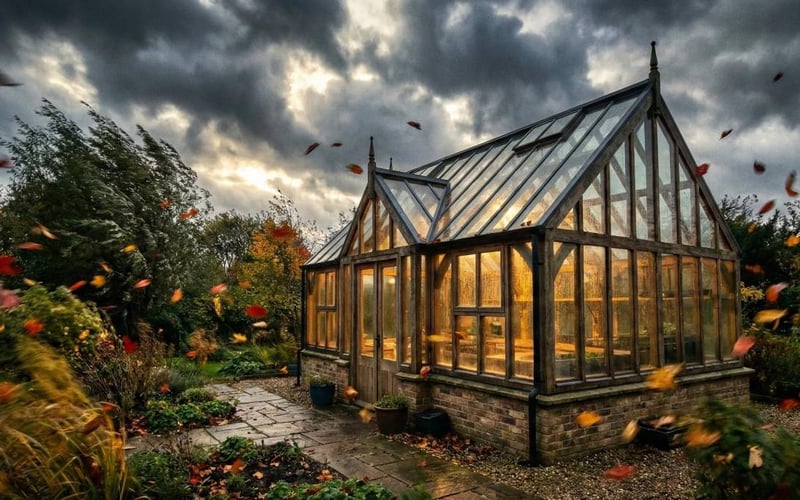
We fit greenhouses across the UK, including clifftop and coastal positions. Wind damage is the number one call we receive after autumn storms. Nearly every failure we see follows the same pattern: a door or vent blew open, wind got inside, and the frame could not hold. This guide shares exactly what we tell every customer before storm season, plus what to do after the wind has done its worst.
Why do greenhouses collapse in high winds?
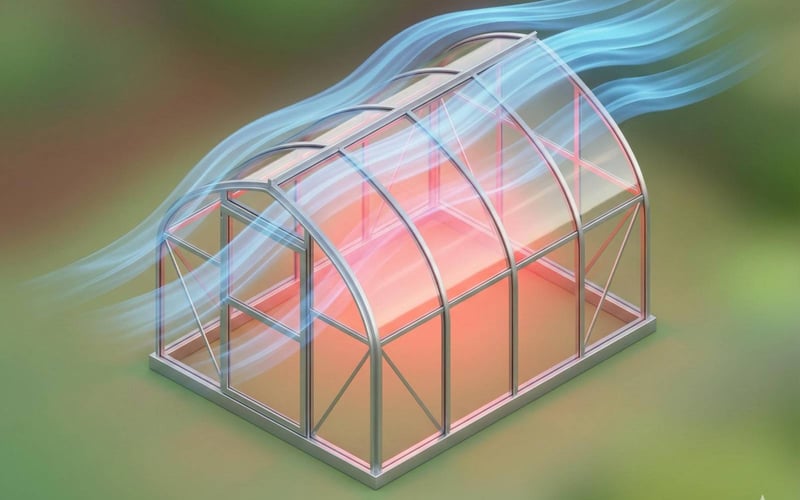
Wind damage is not just about force pushing against a wall. It is about pressure working on both sides of the frame at once.
External suction and uplift
Wind flowing over a greenhouse roof creates an airfoil effect. This is the same principle that lifts an aeroplane wing. Negative pressure above the roof pulls the structure upward. The faster the wind, the stronger the uplift.
Internal pressure
If a door, vent or louvre opens during a storm, wind rushes inside. This creates positive pressure that pushes outward against walls and roof panels. The greenhouse becomes a balloon trying to inflate from within.
The double force effect
This is where catastrophic failure happens. Uplift pulls the roof upward from outside. Internal pressure pushes the roof outward from inside. These two forces combine and double the total wind load on the frame. A Force 9 gale (75-88 km/h) generates roughly 770 N per square metre on a sidewall. With the double force effect, that load doubles again.
For more on how different glazing materials handle these forces, read our comparison of glass vs polycarbonate greenhouses.
How to prepare your greenhouse before a storm

When a storm warning arrives, act immediately. Do not wait until the wind picks up. This checklist takes 15 minutes and prevents most damage.
Seal the building envelope
This is the single most important step. Keep wind out of the greenhouse at all costs.
- Close and latch all doors. Check the catch engages fully. A door that rattles will eventually blow open.
- Shut every roof vent and louvre. Wind suction can pull open vents that are not latched properly.
- Disengage auto vent openers. Remove the wax cylinder entirely or tie the vent arm down. Wind suction can trigger them open. Store the cylinder somewhere cool and refit after the storm.
- Secure loose polycarbonate panels. Apply glazing repair tape along the edges if panels feel loose in the frame.
Clear the perimeter
Wind turns loose objects into projectiles. A terracotta pot at 80 km/h will smash through any glazing.
- Move pots, wheelbarrows and garden tools indoors or into a shed.
- Check for dead branches on nearby trees. These snap first in high winds.
- Secure bin lids, trellises and anything lightweight within 10 metres of the greenhouse.
- Empty or secure water barrels, cloches and cold frames.
Check your clips and seals
Missing or damaged glazing clips are the weak point that lets the wind in. Walk the entire greenhouse and check every pane.
- Replace missing spring clips. Our Vitavia glazing spring clips at £18 fit most Vitavia and Halls models.
- Upgrade from spring clips to wire clips for exposed sites. Elite wire clips at £30 grip harder and resist wind suction better than standard spring clips.
- Apply silicone sealant to clips on exposed panes. A bead of clear silicone over each clip stops wind vibration from working them loose.
- Check the rubber seals around the door frame. Perished seals let wind whistle in. Replace them before storm season.
Matt's Tip: The Door Test
Before every storm, stand inside the greenhouse and push each door outward. If it flexes more than 5mm at the centre, the latch is not holding properly. Tighten the catch or add a bolt. That 5mm gap is all the wind needs to get a grip and rip the door open. I have seen entire greenhouses lost because of a weak door latch.
How to set up windbreaks to protect your greenhouse
A windbreak is the single most effective long-term protection for a greenhouse in an exposed position. A good hedge or fence reduces wind speed by 50% for a distance of 10-15 times its height downwind. A 2-metre hedge protects everything within 20-30 metres behind it.
Natural windbreaks: hedges and trees
A semi-permeable barrier like a hedge works better than a solid wall. Solid walls create turbulence on the leeward side, which can be worse than the original wind. A hedge filters the wind, slowing it gradually without creating eddies.
| Windbreak Plant | Growth Rate | Mature Height | Notes |
|---|---|---|---|
| Leylandii | 60-90cm/year | 5-8m (trim to 2-3m) | Fastest option. Needs regular trimming or it becomes a nuisance. Keep to 2m for neighbours. |
| Western Red Cedar | 30-60cm/year | 3-5m | Evergreen, dense foliage, aromatic. Less aggressive than Leylandii. |
| Yew | 20-30cm/year | 2-4m | Slow but extremely dense. Excellent long-term windbreak. Tolerates hard pruning. |
| Laurel | 30-60cm/year | 3-5m | Large glossy leaves. Good screening and wind filtering. Easy to maintain. |
| Mixed native hedge | 30-45cm/year | 2-3m | Hawthorn, blackthorn, hazel. Best for wildlife. Plant double-staggered rows. |
Plant your windbreak at least 3-4 metres upwind of the greenhouse. Too close and the roots may interfere with the base, and falling branches become a risk. Too far and the wind recovers its speed before reaching the greenhouse. The sweet spot is 3-5 times the mature hedge height.
Artificial windbreaks: fencing and netting
If you cannot wait 3-5 years for a hedge to grow, or you need protection now, artificial windbreaks work immediately.
- Windbreak netting (HDPE or Rokolene). Available in 50% shade factor. Reduces wind speed by 50-70%. Fix to timber posts at 2m height. Costs £30-£80 for a 10m roll. This is the quickest, cheapest option.
- Slatted timber fence panels. Gaps between slats filter the wind rather than blocking it. A 1.8m panel with 25mm gaps is effective and looks better than netting.
- Woven willow or hazel hurdles. Natural look, semi-permeable, and effective for 5-8 years before they need replacing. Good for cottage gardens.
- Solid close-board fencing. Provides shelter immediately but creates turbulence behind it. Not ideal within 5 metres of the greenhouse. Better for general garden protection at a distance.
The best approach is a combination: install netting or fencing for immediate protection while a hedge grows behind it. Remove the artificial barrier once the hedge is established.
For more on positioning your greenhouse relative to windbreaks and sunlight, read our best position for a greenhouse guide.
How to strengthen your greenhouse frame
Reinforcing the frame before storm season costs less than replacing it afterwards. These are the upgrades we recommend based on the failures we see.
Replace spring clips with bar capping
Spring clips are the weakest link in any aluminium greenhouse. They rely on friction to hold glass in place. Bar capping screws down over the glazing bar and physically locks the glass to the frame. It is significantly more wind-resistant. Many Elite greenhouses offer bar capping as an option. Ask us about retrofitting it to your model.
Add extra glazing clips
Most manufacturers supply the minimum number of clips. In an exposed position, double the quantity. Instead of two clips per pane, use four. It takes 30 minutes and a pack of Elite spring clips at £26 or Elite overlap clips at £23.
Tighten all frame bolts
Walk the entire frame with a 10mm socket and check every bolt. Aluminium frames expand and contract with temperature changes. Bolts loosen over time. A loose bolt lets the frame flex, and flex leads to failure. Do this check once a year in September before storm season starts.
Apply silicone sealant to frame joints
A bead of clear silicone along the ridge, eave joints and base rail seals gaps where wind can penetrate. This is particularly effective on older greenhouses where rubber seals have perished. Use a greenhouse-grade silicone that stays flexible in cold temperatures.
How to choose the right glazing for wind resistance
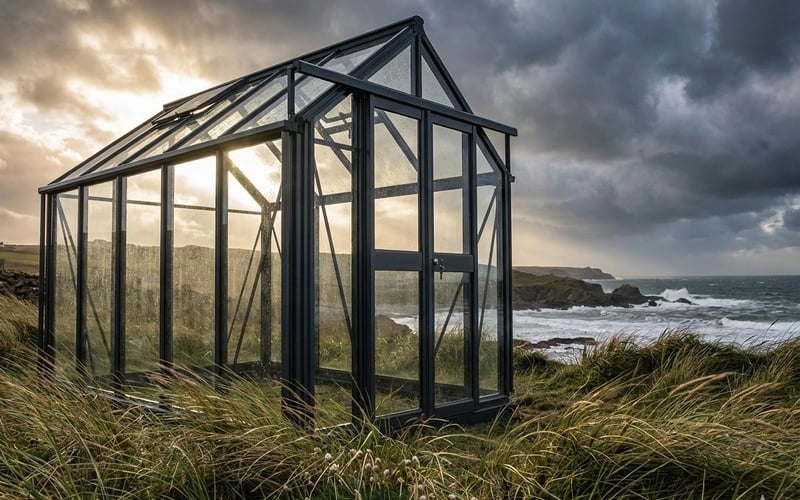
Your choice of glazing determines how well a greenhouse handles wind. Here is what we recommend based on 16 years of installations.
| Glazing Type | Weight | Wind Resistance | Best For |
|---|---|---|---|
| Horticultural glass | Light (overlapping panes) | Low. Panes slip at Force 6 (39-49 km/h). | Sheltered gardens only |
| Polycarbonate | Very light | Medium. Can flex and pop out of frame. | Sheltered, low-risk sites |
| Toughened safety glass | Heavy (single pane) | High. Rigid, locked to frame. | Exposed, coastal, hilltop |
| Toughened + bar capping | Heavy + mechanically locked | Very high. Strongest glazing option. | High wind, clifftop sites |
| Wooden frame + glass | Naturally heavy | Very high. Mass resists uplift and racking. | Stormy positions |
| Elite Titan (reinforced alloy) | Reinforced aluminium | Very high. Core-vector block bars. | Extreme exposure |
Browse our full range of toughened glass greenhouses for wind-resistant options. For wooden alternatives, see our wooden greenhouses collection. For a full comparison, read our wooden vs aluminium greenhouses guide.
How to anchor a greenhouse against high winds
Even the strongest greenhouse fails without proper anchoring. Weight alone is never enough to resist uplift from a Force 9 gale.
Positioning
Point the gable end (the narrow triangular wall) toward the prevailing wind. In the UK, this is typically from the south-west. This presents the smallest surface area to oncoming gusts. The ridge line should run parallel to the prevailing wind, not across it.
Anchoring on soil
Use screw-in ground anchors driven at least 450mm into the earth. Alternatively, set wooden or metal posts into concrete at each corner and along the base rail. Space anchor points no more than 1.2 metres apart for proper load distribution.
Anchoring on concrete
Drill into the pad and fix the base rail with expanding bolts at 600mm intervals. Use stainless steel fixings to prevent corrosion. Check bolt tension before every storm season.
A solid base is the foundation of wind resistance. Read our guide on preparing the ground for a greenhouse base for full details.
What to do after a storm: post-storm inspection guide
Inspect your greenhouse within 24 hours of any storm. Small damage left unrepaired becomes big damage in the next blow. Here is our post-storm checklist.
Immediate safety check
- Do not enter a damaged greenhouse until you have checked the roof from outside. Cracked roof panes can fall without warning.
- Wear thick gloves and safety glasses. Broken glass may be hidden in staging or on the floor.
- Check for structural lean. Stand back and look at the greenhouse from each end. If the frame is visibly leaning or twisted, do not enter until it is braced.
Frame inspection
- Check every bolt with a 10mm socket. Storm vibration loosens bolts. Tighten anything that turns more than a quarter-turn.
- Look for frame distortion at the eave-to-upright joints. These are the first points to fail. If the angle has changed, the frame may need professional straightening.
- Check the base frame is still square. Measure diagonally from corner to corner. Both diagonals should be within 5mm of each other. If not, the frame has racked and needs realigning before the next storm.
- Inspect the ridge bar for bowing. Uplift force concentrates at the ridge. Any bowing means the ridge bolts need tightening or the bar may need replacing.
Glazing inspection
- Check every pane for cracks. Run your finger along the edges. Hairline cracks are easy to miss visually but will fail in the next storm.
- Count your clips. Walk the greenhouse and check that every glazing clip is still in place. Replace any missing clips immediately.
- Look for gaps between overlapping panes. Wind can work overlapping horticultural glass apart. Reseat and reclip any shifted panes.
- Check the door and vent mechanisms. Storm force can bend vent hinges and distort door runners. Open and close everything to check smooth operation.
Repair damage immediately
Do not leave damaged panes, missing clips or loosened bolts for later. Every weakness compounds in the next storm. A cracked pane weakens the structural load path. A missing clip lets the adjacent pane rattle loose. A loosened bolt lets the frame flex. Repair within 24 hours.
Emergency temporary repairs
If you cannot get replacement glass immediately, use these temporary fixes to keep the greenhouse sealed until parts arrive:
- Clear polythene sheeting taped over the opening. Use heavy-duty greenhouse polythene, not bin bags. Tape on both sides of the frame.
- Corrugated plastic sheet. Cut to size and fix with self-tapping screws through the glazing bar. Quick, effective and weatherproof.
- Plywood for larger gaps. Not ideal for light but keeps wind and rain out until glass arrives.
For replacement glazing clips and fixings, browse our Vitavia glazing clips, Vitavia retaining clips at £19, and Elite wire clips.
How to use storm fencing as temporary wind protection
If your greenhouse takes repeated punishment from the same wind direction, temporary storm fencing can reduce damage while you plan a permanent windbreak.
Timber storm fencing panels (1.8m high, slatted) placed 3-5 metres upwind of the greenhouse will cut wind speed by 40-50% before it reaches the glass. Fix the panels to driven stakes or concrete-in posts for stability. This is not a permanent solution but it buys time while a hedge grows or while you decide on a permanent setup.
Windbreak netting is even faster to deploy. Stretch it between two posts upwind of the greenhouse. HDPE netting with a 50% shade factor reduces wind speed by 50-70% and costs £30-£80 for enough to protect a standard 8x6 greenhouse.
Insurance and replacement after storm damage
Most greenhouse damage falls under household buildings insurance. Contact your insurer and request a like-for-like replacement quote. Here is how to handle the claim:
- Photograph everything before clearing debris. Take wide shots of the overall damage and close-ups of specific failures (cracked glass, bent frame, missing panels).
- Do not dispose of damaged parts until the insurer has seen the photos. Some insurers send an assessor for larger claims.
- Get a replacement quote. We provide free insurance replacement quotes. Visit our insurance replacement greenhouse page. We handle the full supply and installation.
- Consider upgrading. Many customers use insurance claims to upgrade to a stronger model. The insurer pays for the like-for-like value and you pay the difference to the upgrade.
|
Matt's Pick for Extreme Wind ResistanceBest For: Exposed, coastal and hilltop positions Why I Recommend It: We have fitted Titans on clifftop sites and open farmland with zero failures. The core-vector block bars lock the frame rigid. It is the strongest greenhouse frame we sell. Price: £2,879 |
Frequently asked questions
Should I leave greenhouse vents open during a storm?
No. Always close every vent before a storm. Some gardeners suggest leaving a leeward vent open to equalise pressure. We strongly disagree. In our experience, any opening lets wind in and the double force effect causes far more damage than any pressure equalisation could prevent. Seal the entire building envelope.
Is glass or polycarbonate better for windy areas?
Toughened safety glass is better for windy areas. Each pane is heavy, rigid and locks firmly to the frame. This weight adds structural resistance to uplift and lateral forces. Polycarbonate is lightweight and can flex or pop free under high wind loads.
How much wind can a greenhouse withstand?
It depends on the glazing and frame type. Standard horticultural glass greenhouses risk pane slippage at Force 6 (39-49 km/h). Structural damage to most frames begins at Force 8-9 (62-88 km/h). Heavy-duty models like the Elite Titan with toughened glass and bar capping handle significantly higher loads.
How do I anchor a greenhouse against high winds?
Use ground anchors in soil or expanding bolts on concrete. For soil, drive screw-in anchors at least 450mm deep at each corner and along the base rail. For concrete pads, fix expanding bolts at 600mm intervals. Weight alone is never sufficient to resist uplift.
Will my insurance cover greenhouse storm damage?
Most household buildings insurance covers greenhouse storm damage. Check your policy for outbuilding or glass structure exclusions. Take photographs of all damage before clearing debris. We offer a free insurance replacement quote and handle the full installation.
What should I do immediately after a storm?
Inspect the frame, glazing and base within 24 hours. Check every bolt with a 10mm socket, look for cracked panes, count your glazing clips and measure diagonals to check the frame is still square. Repair any damage before the next storm.
Do windbreaks really protect greenhouses?
Yes. A 2-metre hedge reduces wind speed by 50% for up to 20-30 metres downwind. Plant the windbreak 3-5 times its mature height upwind of the greenhouse. Semi-permeable barriers like hedges work better than solid walls, which create turbulence behind them.