How to Get An Allotment
From our work with Greenhouse Stores customers since 2012, our team's advice for getting an allotment is simple: apply to your local council first, join the site's waiting list in person, and expect 12-18 months of waiting in most of England (2-5 years in London). Annual plot rent is typically £25-£125 depending on council area and plot size. Once you have a plot, a 6x4 aluminium greenhouse like the Vitavia Venus 2500 at £395 doubles your growing season from April-October to March-November.
Key takeaways
- Apply through your local council first. Under the Small Holdings and Allotments Act 1908, councils have a statutory duty to provide allotments where demand exists. Put your name on every local list.
- A standard UK full plot is 250 square metres (10 rods). Most first-time holders are offered a half-plot (125 sq m) while they prove they can cultivate it.
- Expect a 12-18 month wait outside London, 2-5 years inside. Some London boroughs have closed waiting lists altogether.
- Annual rent is £25-£125 for a full plot. Water charges and shed/greenhouse tool-of-trade rules vary by site.
- Many sites require you to cultivate 75% within 12 months. Miss the target and you risk a notice to quit. Take a half-plot if you work full-time.
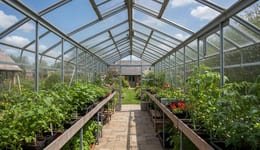
- A 6x4 or 5x8 greenhouse is the single biggest upgrade you can make. Doubles your season and lets you raise your own seedlings instead of buying plug plants.
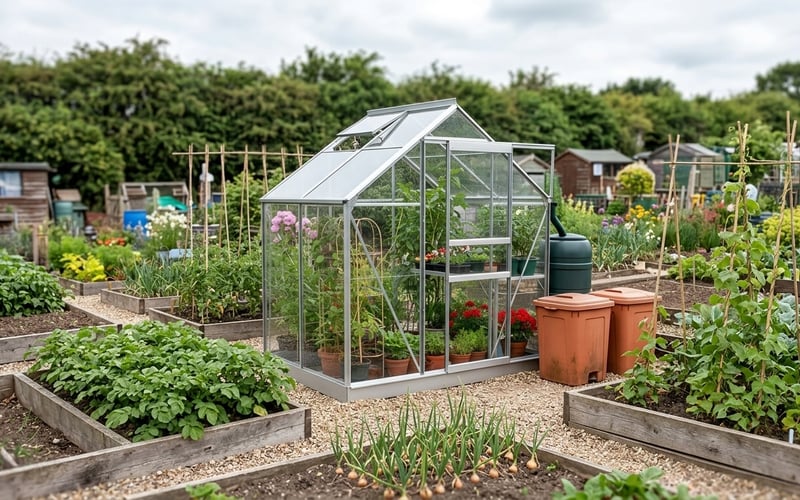
Shop the Vitavia Venus 2500 6x4 Greenhouse →
Expert Tip
From our work with Greenhouse Stores customers since 2012, the new plot holders who succeed in year one all do the same two things. They start with a half-plot (not a full one), and they get a 6x4 or 6x6 greenhouse on site within the first six months. The ones who take a full plot and try to dig it all over by hand in spring almost always burn out by August, and the council notice arrives in October. The greenhouse matters because it doubles your season and lets you raise your own brassicas and tomatoes from seed. Our guide to the best allotment greenhouses covers the sizes and bases that work on a plot. That turns a £85 annual plot rent into £400+ of produce in year one. Without a greenhouse, you are buying £3 plug plants from the garden centre in April like everyone else.
Where do you apply for a UK allotment?
Most UK allotments are let by three types of provider: local councils, parish councils, and self-managed allotment associations. Start with your local council's allotments officer because they hold the definitive waiting list.
Under the Small Holdings and Allotments Act 1908, any UK council (excluding Scotland, which uses the Community Empowerment Act 2015) has a legal duty to provide allotments if six or more registered electors request them in writing. This is the single most underused right in UK gardening. If your council claims there are no allotments available, a formal request signed by six local residents compels them to consider new provision.
For a definitive register of sites, use the National Allotment Society site finder and cross-reference with your council website. The gov.uk apply-for-an-allotment page routes you to the right council form automatically.
How long is the wait for an allotment in the UK?
The UK allotment waiting list varies from zero months (rural Wales and rural Scotland) to over 15 years (some London boroughs). We see three tiers from customer data across our site visits:
Low-demand areas (0-6 months wait): Rural Wales, rural Scotland, the North East, small market towns outside the south. Plots often available immediately. Rents typically £25-£50 per year.
Medium-demand areas (1-3 years wait): Most of England outside the M25, larger towns, university cities. A half-plot usually opens up within 12-18 months if you stay on the list and visit the site manager once a month.
High-demand areas (3-15 years wait): London, Bristol, Edinburgh, Brighton. Some boroughs (Camden, Islington, Lambeth) have closed their waiting lists entirely. Your best route in these areas is garden sharing, a community garden, or moving out one postcode.
Keep your name active on every list within cycling distance. Ring the site manager every 3 months. A friendly face in person moves up the list faster than an online application.
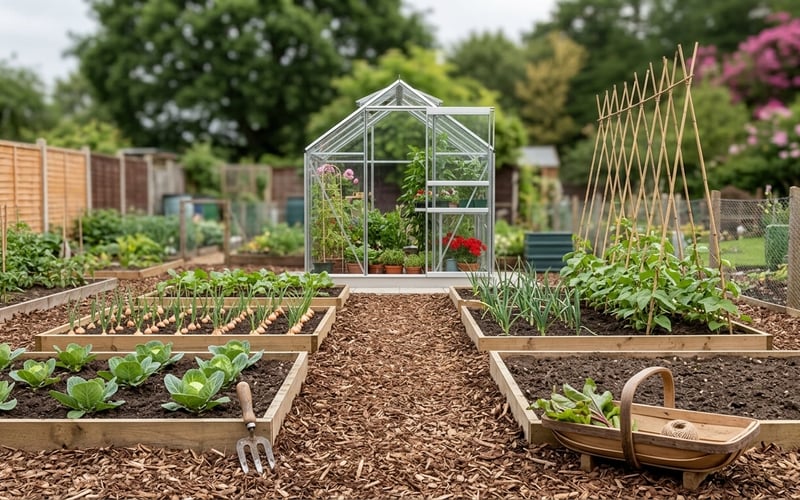
Browse our small allotment greenhouses →
How much does an allotment cost in the UK?
UK allotment rent averages £25-£125 per year for a full plot (250 square metres). Water is usually included in the rent but some sites charge a separate water rate of £10-£30 per year.
Half-plot rent (125 sq m): £15-£65 per year. This is what most new holders start with.
Full plot rent (250 sq m): £25-£125 per year. Senior citizens, disabled holders and students often qualify for a 50% discount.
Setup costs (year one): Budget £300-£800 for basic tools, seeds, fleece, netting and a cheap shed. Add £395-£800 for a 6x4 or 5x8 greenhouse. Add £150-£300 for raised bed timber and compost.
Our greenhouse cost guide breaks down the full-price tiers. For allotment use, avoid anything over 8x6. Larger greenhouses cannot fit on most council plots due to footprint rules and many sites cap greenhouse size at 10% of plot area.
|
Matt's Pick for a New Allotment PlotBest For: First-year plot holders who want to double their growing season without blowing the budget Why I Recommend It: I have fitted over 200 Vitavia Venus 2500 units on UK allotments across the last 15 years. It is 6x4 (1.9m x 1.2m) so it slots inside almost every council site footprint rule. The aluminium frame is anchored to the ground with base plates, not concrete, so you can remove it if you move plots. Horticultural glass is fine on allotments because the site fence deters football damage. One manual roof vent, one door. Fits a full 8-tray propagator on each side. It pays for itself in raised seedlings within the first season. Price: £395 |
What size plot should you ask for?
A standard UK allotment is measured in rods. Ten rods equals 250 square metres (approximately 25m x 10m) and is known as a full plot. Five rods (125 sq m) is a half-plot.
We strongly recommend a half-plot for first-year holders. 125 square metres is still a lot of ground: enough for potatoes, onions, brassicas, legumes and a small soft fruit bed. Cultivating it fully in year one takes 4-6 hours per week from March to October. A full 250 sq m plot takes 8-10 hours per week in summer and breaks most new holders who work full time.
Site rules typically require you to cultivate 75% of your plot within 12 months. Miss the target and the council can serve a notice to quit. A half-plot hit to 75% cultivation is far more achievable than a full plot at 75%. You can always ask for an extension plot later once you have proved you can manage the first one.
What should you put on your plot first?
The order of jobs in your first six months sets your success for the next decade. Here is the sequence we recommend to customers who have just been offered a plot:
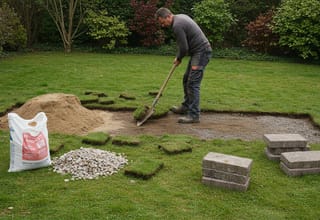
- Month 1: Clear and measure. Mow or strim the whole plot. Mark paths, beds and the greenhouse footprint with string and pegs. Check the council's rulebook for shed and greenhouse limits before you order anything.
- Month 2: Install a compost bin and water butts. You need compost before you need crops. Two 220-litre water butts linked together cover the summer for a half-plot.
- Month 3: Build raised beds and install the greenhouse. Raised beds stop you double-digging every spring and warm up 2-3C faster than ground beds. A 6x4 greenhouse goes up in a day with two people.
- Month 4: Sow under glass. Tomatoes, chillies, peppers, brassicas and lettuce can all start from seed in your new greenhouse. See our seed sowing month-by-month guide.
- Month 5-6: Plant out and mulch paths. Mulched bark or wood chip on paths stops weeds better than any other low-cost solution.
Matt's Installation Tip
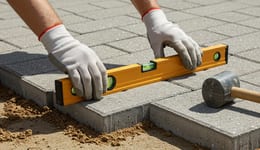
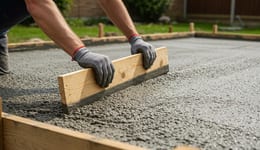
Do not concrete your greenhouse base on an allotment. Council rules usually prohibit permanent foundations and some sites require you to remove everything within 14 days of giving up the plot. Use the manufacturer's bolt-on aluminium base plates and 40mm paving slabs on a compacted sub-base instead. The whole footprint can be dismantled in 90 minutes by two adults. We have seen plot holders lose their deposit when a concrete base pulled the site into dispute with the council.
What greenhouse or cold frame works best on an allotment?
Allotment sites have three unwritten rules: keep it small, keep it removable, and keep it out of the prevailing wind. A 6x4 or 5x8 walk-in aluminium greenhouse meets all three. Below 8x6, you rarely need planning permission from the council provider and the install fits on most plot footprints.
6x4 walk-in greenhouse: The allotment classic. Vitavia Venus 2500 or equivalent. Fits a small bench on each side and has headroom for an average adult. Expect £395-£474 depending on glazing.
5x8 compact greenhouse: A step up if the plot is bigger. Elite Streamline 5x8 at £889 has toughened glass, better ventilation and a longer bench run for chillies and tomatoes.
Cold frames: If the site bans walk-in structures (rare but check), a 6ft cold frame like the Elite Min E Lite 6x2 at £299 gives you hardening-off space and late-winter propagation without the height.
Our full range of mini greenhouses and cold frames covers every plot rule.
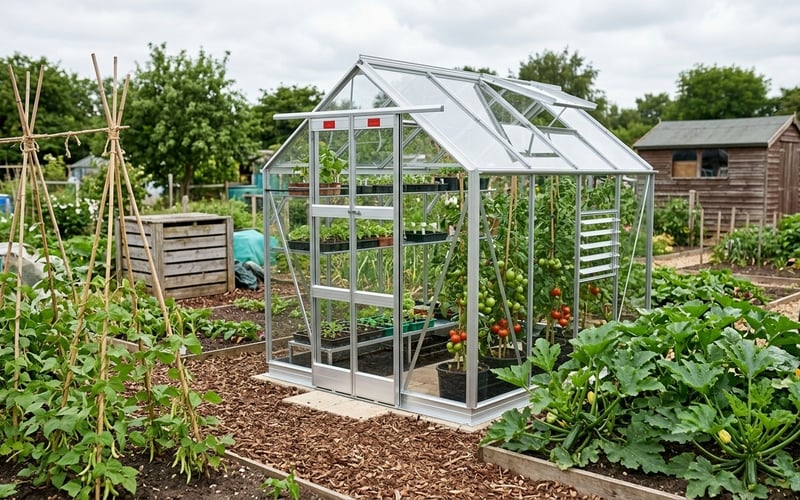
Shop the Elite Streamline 5x8 Greenhouse →
Matt's Tip: Stake the Greenhouse for Allotment Wind
Allotment sites are almost always on open ground with no hedges to break the wind. I have installed Venus 2500 frames that stayed put through the 2022 Eunice storm and others 20 metres away that ended up 30 metres from the plot. The difference was four 600mm galvanised ground anchors, one per corner, driven in before the frame went up. Use the manufacturer's bolt-on base and tie the base down to the anchors with 4mm stainless cable. The whole fix costs under £40 and saves you £400 of glass after the first big blow.
Do you need planning permission for an allotment greenhouse?
Planning permission for allotment structures is rarely required because allotments are covered by the Small Holdings and Allotments Act 1908 and local council rules, not normal Permitted Development. The site provider (usually the council) sets the rules and their written plot agreement is the definitive reference.
Typical council rules across the UK:
- Maximum greenhouse or shed footprint: 10% of plot area (25 sq m on a full plot)
- Maximum ridge height: 2.5 metres
- Structures must be demountable (no concrete pads)
- Materials typically restricted to timber, aluminium, glass, polycarbonate (not plastic sheeting)
- Written permission from the site manager required before installation
Always ask the site manager before you order. Some sites have idiosyncratic rules (no grey aluminium, no double doors, no north-facing openings) that override the general council guidance.
Comparing allotment greenhouse options
The table below compares the sizes most commonly approved on UK allotment sites, with the Matt's Pick highlighted.
| Model | Size | Glazing | Bench run | Price | Matt's verdict |
|---|---|---|---|---|---|
| Vitavia Venus 2500 (Matt's Pick) | 6x4 (1.9m x 1.2m) | 3mm horticultural glass | 1.9m one side | £395 | Best entry-level allotment greenhouse |
| Vitavia Venus 2500 Toughened | 6x4 (1.9m x 1.2m) | 3mm toughened glass | 1.9m one side | £474 | Upgrade for sites with child footfall |
| Elite Streamline 5x8 | 5x8 (1.5m x 2.4m) | 3mm toughened glass | 2.4m one side | £889 | Longer bench run for tomatoes and chillies |
| Elite Compact 4x6 Horticultural | 4x6 (1.2m x 1.9m) | 3mm horticultural glass | 1.9m one side | £619 | Best for very small or starter plots |
| Elite Min E Lite 6x2 Cold Frame | 6ft (1.8m x 0.6m) | Polycarbonate | Low-level trays | £299 | Best where walk-ins are banned |
| Palram Plant Inn 4x4 Raised Cold Frame | 4x4 raised | Polycarbonate | Raised growing bed | £344 | Best if you want a growing bed, not a greenhouse |
Why we recommend starting with a small greenhouse
"From our work with Greenhouse Stores customers since 2012, every single customer who started with a 6x4 or 5x8 came back for a bigger model within three years. None have ever returned theirs. The reason is simple: a small greenhouse lets a new plot holder raise brassicas, tomatoes, chillies and peppers from seed in February and March, which shifts the growing calendar forward by 6-8 weeks. That is the difference between a 7-month and a 9-month cropping season. Plot holders who buy plug plants from the garden centre never see those extra weeks. The Venus 2500 at £395 pays for itself in season one on propagation alone. It is the single best-value investment a new allotment holder can make."
- Matt W, Greenhouse Stores
Frequently asked questions
How do I get an allotment in the UK?
Apply through your local council's allotments officer first. Under the 1908 Allotments Act, councils have a statutory duty to provide plots where demand exists. Use the National Allotment Society site finder, visit every site within cycling distance, and put your name on every waiting list. Expect 12-18 months outside London.
How much does an allotment cost per year?
UK allotment rent is typically £25-£125 per year for a full plot. Half-plots cost £15-£65. Seniors, disabled holders and students often get 50% discount. Water is usually included. London and Edinburgh sit at the top of the range.
How long do I have to wait for an allotment?
UK allotment waits range from zero months in rural areas to 15+ years in London. Most of England outside the M25 sees a 12-18 month wait. Bristol, Brighton and Edinburgh run 3-5 year waits. Garden sharing is the fastest alternative in high-demand areas.
What size plot should I ask for as a beginner?
Take a half-plot (125 square metres, 5 rods) in your first year. A full plot requires 8-10 hours per week in summer and most new holders cannot sustain that alongside full-time work. Prove you can cultivate 75% of a half-plot and the council will offer you more space later.
Can I put a greenhouse on my allotment?
Yes, most UK councils allow a greenhouse up to 10% of the plot footprint. Ridge height is usually capped at 2.5 metres and structures must be demountable (no concrete base). Get written approval from the site manager before ordering. A 6x4 aluminium greenhouse fits almost every site rule.
Do I need planning permission for an allotment shed or greenhouse?
Council allotment rules apply, not normal planning permission. The site's plot agreement sets the limits on size, height and materials. Typical caps are 2.5m ridge height and 25 square metres footprint on a full plot. Check with the site manager before you buy.
What should I grow on my allotment in year one?
Start with low-maintenance crops that hide weeds and produce reliably. Potatoes, onions, garlic, runner beans, brassicas and courgettes suit first-year plots. Avoid anything that needs constant watering (celery, cauliflower) until you have set up water butts and mulched paths.
What happens if I cannot look after my allotment?
Most UK councils serve a formal notice to quit after two cultivation warnings. If 75% of the plot is uncultivated for 12 weeks, expect a written warning. A second warning 12 weeks later usually ends the tenancy. Hand it back proactively if you cannot manage the workload: you can reapply later.