Greenhouse Seed Sowing: UK Month-by-Month Guide
Greenhouse seed sowing in the UK extends the growing season by 4-6 weeks at either end compared to sowing direct outdoors. Heated propagators start tomatoes, peppers, and aubergines in late January-February. Unheated greenhouse sowing begins in March for hardy crops and late April for tender ones. Soil needs to hit 15-21°C for reliable germination. After installing greenhouses for over 500 UK growers, Matt's best-performing sowing calendar is set out below.
Key Takeaways
- Heated propagator starts January. Tomatoes, peppers, and aubergines need 20°C+ soil from day one.
- Unheated greenhouse starts March. Hardy annuals, brassicas, lettuces — 4-6 weeks earlier than outdoor sowing.
- Soil thermometer beats calendar. Germination failure on a dozen named crops tracks soil temperature, not the date.
- Modular tray frames double your capacity. A 3-tier Elite rig fits 6-12 seed trays in the footprint of 2.
- Bottom heat lifts germination 30-50%. Propagator base under a seed tray is the single biggest kit upgrade.
- Harden off before moving outside. Two weeks in an open coldframe or porch prevents shock losses.
Installer's Note
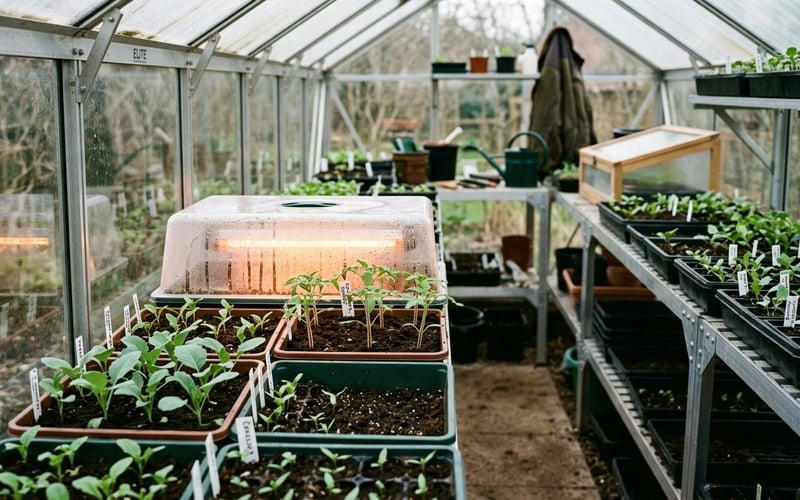
The single biggest seed-sowing mistake I see in customer greenhouses is ignoring soil temperature. Growers follow a generic sowing calendar, sow tomatoes in February, then lose 40-60% of the batch because the compost never climbed above 12°C. Spending £26 on a soil thermometer and waiting for 20°C solves it. The second mistake is unheated sowing in a cold corner of the greenhouse floor — always sow on elevated staging where rising warm air circulates.
January — heated propagator only
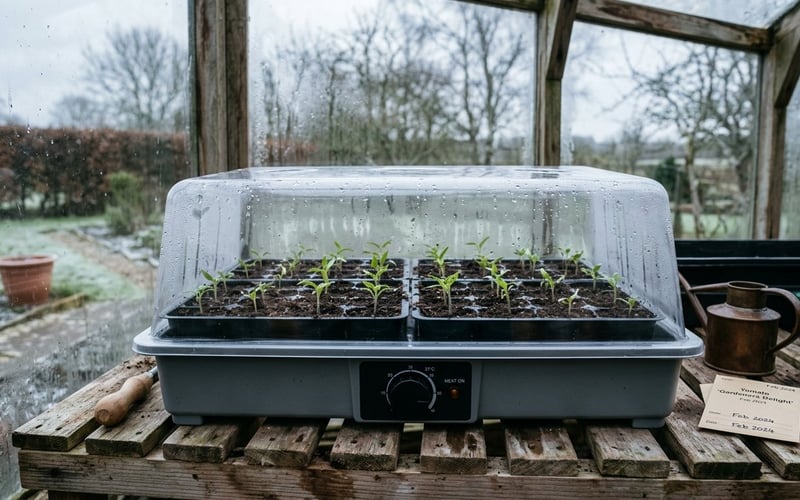
Only propagator-heated sowing works in January across the UK. Greenhouse ambient temperatures still drop below freezing overnight in most of the country, so seed trays must sit on a thermostat-controlled base.
Sow at 20-22°C soil temperature: chilli peppers (the slowest, need 120+ days to ripen), aubergines, and early tomato varieties. Use cell trays over open trays so each seedling's root ball stays compact when you pot on in March.
Check our heating cost guide before investing — a modest propagator running 24/7 for 10 weeks costs around £8-£12 in electricity.
February — start of the main season
February brings reliable heated sowing across all tender crops. Propagator at 20°C handles tomatoes (all varieties), peppers, aubergines, and basil. In an unheated greenhouse with bubble wrap insulation, early brassicas and lettuces germinate reliably in the last week of February provided nights stay above -2°C.
Keep propagator lids on until 70% of seeds have shown first true leaves. Premature lid removal drops humidity and stalls growth. See our greenhouse insulation guide for keeping night temperatures above freezing without a heater.
March — unheated greenhouse opens
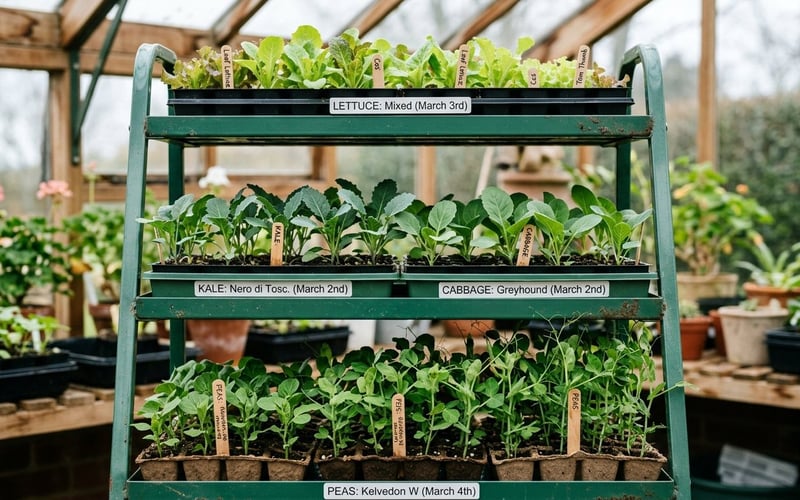
March is the month an unheated greenhouse genuinely pulls its weight. Soil warms above 10°C on south-facing staging. Hardy crops germinate without bottom heat: lettuce, spinach, kale, cabbage, cauliflower, onions (from seed), peas, broad beans, and most hardy annuals.
Move January and February propagator batches off heat and onto open staging. First potting-on happens here: 9cm pots for tomatoes, 7cm for peppers. This is the busiest month in the sowing calendar — expect to spend 3-5 hours per week on seedling care.
April — transition to outdoor hardening
April sees greenhouse staging at maximum density. Earlier sowings need hardening off for outdoor planting from mid-April. Open coldframes or the greenhouse with all vents open by day provide the step-down in temperature and wind exposure.
April sowing covers tender annuals (cosmos, zinnias, cleome), French and runner beans for May planting out, courgettes and squashes (these need their own propagator cell because they dislike root disturbance), and late brassicas for autumn harvest.
May — last indoor sowings, first plantings out
After the last frost date (varies UK region: mid-May south, end of May north), tender crops move to final greenhouse borders or outdoor beds. Sowing activity drops as focus shifts to transplanting and trellising.
Final seed sowing for: sweetcorn (sow direct into final pots), cucumbers and melons for greenhouse borders, late lettuce, and French beans for succession. First tomatoes planted in ring culture or grow bags. See our greenhouse tomato guide for the full growing calendar.
June to August — succession sowing only
Peak summer greenhouse use shifts from propagation to fruiting crops. Seed sowing drops to succession work: salad leaves every 2-3 weeks, coriander, dwarf French beans, and autumn/winter brassicas started in July for October planting.
Heat stress is the main issue: keep propagator use to a minimum because ambient temperatures already sit at 25-30°C by day. Germination of cool-season crops like lettuce fails above 24°C — sow in the coolest corner of the greenhouse or outside in a shaded coldframe.
September to December — winter sowings
September is the best month of the year for greenhouse winter crop sowing. Soil is still warm from summer, days are shorter (triggering cold-tolerant crops), and pest pressure drops. Sow: winter lettuces (Winter Density, Arctic King), spring onions, winter hardy cabbage, and salad leaves.
October sowings under cover: broad beans (Aquadulce Claudia for autumn-sown), hardy peas (Meteor), and garlic cloves. November and December are dormancy months — heated propagator only, restart the January cycle with chillies.
Matt's Tip: the £26 upgrade most growers skip
A proper soil thermometer changes everything. Seven out of ten customers who ring me about germination failures are sowing at the wrong soil temperature. They assume air temperature is close enough. In a UK unheated greenhouse in early March, air can read 15°C at midday while compost sits at 8°C all day. A Vitavia Soil Thermometer costs £34 and pays for itself in the first saved seed tray.
Monthly sowing reference table
| Month | Propagator (20°C) | Unheated greenhouse | Key tasks |
|---|---|---|---|
| Jan | Chillies, aubergines, early tomatoes | None | Propagator setup, clean trays |
| Feb | Tomatoes, peppers, basil | Late Feb: lettuce, early brassicas | Monitor lids, humidity |
| Mar | Continue tender crops | Most hardy crops, annuals, alliums | First potting on |
| Apr | Courgettes, squashes, cucumbers | Tender annuals, beans, late brassicas | Start hardening off |
| May | Final tender batch | Sweetcorn, cucumbers, succession lettuce | Plant out tomatoes |
| Jun-Aug | Minimal (heat stress) | Salad succession, autumn brassicas | Focus on fruiting crops |
| Sep-Oct | None | Winter lettuces, broad beans, garlic | Clean up summer crops |
| Nov-Dec | Start chillies end of Dec | None | Insulate, clean trays |
Matt's Pick: the kit that transforms seed sowing capacity
| Matt's Pick for serious greenhouse seed sowing | |
| Best for | 6ft to 10ft wide greenhouses wanting to triple seed tray capacity without extending the greenhouse |
| Why I recommend it | The Elite 3 Tier 6 Seed Tray Frame fits six standard seed trays in the footprint of two. I've installed it in over 40 customer greenhouses and it solves the March capacity crunch every time. Powder-coated aluminium, rigid, and takes propagator bases on the bottom shelf where warm air pools. |
| Price | From £98 |
| Link | View the Elite 3 Tier 6 Seed Tray Frame |
How greenhouse sowing compares to windowsill and outdoor
| Method | Earliest start | Space | Success rate on tomatoes | Cost |
|---|---|---|---|---|
| Windowsill | Feb | 1-2 trays | 50-70% | Free |
| Unheated greenhouse | Late Feb (hardy only) | 6-20 trays on staging | 80-90% | Greenhouse base cost |
| Heated propagator in greenhouse | Jan | Limited only by propagator size | 90-95% | Propagator + £8-12/season running |
| Outdoor direct | Late April | Unlimited | 40-60% | Free |
Frequently asked questions
When can I start sowing seeds in an unheated greenhouse?
Unheated greenhouse sowing starts in late February for hardy crops and March for most others. Soil temperature must reach 10°C on average for reliable germination. An insulated greenhouse with bubble wrap holds 3-5°C above outside air overnight. Check soil temperature with a thermometer before sowing — it lags air temperature by 5-7 days in early spring.
What soil temperature do seeds need to germinate?
Most UK crop seeds need 15-21°C soil to germinate reliably. Tomatoes, peppers, and aubergines need 20°C+ and fail below 15°C. Lettuce germinates at 10-15°C but fails above 24°C (summer bolting). Brassicas germinate at 15-20°C. Always measure compost temperature, not air temperature — they differ by 3-8°C in spring greenhouses.
Do I need a propagator or just a heated greenhouse?
A propagator is more efficient than heating a whole greenhouse. A typical 80W propagator costs £8-12 to run per month keeping 2-4 seed trays at 20°C. Heating an entire 6x8 greenhouse to the same temperature runs £80-150 per month. Propagator-plus-insulated-greenhouse is the cheapest way to start tender crops in January.
Can I sow tomatoes in January in a greenhouse?
Yes, but only in a heated propagator. Greenhouse ambient temperatures still drop below freezing in January across most of the UK. Propagator at 20-22°C germinates tomato seeds in 7-10 days. Move seedlings to open staging at first true leaf stage and continue propagator use for pepper and aubergine batches.
How do I harden off greenhouse seedlings?
Harden off over 10-14 days by gradually exposing seedlings to outdoor conditions. Start with an open greenhouse door all day, then move plants to a coldframe with lid open in day, closed at night. After 7 days open the frame lid overnight in frost-free weather. At day 14, plants are ready for final outdoor positions. Skipping this step causes wilting and stunted growth.
What is the biggest seed sowing mistake UK growers make?
Sowing too early without soil temperature data. Every February I get calls from customers whose February tomato batch failed. They sowed following a generic calendar, but compost in an unheated greenhouse was still 10-12°C. Tomatoes germinate poorly below 15°C and hardly at all below 12°C. A soil thermometer and a propagator fix this.
How many seed trays fit in a 6x8 greenhouse?
A standard 6ft by 8ft greenhouse fits 8-12 seed trays on single-tier staging, or 24-36 trays on a 3-tier frame system. Add propagator capacity separately (usually 2-4 trays on heated base). Most customers hit a capacity ceiling in March when spring sowings overlap with potting-on of earlier batches — that's when modular tier systems pay off.