How to String and Support Tomatoes in a Greenhouse: UK Step-by-Step Guide
Stringing tomatoes in a greenhouse gives each plant a vertical growing guide that lasts the whole season. After fitting greenhouses for over a decade and growing cordon tomatoes in every one we install, we've found overhead string outperforms canes for support, airflow, and yield. The technique uses a simple twist around the stem, anchored to a hook in the roof bar. This guide covers the full stringing process: which hooks fit which greenhouses, when to start training, how to tie the twist correctly, and how to sideshoot while the plant climbs.
Key Takeaways
- Overhead string is best for cordon tomatoes: A single length of jute twine tied to a roof hook supports plants 2m+ tall without bending
- Start stringing at the first truss: Usually late May when plants reach 40-50cm tall and flowers begin setting
- Use the twist technique: Wind the string clockwise around the main stem, one twist every 15cm - never tie knots around the stem itself
- One plant carries 8-10kg at full load: Hooks must be rated accordingly and fixed into the glazing bar channel, not the glass
- Remove sideshoots weekly: Pinch out shoots growing at 45° from leaf joints so the plant sends energy into fruit, not foliage
- String beats canes: No snapping in high winds, no sideways lean, and no wasted floor space from cane bases
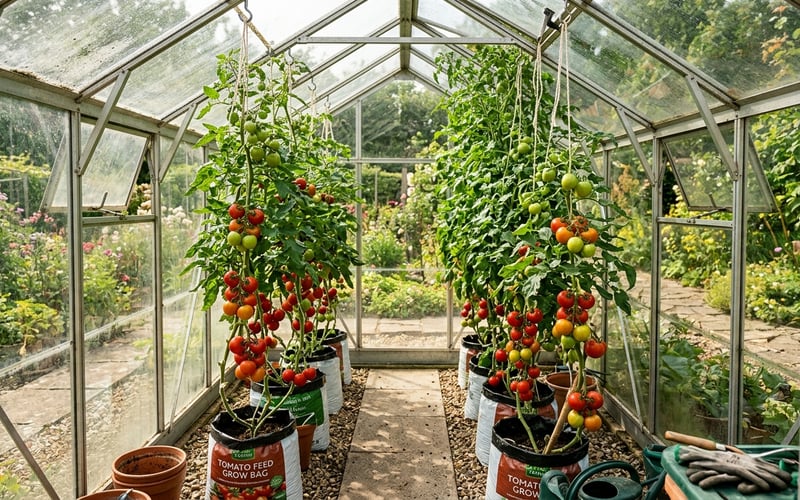
Installer's Note
Every greenhouse we install has the same conversation at handover: how do you support the tomatoes? Customers reach for canes because that's what they know. The problem is canes snap when a plant hits 2 metres with 8kg of fruit hanging off it. We always demonstrate the stringing method before we leave. Fix a hook into the ridge bar channel, tie a length of jute twine to it, let the string hang down to the base of the plant, and twist it around the stem as it grows. It takes less time to set up than a cane and lasts all season. The first thing I do in my own greenhouse in May is run string down for every tomato plant.
Why string beats canes for greenhouse tomatoes
Bamboo canes were the standard for decades because that's what garden centres sold. In a greenhouse, canes fall short in four ways:
- Height limit: Most canes top out at 1.8m. A healthy cordon tomato reaches 2.2-2.5m under glass
- Weak base: A cane pushed into a grow bag only anchors 10-15cm deep. That's not enough when the plant carries 8kg of fruit
- Wasted space: Canes lean outward as the plant grows, blocking walkways and shading neighbouring plants
- Breakage: Bamboo snaps at the weakest joint, usually when the plant is fully loaded in August - the worst possible time
String solves all four problems. The anchor point sits overhead in the roof bar, so height is unlimited. The weight hangs vertically, pulling the plant straight up rather than leaning. You lose no floor space. And jute twine is strong enough that it never fails under normal loads.
Our full greenhouse tomato growing guide covers the complete season from sowing to harvest, but the single biggest yield improvement you can make is switching from canes to overhead string.
Screwhooks: the foundation of any stringing system
Every stringing system starts with an overhead anchor point. The best type for most greenhouses is a twist-fit screwhook that slots directly into the aluminium glazing bar channel. No drilling, no damage to the frame, and you can reposition them season by season.
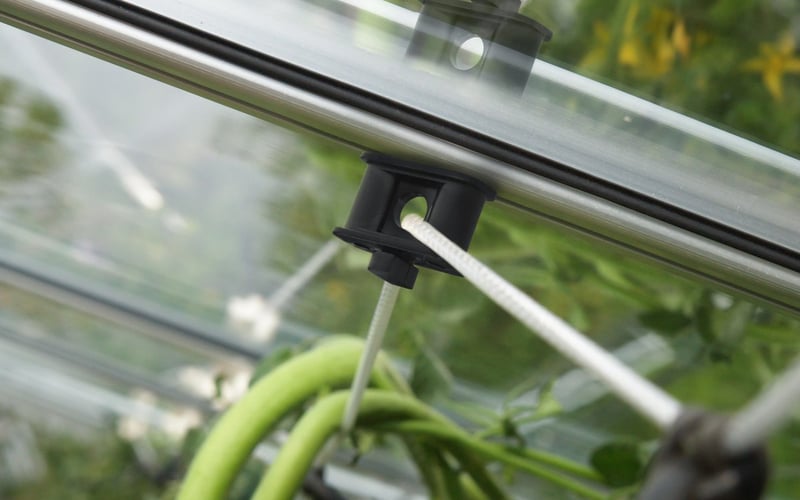
Vitavia Screwhooks fit the 25mm glazing bar channel found on Vitavia greenhouses. A pack of 10 costs £17 and each hook is rated to 5kg - enough for a single cordon tomato. Thread each one clockwise into the channel until the rubber washer sits firm against the bar. That washer is the critical bit: it stops the hook backing out under load.
For heavier cropping or horizontal wire runs, space screwhooks every 60cm along the ridge bar and stretch 1.5mm galvanised wire between them. The wire distributes weight across multiple fixing points and lets you tie several plants to a single wire run rather than individual hooks.
Hooks for palram canopia greenhouses
Palram greenhouses use a 16mm polycarbonate bar profile that standard aluminium hooks don't fit. Palram makes a dedicated trellising kit that comes with roller hooks, tomato clips, and training parts specifically engineered for their frames.
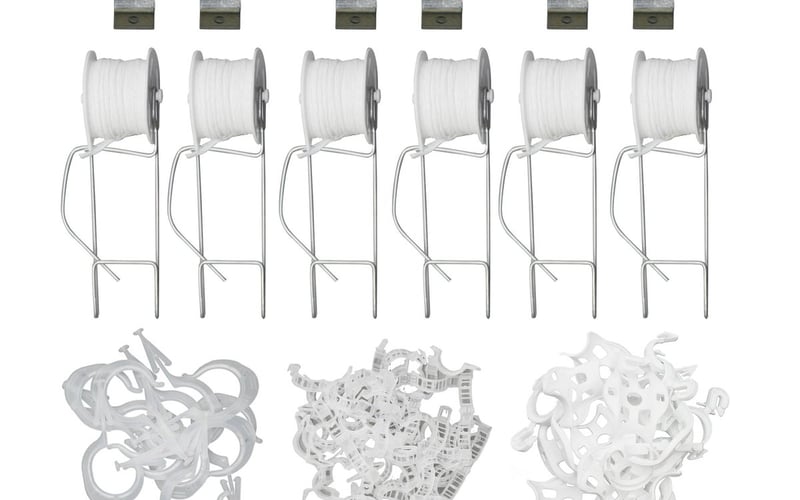
Shop the Palram Canopia Trellising Kit Pro →
The kit includes 6 roller hooks, 48 tomato clips, 12 radial support hooks, and metal shims that attach without drilling the polycarbonate. Roller hooks are the clever bit - they let you lower the plant and feed the lower stem along the ground as it outgrows the greenhouse height, extending the harvest by several weeks.
Hooks and tying eyes for elite greenhouses
Elite greenhouses use a slightly different channel profile. Elite make two options: plain hooks for insulation and shading, and dual-purpose tying eyes designed for heavy cropping.
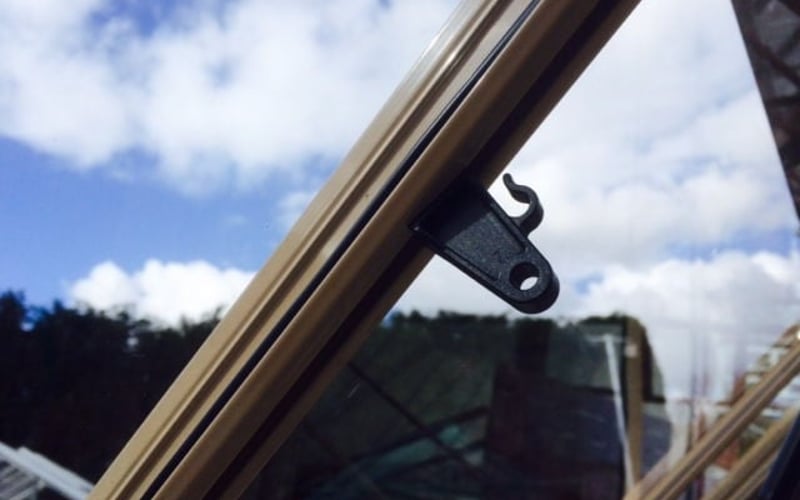
Tying eyes have both a hook and an eye on each unit. The eye lets you run horizontal training wire between multiple points - this is how commercial greenhouses support cordon crops. A mature tomato plant reaches 8-10kg by late summer, and a wire system distributes that weight across several fixing points rather than a single hook. For smaller plant counts or lighter training duty, the plain Elite lining hooks work fine:
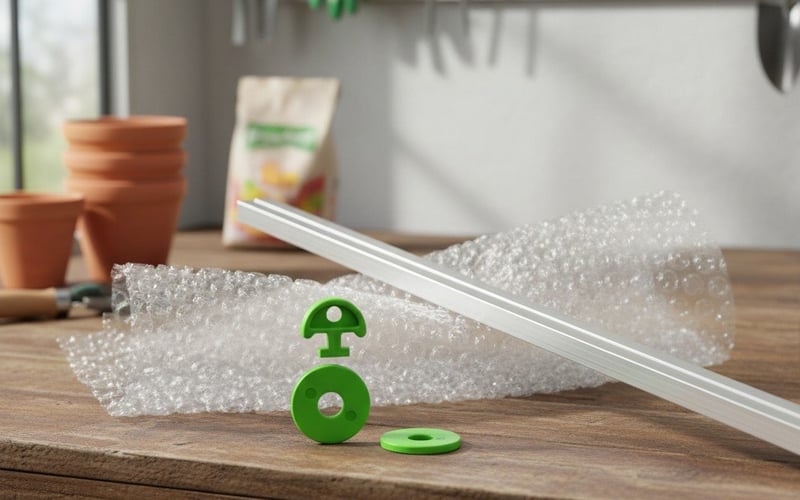
Browse the full string tomatoes greenhouse accessory range for Vitavia, Elite, and Palram greenhouses.
When to start stringing tomato plants
Timing matters. Start stringing too early and the plant is too flimsy to hold itself up even with support. Start too late and the plant sprawls sideways before you catch it. The window is tight:
| Plant Stage | Plant Height | What to Do |
|---|---|---|
| Seedling in pot | 15-30cm | No support needed. Let the stem thicken |
| Planted out, first truss forming | 40-50cm | Install hook overhead. Tie string to hook, let it hang to base |
| First flowers open | 50-70cm | Start the twist. Wind string clockwise up the main stem |
| Fruit setting | 80-120cm | Continue twisting weekly. Pinch out sideshoots |
| Mature plant | 150-220cm | Final twisting. Plant now carries full fruit load |
For most UK growers, this means starting between mid-May and early June depending on when you planted out. Our best tomato varieties guide covers which cordon types respond best to this training - Sungold, Shirley, and Moneymaker are all ideal candidates.
How to tie the twist: step by step
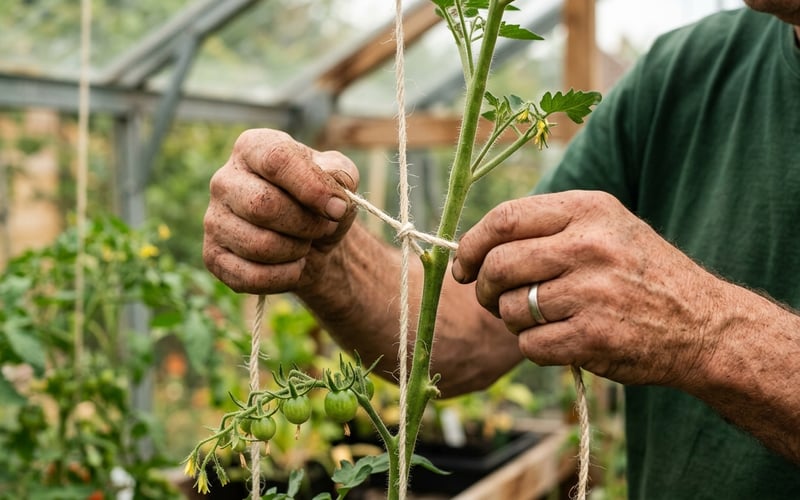
The twist technique takes two minutes per plant to learn and lasts the whole season. Here's the exact method we use:
- Fix the hook: Twist a screwhook into the ridge bar channel directly above the base of the plant. Push until the rubber washer is firm against the bar
- Cut the string: Use natural jute twine, around 2.5-3 metres long per plant. That gives you slack for a 2.2m plant plus tying off
- Tie to the hook: Loop the top of the string through the hook with a simple double knot. Make it tight - this is the only knot in the whole system
- Anchor at the base: Loop the bottom of the string loosely around the base of the stem, at ground level. Leave a 10cm tail of slack
- Start the twist: Hold the main stem in one hand and the string in the other. Wind the string clockwise around the stem, one full turn every 15cm of height
- Keep tension light: The string should touch the stem on all sides but never pinch it. A stem that's too tight will damage the cambium layer and stop nutrient flow
- Never tie knots on the stem: The twist holds itself. Knots cut into the stem as it grows and can sever a mature plant clean through
- Repeat weekly: Every week, continue the twist upward as the plant grows. One new twist per 15cm of new growth
Matt's Tip: The Base Slack Trick
Leave 10cm of slack coiled at the base of the plant when you first tie it off. As the season goes on, the stem gets thicker and the plant gets heavier. That slack lets you unwind a little length and re-twist from a higher point if the original base tie starts to strangle the stem. I learned this the hard way after losing two plants in 2019 to stem strangulation. Now I always leave base slack.
Sideshooting while stringing
A cordon tomato produces sideshoots at every leaf joint. Each one wants to become a new branch with its own trusses. If you let them grow, you end up with a sprawling bush that splits the plant's energy across dozens of weak fruit trusses.
Sideshoot rules:
- Check every plant twice a week from the first truss onwards
- Pinch out any shoot growing at 45° from a leaf joint (between the main stem and a leaf)
- Do it when the shoot is 2-5cm long - large enough to grip, small enough to snap cleanly
- Use clean fingers, not scissors - tearing the base seals the wound faster than a cut
- Never remove the leaves themselves, only the shoots growing from leaf axils
Our cucumber growing guide covers the same twist-and-sideshoot technique - cucumbers respond to stringing even better than tomatoes because their stems are lighter and their fruits hang straight down from the main vine.
Weight, load, and when to upgrade your hooks
A single cordon tomato plant in full production carries 8-10kg of fruit and stem at peak season. That's the equivalent of a bag of compost hanging from one hook. Most greenhouse screwhooks are rated between 5kg and 7kg individually, which is why spacing matters.
| Setup | Plants Supported | Best For |
|---|---|---|
| Single hook per plant | 1 plant per hook | Small greenhouses, 2-4 plants total |
| Hook plus wire runs | 6-10 plants per 3m wire run | Medium greenhouses, mixed crops |
| Tying eyes with steel cable | Unlimited (commercial scale) | Large greenhouses, serious cropping |
| Palram Trellising Kit | 6 plants per kit | Palram Canopia polycarbonate greenhouses |
The warning sign for hook failure is the rubber washer slipping. If you see a hook starting to rotate or the string angle changing, replace or relocate it immediately. Our common greenhouse mistakes guide covers hook failures as one of the top five avoidable problems in UK greenhouse growing.
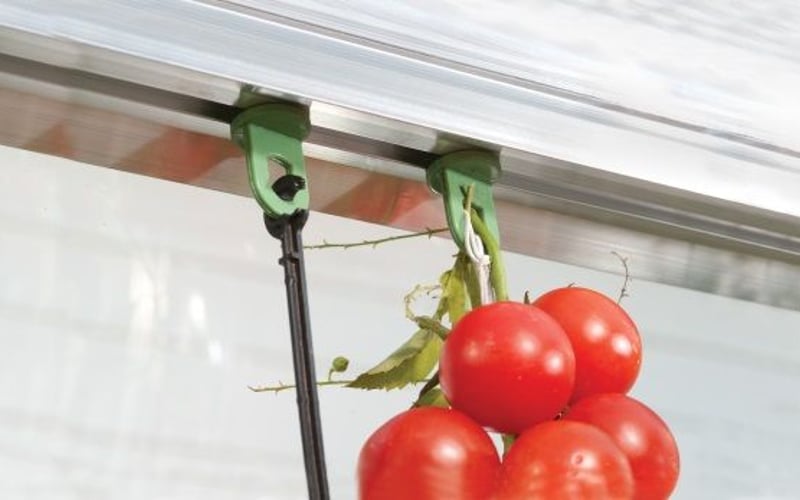
Shop the Palram Plant Hangers →
For Palram Canopia owners who want individual hangers rather than the full trellising kit, the plant hangers give you 10 anchor points that fit Palram's polycarbonate glazing bar profile directly.
|
Matt's pick for stringing tomatoesBest For: Stringing cordon tomatoes, cucumbers, and vine crops in Vitavia greenhouses Why I Recommend It: This is the exact hook I use in my own greenhouse. A pack of 10 covers two full seasons of tomatoes in a 6x8. The rubber washer holds tight under a fully loaded 10kg plant and twist-fits in 5 seconds per hook. No drilling, no glass damage, no excuses. Price: £17 |
String vs cane vs cage: the full comparison
| Support Method | Max Height | Best For | Weaknesses |
|---|---|---|---|
| Overhead string | Unlimited (2.5m+) | Cordon tomatoes in greenhouses with roof hooks | Needs overhead anchor point |
| Bamboo cane | 1.8m practical max | Short-season outdoor tomatoes, bush varieties | Snaps under weight, leans, limits height |
| Wire cage | 1.2-1.5m | Outdoor bush or dwarf varieties only | Too short for cordons, hard to sideshoot inside |
| Spiral support | 1.5m | Patio container tomatoes | Plants grow through the spiral and can't be removed |
| Training wire system | Unlimited | Commercial or multi-plant setups | Needs installation time and multiple fixings |
For greenhouse cordon tomatoes, overhead string wins outright. It's the cheapest, most space-efficient, and most reliable method. The only time we recommend another option is for bush or dwarf varieties which don't grow tall enough to need stringing - but these are rare in UK greenhouse growing because they crop less heavily than cordons.
Common stringing mistakes (and how to fix them)
Mistake 1: Tying the string too tight. A tight string cuts into the stem as the plant grows and can girdle the plant completely. Always use the twist, never knots.
Mistake 2: Starting too late. If you wait until the plant is 1m tall and leaning sideways, you can't straighten it without snapping the stem. Start at 40-50cm.
Mistake 3: Using the wrong string. Synthetic polypropylene is strong but slippery - the twist unwinds. Natural jute twine grips the stem and holds its position.
Mistake 4: Single hook for multiple plants. Two plants on one hook doubles the load and usually pulls the hook out. One plant per hook, or use a wire run.
Mistake 5: Ignoring sideshoots. A cordon tomato with sideshoots left on becomes a bush. You lose yield, airflow, and the whole point of stringing. Sideshoot weekly without fail.
Frequently asked questions
What is the best way to support tomatoes in a greenhouse?
Overhead string is the best way to support cordon tomatoes in a greenhouse. Fix a screwhook into the roof bar channel directly above each plant, tie a length of jute twine to the hook, and twist the string clockwise around the main stem as the plant grows. This method supports plants over 2 metres tall, carries the full 8-10kg fruit load, and wastes no floor space. Canes and cages don't work for greenhouse cordons because they're too short and too weak.
When should I start stringing up my tomato plants?
Start stringing tomatoes when the first truss forms, usually at 40-50cm tall. In most UK greenhouses this is mid-May to early June, depending on when you planted out. Fix the overhead hook first, tie the string, then start the twist once the plant has 4-6 true leaves. Starting later than this risks the plant sprawling sideways before you can train it vertical.
What kind of string is best for tying tomato plants?
Natural jute twine is the best string for tying tomato plants. It grips the stem, doesn't slip, breaks down at the end of the season, and is strong enough to hold a 10kg plant. Avoid synthetic polypropylene which slips and unwinds from the stem, and avoid raffia which snaps under heavy loads. A 150m ball of jute twine costs around £5 and supports a full greenhouse of tomatoes for one season.
How do you tie a tomato plant to a string?
Never tie knots directly around the tomato stem - use the twist method instead. Anchor the string to a roof hook at the top and loop it loosely around the base of the stem. Then wind the string clockwise around the main stem as it grows, one full turn every 15cm of height. The twist holds itself through friction alone. Knots cut into the stem as it thickens and can sever a mature plant.
How much weight can a greenhouse screwhook hold?
Standard greenhouse screwhooks are rated between 5kg and 7kg each. A single cordon tomato plant at peak cropping weighs 8-10kg. This means you should use one hook per plant for lighter varieties, or upgrade to tying eyes with training wire for heavier crops. For plants carrying more than 7kg, space multiple hooks across the roof bar or run horizontal training wire to distribute the load.
Can you grow tomatoes in a greenhouse without stringing?
You can grow bush or determinate tomato varieties without stringing, but cordon varieties will fail. Cordon tomatoes grow indeterminately and need vertical support to carry their fruit load. Without stringing, they collapse sideways by mid-July and most of the lower fruit ends up on the ground. Bush varieties like 'Tumbling Tom' stop growing at 60-80cm and can be grown in pots without support, but they produce less than half the yield of a strung cordon plant.