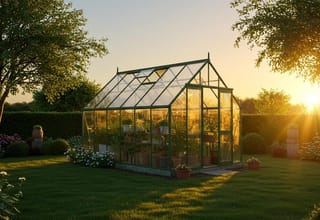
Small Garden Greenhouses: Sizes and Space Guide
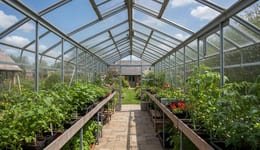
A small garden can accommodate a greenhouse when its actual dimensions leave enough room for access and installation. The Elite Compact 4x4 measures 1,300 × 1,351mm. The Vitavia IDA 900 projects 690mm from a suitable wall. Choose between them by measuring the usable ground, checking sunlight and planning your working space. A model's advertised size alone cannot tell you whether it fits.
Key Takeaways
- The Elite Compact 4x4 needs a minimum base of 1,300 × 1,351mm, plus working clearance.
- The IDA 900 measures 1,320mm along the wall and projects 690mm into the garden.
- Sliding doors avoid a swinging leaf, but you still need somewhere to stand and carry pots.
- A lean-to uses a wall; it does not automatically halve the space required.
- Check the base, glazing and ventilation before comparing the final delivered price.
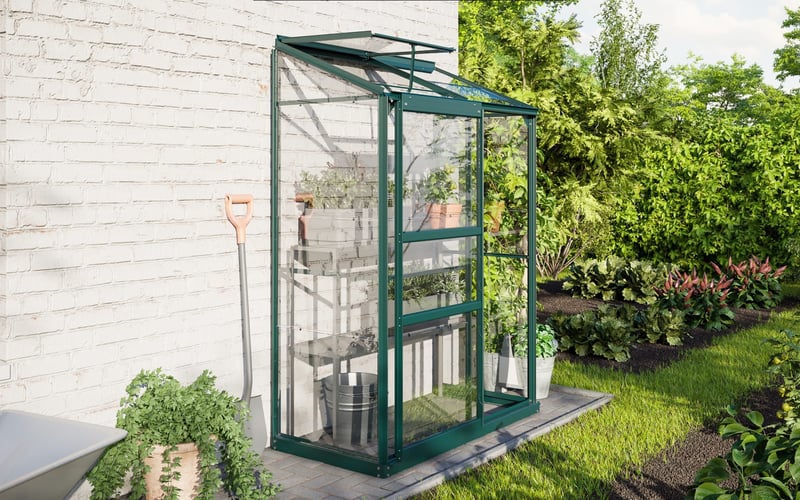
Shop the green Vitavia IDA 900 →
Installer's Note
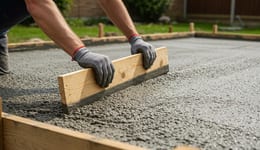
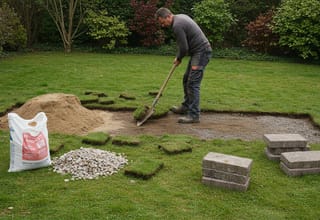
Greenhouse Stores has professionally installed more than 3,000 greenhouses since 2012. For a tight plot, check the installation requirements before ordering. Elite's installation terms specify a level base and sufficient working clearance around the structure. An undersized or inaccessible base can prevent installation and lead to a return-visit charge.
How much space does a small greenhouse really need?
The space required includes the structure, its access route and the area needed to assemble and maintain it.
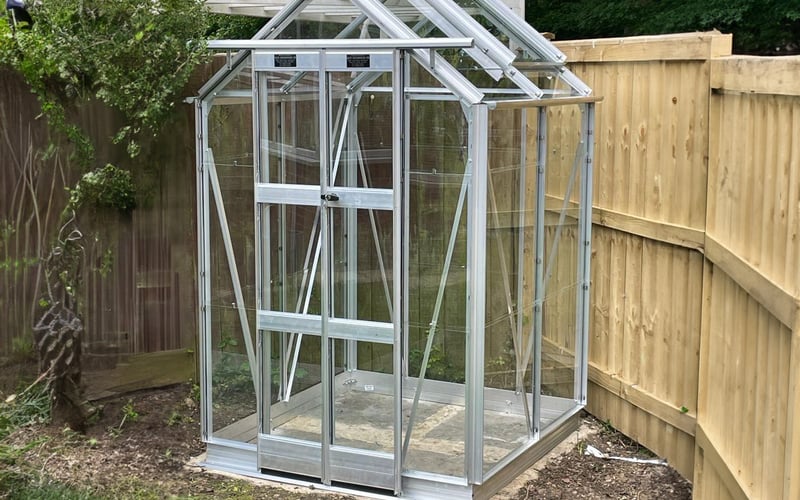
Start with the product's dimension drawing. For the Elite Compact, the minimum base is 1,300 × 1,351mm. Its sliding doors have a 600 × 1,750mm aperture. That door width matters when you carry a tray or watering can.
Here is a worked planning example using 600mm clearance on every side. Width becomes 1,300 + 600 + 600 = 2,500mm. Depth becomes 1,351 + 600 + 600 = 2,551mm. The resulting area is about 6.38m², including clearance. This is an illustrative layout, not a universal installation specification. Confirm the required space with your installer before building the base.
Mark both rectangles on the ground. Walk around them with your largest pot. Our greenhouse size guide helps compare the internal layouts.
Which small greenhouse suits your available space?
A narrow wall-side strip suits a shallow lean-to; an open corner may accommodate a compact freestanding model.
These dimensions come from the current Greenhouse Stores product records. Width means the front width for freestanding models and the wall run for lean-tos. Depth is the distance from front to back, or the projection from the wall.
The Windsor needs particular care: its overall width differs from its listed minimum base width. Use the base drawing for construction and the overall dimensions for clearance. Leave space for gutters and open vents too.
| Model/option | Width × depth | Ridge / eaves | Door aperture | Key spec | Price | Matt's verdict |
|---|---|---|---|---|---|---|
| Elite Compact 4x4 horticultural | 1,300 × 1,351mm | 2,122 / 1,553mm | 600 × 1,750mm | 3mm glass; double sliding doors; one roof vent | £589 | Pick for an open corner with confirmed access. |
| Vitavia IDA 900 green toughened | 1,320 × 690mm | 1,840 / 1,520mm* | 610 × 1,506mm | 3mm glass; sliding door; one roof vent | £339 | Shallow option for a suitable wall. |
| Vitavia Venus 2500 green toughened | 1,930 × 1,310mm | 1,970 / 1,240mm | 610 × 1,650mm | 3mm glass; sliding door; one roof vent | £519 | More width, with lower eaves to consider. |
| Elite Windsor 4x4 toughened | 1,346 × 1,297mm | 2,010 / 1,590mm* | 600 × 1,600mm | 3mm glass; sliding door; one roof vent | £649 | Deeper lean-to; check its end-door approach. |
*IDA and Windsor heights exclude their optional base plinths. Prices refer to the listed configurations; check selected extras before ordering.
Use these measurements to shortlist small greenhouses. Check the final model drawing before committing any space.
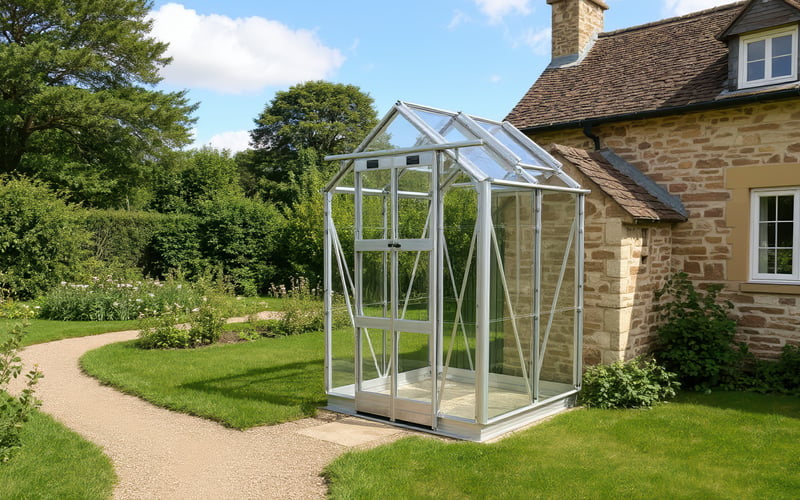 |
Matt's Pick for an open garden cornerBest for: A freestanding layout where a wall-mounted greenhouse would be awkward. Why I recommend it: I would choose the Compact for its 1,300mm width and low-threshold, double sliding doors. Check whether its 600mm opening suits your access needs. This configuration has horticultural glass; consider toughened glazing beside busy paths. Price: £589 |
Will a lean-to fit beside your house?
A lean-to can fit a narrow space if the wall, access and light are suitable.
The IDA 900's 690mm depth is useful where a full-width greenhouse would block the garden. However, its 1,506mm door aperture is low. Check whether you can reach the plants comfortably before choosing it.
A wall-mounted greenhouse needs suitable fixings and a sound supporting surface. Check for pipes, air bricks and opening windows. Keep access to drains and services. Roof flashing and weatherproofing may require separate work.
The wall does not reduce the greenhouse's floor area by half. Compare actual projections instead. The Windsor projects 1,297mm, almost twice the IDA's depth. It serves a different space requirement.
Planning treatment also depends on how the structure joins the house. Read our house-attached greenhouse planning guide before ordering.
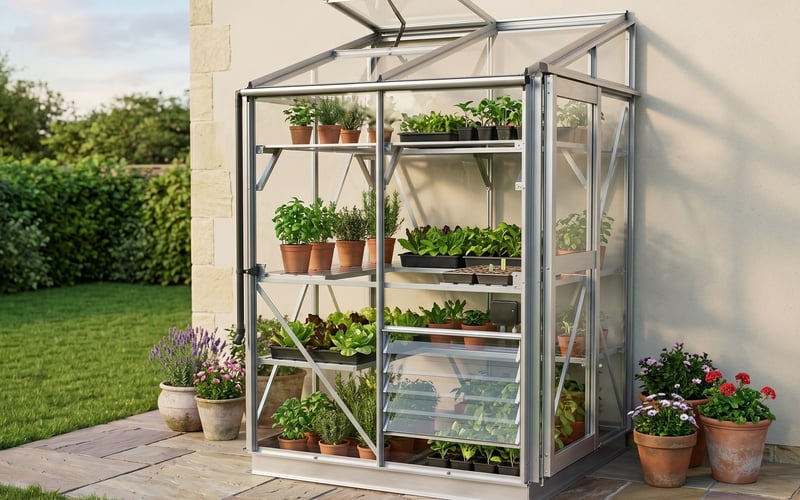
Shop the toughened-glass Elite Windsor 4x4 →
Can a small greenhouse go on an existing patio?
Existing paving may work when it provides the level, stable support and anchoring required by the greenhouse manufacturer.
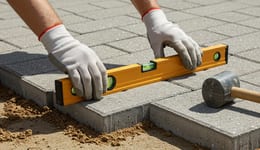
A patio often slopes deliberately to shed rain. Check its levels across the entire proposed base. Loose slabs or unsupported edges need attention before the frame arrives. A metal base plinth does not correct unsuitable foundations.
Choose fixings for the supporting material and follow the assembly instructions. Avoid improvised packing beneath individual corners. Keep the surrounding drainage route clear so rainwater can escape.
Before arranging installation, confirm the base dimensions and working clearance in writing. Include photographs if fences or walls make access awkward. Our paving slab base guide explains the preparation.
Matt's Installation Tip
Measure both diagonals before fixing the frame. Equal diagonals help confirm the base rectangle is square. Check levels separately; a square base can still slope.
How do you keep enough room for plants and people?
Plan the working aisle before adding staging, pots or permanent growing beds.
The Compact's 1,300mm external width is an upper limit for this rough layout calculation. Subtracting two 450mm benches leaves 400mm before accounting for the frame. The actual aisle would be narrower. One bench may therefore make more sense than two.
Keep the doorway clear. Test the layout with your usual watering can and seed trays. Lower shelves can store pots, but plants beneath staging receive less light. Extra shelf area does not guarantee extra crop yield.
Choose crops around the available headroom and their mature spread. Tomato plants need access for watering and side-shoot removal. A narrow greenhouse crowded with foliage quickly becomes difficult to manage.
Matt's Tip: try the layout before buying
I would mark the bench and doorway positions with string first. If carrying a tray feels awkward outside, the glass will make it tighter.
Compare greenhouse staging sizes before allocating bench space.
What should you check before ordering?
Check sunlight and ventilation alongside the total fitted cost.
Watch where shadows fall during the day. A bright-looking gap beside a fence may receive little direct sun. Roof ventilation matters even in a tiny greenhouse. Automatic openers help, but check temperatures and provide additional ventilation when needed.
Budget for base preparation and any missing base plinth. Add the chosen glazing, staging and installation. Check delivery charges for your postcode. Treat food savings as a possible benefit rather than a guaranteed payback period.
Planning rules vary across the UK. In England, a detached greenhouse may qualify as permitted development subject to all relevant conditions. Height alone does not establish permission. Listed properties, flats and house-attached structures need particular care. Check your local authority's rules before ordering.
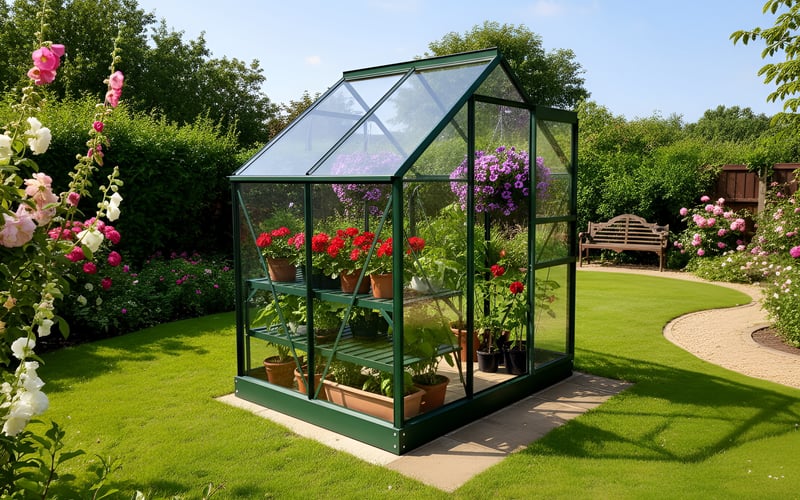
Shop the toughened-glass Vitavia Venus 2500 →
"I would compare door access before choosing by floor area. The Compact's low threshold and double sliding doors deserve attention in a small working garden."
Matt W, Greenhouse Stores
Frequently asked questions
Is my garden too small for a greenhouse?
A greenhouse may fit if usable ground remains after allowing access and installation space. Measure the actual model and check its working clearance. The IDA 900 projects 690mm; the Compact 4x4 needs a 1,300 × 1,351mm base.
How much clearance should I leave around a small greenhouse?
Use the manufacturer's and installer's clearance requirements for your chosen model. Our Compact example allows 600mm on each side, giving 2,500 × 2,551mm overall. That is a planning example, not a universal minimum.
Does a sliding door mean I need no space in front?
No, you still need clear space to stand, enter and carry equipment. A sliding door removes the swinging leaf. It does not remove the approach or the need to clean the glazing.
Can I grow tomatoes in a mini greenhouse?
Yes, if its light, headroom and ventilation suit the chosen tomato variety. Check mature plant size and keep watering access clear. A shallow unit may suit compact varieties better than tall cordon plants.
Does a small greenhouse need planning permission?
Permission depends on location, property type and the structure's design. Some detached greenhouses qualify as permitted development. Check local rules and restrictions. A greenhouse attached to a house may be assessed differently.