June Gardening Jobs UK: 12 Tasks From Expert Greenhouse Installers
June is the first real harvest month in UK gardens and the start of peak watering season. Water greenhouse plants daily before 10am to avoid grey mould. Fit louvre vents on side walls so cross-flow with roof vents stops temperatures topping 35°C. Check plants daily for aphids and net strawberries before they ripen. Harvest first lettuce, radish, broad beans and early new potatoes this month.
June is the first real harvest month in UK gardens and the start of peak watering season. Water greenhouse plants daily before 10am to avoid grey mould. Fit louvre vents on side walls so cross-flow with roof vents stops temperatures topping 35°C. Check plants daily for aphids and net strawberries before they ripen. Harvest first lettuce, radish, broad beans and early new potatoes this month.
Key Takeaways
- Water before 10am, never in the evening: overnight damp foliage causes grey mould and powdery mildew within seven days.
- Fit a side-wall louvre vent: cross-flow with the roof vent drops greenhouse temperature by 5-8°C on a hot day.
- Net strawberries the moment fruit colours up: blackbirds learn the spot in 24 hours and clear a plant overnight.
- Squash the first aphids by hand: waiting a week turns 10 aphids into 1,000 because each adult clones 5 daughters a day.
- String tomatoes now: by mid-June stems are too brittle to bend — leave it later and you snap the leader.
- Last window for tender vegetables: French beans, courgettes and sweetcorn planted in the first week of June still crop before October.
- Mulch borders 5-7cm deep: a single mulch in June cuts watering frequency by roughly half through July and August.
- Sow salad every fortnight: a single sowing bolts in two weeks; rolling sowings give continuous heads to September.
Expert Tip
June greenhouses hit 40°C if you rely on roof vents alone. Hot air rises and escapes through the ridge, but no fresh air gets in unless you give it a low entry point. A louvre vent on the side wall fixes this in 20 minutes — cool air enters low, warm air exits high, and the greenhouse self-regulates around 28°C. We fit louvres on roughly nine out of ten of our installations from May onwards because the difference is that obvious. A single Elite Automatic Louvre Vent Opener costs £59 and pays for itself the first time you avoid a tomato leaf-scorch.
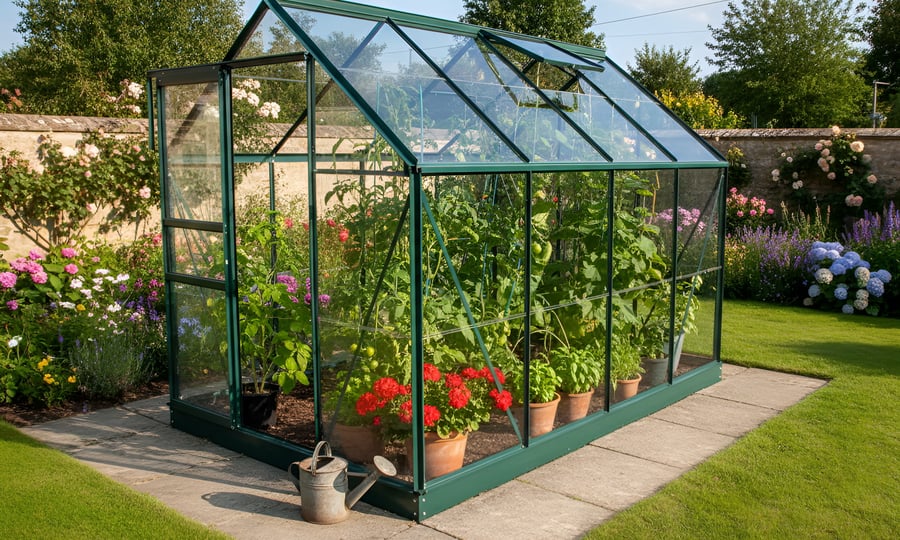
June is the month gardening stops being theoretical. The seedlings you nursed in March are now tomatoes the size of a fist. The grass you cut weekly in April needs cutting twice a week. The aphids you saw two of last week are now a colony of two hundred. Everything accelerates at once, and the gardeners who keep up are the ones who shift from a spring "planting" mindset to a summer "managing" mindset.
This guide is the routine we run on our own greenhouses and gardens through June. It comes from our work with UK greenhouse customers since 2012 and from harvesting on our own demonstration plots in Suffolk. None of it is theoretical. Where a job has a number attached — how often to water, how high to cut grass, how deep to mulch — it is the number we use ourselves.
1. Water early, water deep, never in the evening
Water greenhouse plants once a day between 6am and 10am. Containers in full sun outdoors need the same. Established borders manage on a deep weekly soak unless we are in a heatwave. The single biggest June mistake we see on customer visits is evening watering — damp tomato foliage sitting at 18°C overnight is the textbook condition for botrytis, and we get the panicked call about grey fuzz on stems every July from gardeners who watered after work the previous month.
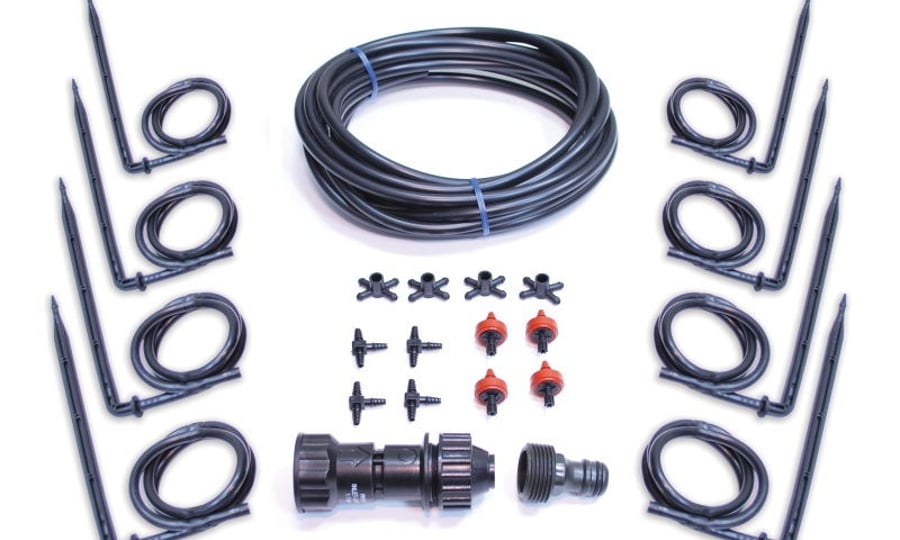
Morning watering gives leaves a full day to dry before nightfall. It also lets the plant absorb water before the heat of the day pulls it back out through the leaves. If you cannot water at 6am, an automatic watering system on a battery timer solves the problem for under £30 of kit and an evening of fitting.
How deep is deep enough?
A tomato in a 30-litre pot wants roughly 2 litres of water in the morning during a hot June week. A cucumber wants the same. Aubergines and peppers are slightly less thirsty — closer to 1.5 litres. For borders, push a finger 5cm into the soil. If the soil is dry at that depth, water until it is wet at 10cm. Surface dampness lies; finger depth tells the truth.
| Plant or position | June watering frequency | Volume per plant | Best time |
|---|---|---|---|
| Greenhouse tomatoes (in pots) | Daily, twice in a heatwave | 2 litres | 6-10am |
| Greenhouse cucumbers | Daily | 2 litres | 6-10am |
| Hanging baskets | Twice daily in sun | 500ml each watering | Morning and 8pm |
| Outdoor containers | Daily | 1-2 litres | Morning |
| New plantings | Every 2 days for 2 weeks | 3-5 litres soak | Morning |
| Established borders | Weekly soak | 10 litres per m² | Morning |
| Vegetable plot | 2-3 times a week | Until wet at 10cm depth | Morning |
2. Fit cross-flow ventilation before the next heatwave
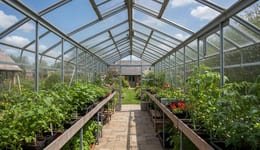
Roof vents alone cannot cool a UK greenhouse in June. Hot air rises and exits the ridge, but unless cool air can enter at a low point, you get no airflow — just hot air leaving and nothing replacing it. Internal temperatures sit at 35-40°C on a 24°C day, tomato leaves curl and bleach, and pollen goes sterile so flowers drop without setting fruit.
The fix is mechanically simple and we install it on roughly 90% of our June visits: a louvre vent on one or both side walls. Cool garden air enters low, warm air exits high through the roof vent, and you get a measurable 5-8°C drop. On a Vitavia, Elite or Swallow frame, a single louvre fits in under half an hour with a 10mm spanner.
Total vent area: the rule we use
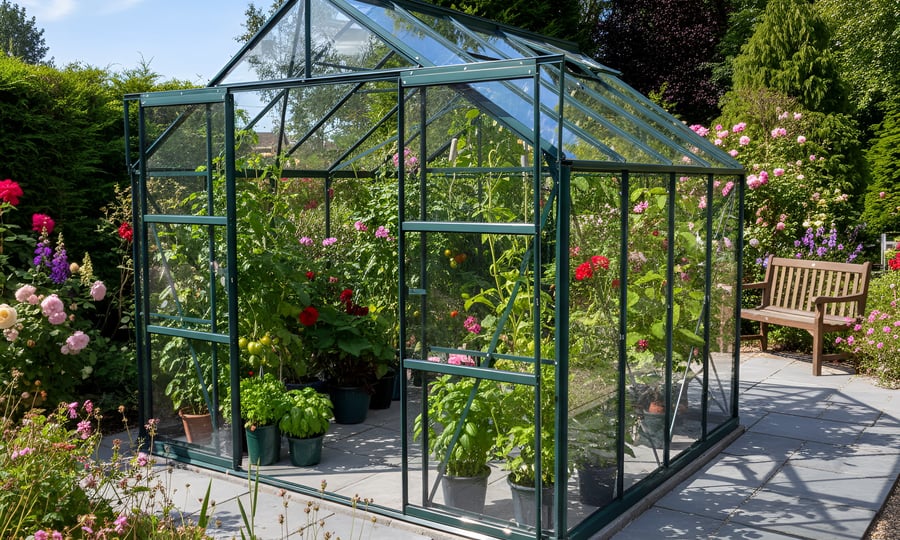
Total openable vent area should equal roughly one fifth of the floor area. A 6x8 greenhouse has 4.5 square metres of floor, so it needs about 0.9 square metres of vent. One roof vent gives you roughly 0.4 square metres. That leaves you 0.5 square metres short — exactly the gap a louvre vent fills. The maths is the same on every freestanding apex greenhouse we fit.
Add to this an automatic vent opener that triggers at around 22°C and you can leave the greenhouse to manage itself while you are at work. For the full breakdown of vent types and fan options, our greenhouse ventilation guide walks through the maths and the kit.
3. Add shading before the second heatwave hits
If your greenhouse is south-facing and you are already seeing leaf scorch by mid-June, ventilation alone may not be enough. Shading drops internal temperatures by another 4-6°C and prevents the pale, papery patches that appear on tomato and cucumber leaves after a single 35°C afternoon.
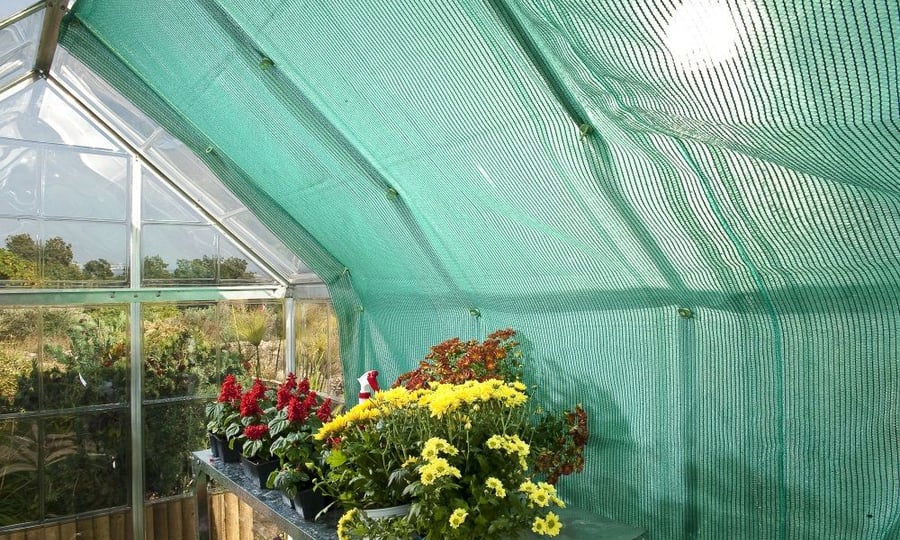
External shade kits beat internal blinds every time — they reflect the heat before it enters the structure rather than trapping it once it is in. If you would rather paint, a single coat of Coolglass shade paint costs about £12 a tin and washes off cleanly in October. For the full method, including which orientations need shading and which do not, see our guide to greenhouse shading methods.
4. String up tomatoes now — you have one week left
Tomato stems become woody and brittle by mid-June. Once that happens, you cannot bend the main leader without snapping it, which means any training you wanted to do is now impossible. The window for stringing or caning tomatoes is roughly the first ten days of June — do it now or accept that the plant will sprawl and the fruit will rot on the floor.
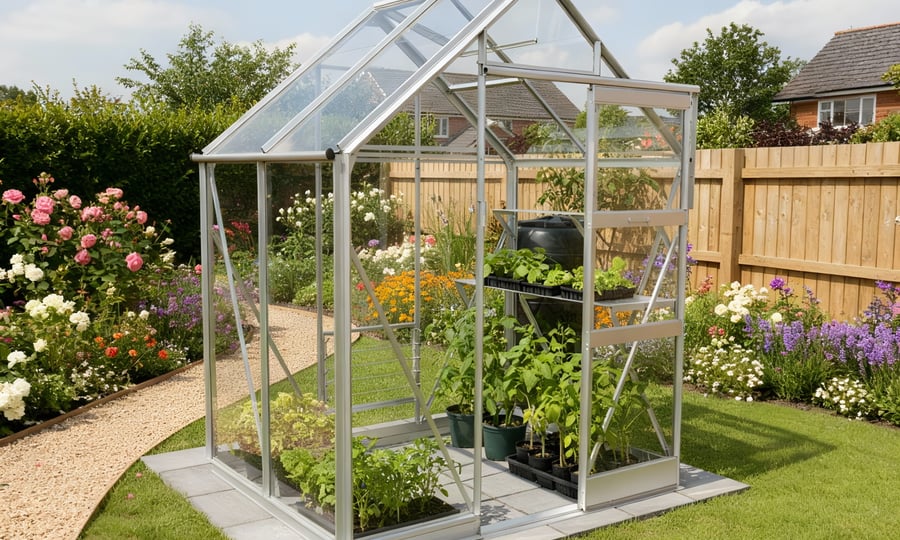
Tie soft string loosely to the base of the stem (or peg it under the rootball when you pot on) and run the other end to a horizontal wire 2 metres up. As the plant grows, wind the stem around the string. This is the simplest, cheapest and most reliable support method we know. Our full step-by-step guide to stringing and supporting tomatoes covers the alternatives if your greenhouse roof will not take a wire.
Side-shoot every week
While you are in there, pinch out side shoots from cordon tomatoes (the shoots that grow in the angle between leaf and stem). Do this once a week. A side shoot left for a fortnight becomes a second stem with its own fruit, but it splits the plant's energy across both and you end up with twice the foliage and half the harvest. The exception is bush varieties like Tumbler or Maskotka, which want to branch and should be left alone.
5. Net strawberries and check daily for aphids
The day your strawberries start to colour is the day you net them. Blackbirds and pigeons learn the location of ripening fruit within 24 hours and will strip a row overnight. We have watched this happen on our own beds — one evening, twelve ripening fruit; next morning, twelve half-eaten remains. Bird netting over hoops is the only thing that works reliably. Lay it flat across the plants and a beak goes straight through to the fruit beneath.
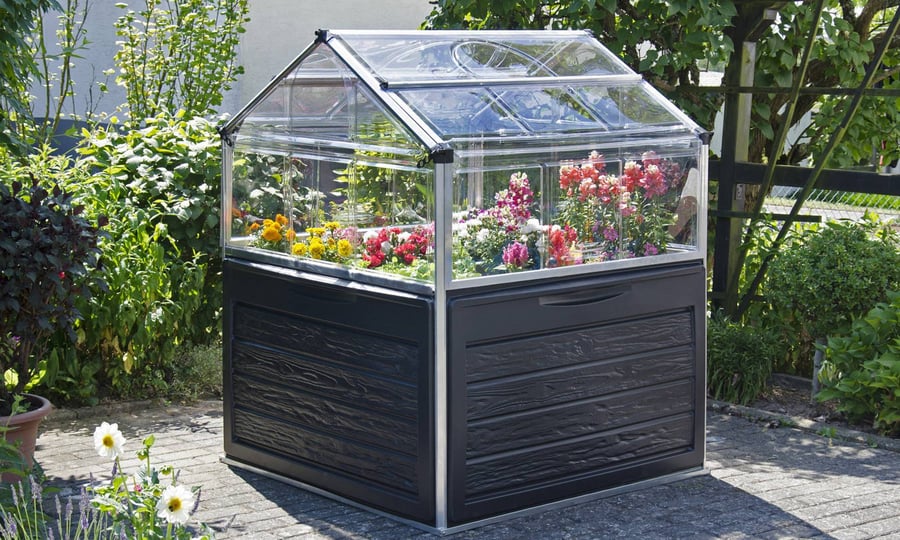
For more on growing the crop itself — varieties, feeding, runner management — see our piece on growing strawberries under glass.
Aphids: squash early, never spray late
A single adult aphid clones up to five daughters a day. Ten aphids spotted on a Monday is a thousand by the following Monday if you do nothing. We squash by hand on the first sighting — one minute with rubber gloves and a kitchen roll handles a small colony. For anything bigger, soapy water from a hand sprayer (one teaspoon washing-up liquid in a litre of water) cuts numbers by 90% in a day, with no chemicals near edible crops. The full method, including biological controls, is in our guide to destroying greenfly.
Slugs hit hardest in warm, damp June nights. A bedtime torchlight walk picks off 20-30 in fifteen minutes — far more effective than any pellet. For the full strategy including nematodes and beer traps, our guide to slug control has the breakdown.
6. Sow now for August, plant out the rest
June is the last reliable window for warm-season vegetables. French beans, courgettes, sweetcorn and runner beans sown or planted in the first week still crop in August and September. After mid-June, sweetcorn becomes risky — it needs 90 frost-free days from sowing to harvest, and southern UK gardeners are cutting it close.
For ongoing salad supply, sow a small row of lettuce, rocket and oriental leaves every fortnight. A single April sowing bolts to seed in two weeks of June sun; rolling sowings every 14 days gives continuous heads to October. Radishes hit harvestable size in 25 days — the fastest crop in the garden for instant wins with children.
| What to sow or plant in June | Best window | Time to harvest | Notes from our plot |
|---|---|---|---|
| French beans (sow direct) | All month | 60-70 days | Sow every 2 weeks for continuous crop |
| Runner beans (plant out) | First week | 80 days | Already 15cm tall in pots ideally |
| Courgettes (plant out) | First fortnight | 50-60 days | One plant per family is enough |
| Sweetcorn (plant out) | First week only | 90 days | Plant in a block of 9 for pollination |
| Lettuce (sow direct) | Every 2 weeks | 45-60 days | Shade in midday sun to prevent bolting |
| Radish (sow direct) | Every 2 weeks | 25-30 days | Fastest crop in the garden |
| Carrots (sow direct) | All June | 70-90 days | Cover with fleece against carrot fly |
| Sunflowers (sow direct) | Mid-June | 80-100 days | Soak seed overnight for fast germination |
| Biennials (sow in trays) | All June | Flower next spring | Foxgloves, wallflowers, honesty |
7. Mulch borders and deadhead roses
A 5-7cm layer of organic mulch applied this month roughly halves the watering you will need to do through July and August. The mulch slows evaporation, smothers weed seedlings before they germinate, and breaks down into compost by autumn. Spent mushroom compost, bark chip and well-rotted manure all work. Keep the mulch 2cm clear of plant stems — direct contact rots bark and invites slugs.
Deadhead roses every few days. Cut just above the first strong set of five leaflets below the spent flower. This signals the plant to push a new bud rather than set hips, and the second flush of flowers arrives in mid-July. For roses in their first flush, feed with a high-potash tomato food after the first deadheading round to fuel the second wave.
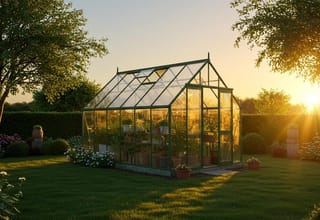
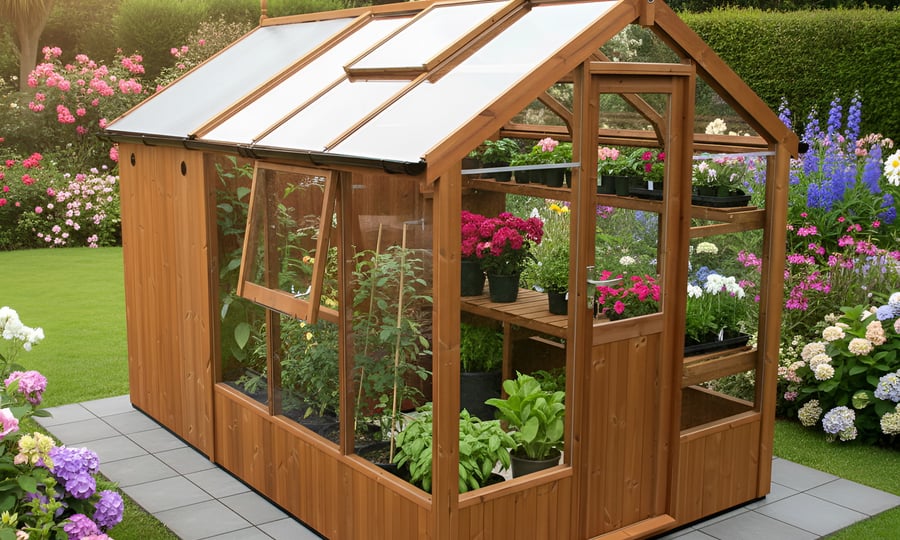
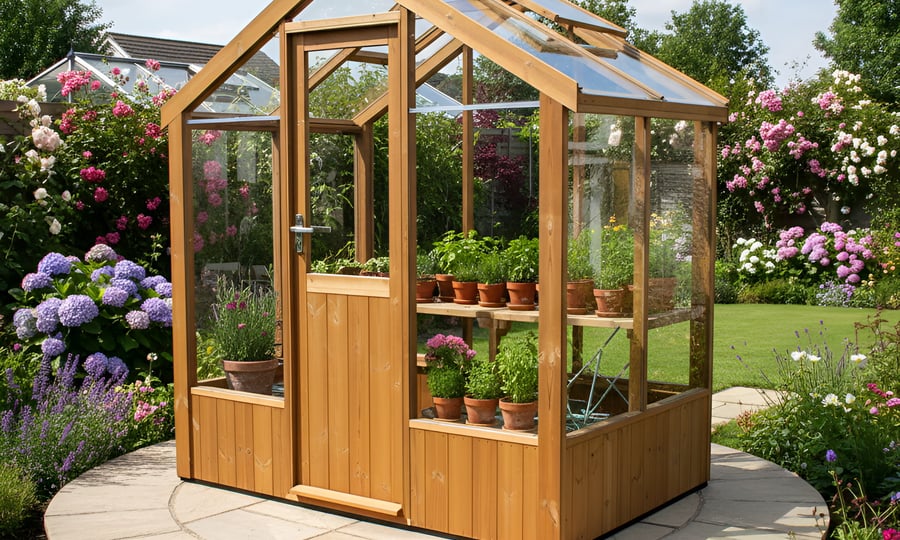 Wooden Greenhouse in thermo wood in a cottage garden setting with mature borders" style="display:block; margin:0 auto; max-width:760px; width:100%; height:auto; border-radius:8px;">
Lawn: raise the mower
Raise the cutting height on your mower by one notch in June. Longer grass shades its own roots, holds moisture in the soil and out-competes weeds. Mowing too short during a dry spell is the single most common cause of the yellow patches we all see in July gardens. Aim for 4-5cm rather than 2-3cm.
Matt's Tip: The Two-Minute June Walk
Every evening before sundown, walk the length of the greenhouse and back, slowly. Look at the top of every plant and the underside of three or four leaves. Three minutes of this catches every problem before it becomes a problem — the first aphid, the first wilting plant that missed yesterday's water, the first split tomato that signals irregular watering. We do this on every customer site visit and it is the single highest-value job in the gardener's day.
8. Plant for pollinators (and pest predators)
Pollinator-friendly flowers are not optional in June. Tomatoes, courgettes, beans and strawberries all need insect pollination to set fruit, and a greenhouse with the door closed has none. Plant calendula, borage, alyssum and nasturtiums in pots near the greenhouse door — bees and hoverflies follow the flowers in.
The bonus is pest control. Hoverflies lay eggs near aphid colonies, and their larvae eat 200-400 aphids each before pupating. A row of marigolds around the tomato beds is genuine biological control, not folklore. The specific pairings that work are covered in our research-backed guide to pest-repelling companion plants.
What about the "3 P rule"?
The 3P rule (Plan, Plant, Prune) is sometimes quoted for October but is most useful in June: Protect ripening fruit with netting, Pinch tomato side shoots weekly, and Pollinate by leaving the greenhouse door open until 5pm. Three jobs, three minutes each, and the harvest is measurably bigger.
Matt's Pick: the single best summer upgrade
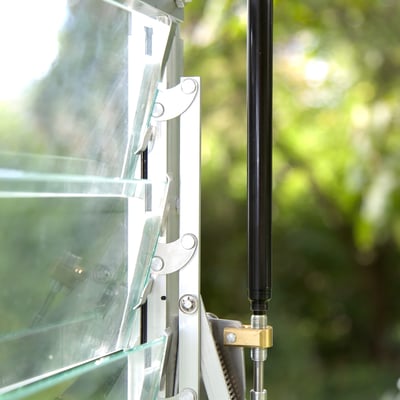
Matt's Pick for June: Elite Automatic Louvre Vent
Best For: Cross-flow ventilation with the roof vent to keep summer greenhouse temperatures under 30°C.
Why I Recommend It: Roof vents alone leave you 0.5m² short of the airflow you need on a 6x8. A single side-wall louvre fixes that, fits in 20 minutes with a 10mm spanner, and drops internal temperature 5-8°C on a hot day. I fit one on roughly 90% of summer installations.
Price: £59
Frequently Asked Questions
What should I be doing in my garden in June?
Water before 10am, fit ventilation, support tomatoes and net soft fruit. June is the first true harvest month and the start of peak watering season. Daily greenhouse watering, cross-flow ventilation, weekly tomato side-shooting, bird netting on strawberries, and fortnightly salad sowings cover the core routine. Aphid and slug checks happen daily on the same garden walk.
What can be planted in June in the UK?
French beans, courgettes, runner beans, sweetcorn, lettuce, radish, carrots and sunflowers. Plant tender warm-season vegetables in the first week of June while the harvest window still works. French beans and salad can be sown every fortnight for continuous cropping. Biennials like foxgloves and wallflowers go into seed trays now for next spring's display. Avoid main-crop potatoes — June is too late.
What is the 3 P rule in gardening?
Protect, Pinch and Pollinate. In June, protect ripening fruit with netting before birds find it, pinch tomato side shoots weekly while stems are still flexible, and pollinate by leaving the greenhouse door open during the day. The version quoted for autumn is Plan, Plant and Prune, but the protect-pinch-pollinate triple is the June priority list.
When should I water my greenhouse in June?
Between 6am and 10am, never after 4pm. Morning watering lets leaves dry before nightfall, which prevents grey mould and powdery mildew. Greenhouse tomatoes in 30-litre pots need roughly 2 litres each in the morning during hot weather. A drip irrigation kit on a battery timer automates the whole job for under £30 of kit.
How do I stop my greenhouse overheating in June?
Fit a side-wall louvre vent and open the door by 9am. Roof vents alone cannot cool a greenhouse — you need a low entry point for cool air. A louvre vent gives the cross-flow you need and drops temperatures 5-8°C. External shade nets or a coat of Coolglass shade paint add another 4-6°C of cooling for south-facing structures.
What vegetables should I harvest in June?
Broad beans, first lettuce, radish, strawberries, early potatoes and asparagus tips. Broad beans are at their sweetest the day after the pods feel firm. Strawberries colour up across the first fortnight. Maincrop early potatoes (Charlotte, Swift) lift from late June. Pick asparagus until midsummer (21 June) then let the rest fern over to feed next year's crowns.
How often should I deadhead roses?
Every 2-3 days through June and July. Cut just above the first strong set of five leaflets below the spent flower. This forces a new bud rather than letting the plant set hips. Feed with a high-potash tomato food after the first deadheading round to fuel the second flush of flowers in mid-July.
How do I get rid of aphids on tomatoes without spraying?
Squash the first sighting by hand, then soapy water for anything bigger. One teaspoon of washing-up liquid in a litre of water from a hand sprayer cuts a colony by 90% overnight, with nothing chemical near edible crops. A row of marigolds or calendula nearby brings in hoverflies, whose larvae eat 200-400 aphids each before pupating.
Related Articles
- May Gardening Jobs UK
- July Gardening Jobs UK
- April Gardening Jobs: What to Do in the Garden and Greenhouse
- Greenhouse Roof Shapes UK: Apex, Lean-To, Orangery, Dwarf Wall & Combi Compared
- Greenhouse Pest Control Guide UK
If your greenhouse is the limiting factor on your June harvest this year, browse our full range at Greenhouse Stores — from 2x3 mini units for patios up to 8x14 statement glasshouses, all fitted by our own installers.