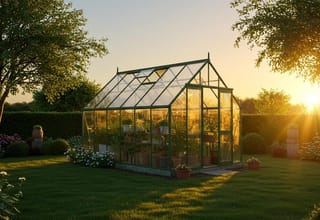
Greenhouse Planning Permission UK: Do You Need It?
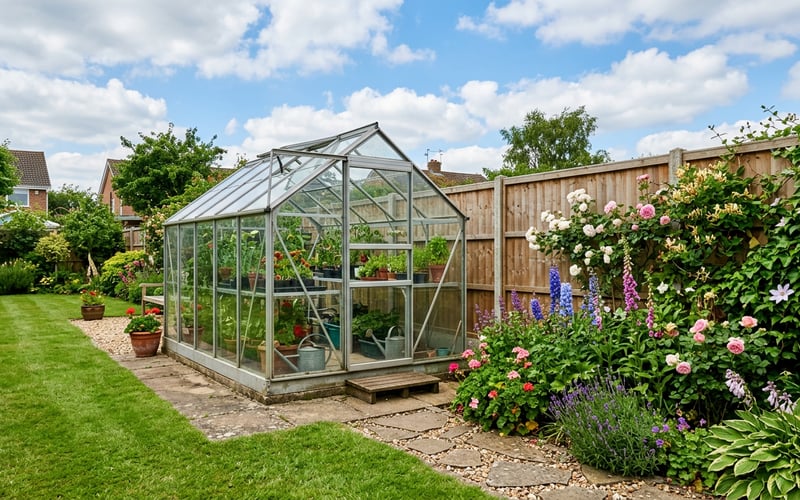
Most domestic greenhouses in the UK do not need planning permission. Standard aluminium greenhouses fall under permitted development rights, which means you can put one up without applying to the council. A typical 8x6 greenhouse has a ridge height under 2m. The permitted limit near a boundary is 2.5m. If your greenhouse sits in the back garden and covers less than half the plot, you are almost certainly fine.
Key Takeaways
- Standard greenhouses do not need planning permission, they are classed as permitted development in England, Wales, and Scotland
- The main rule is height, stay under 2.5m at the ridge if within 2m of a boundary
- Listed buildings are the exception, you need Listed Building Consent plus planning permission
- Check your garden coverage, all outbuildings combined must not exceed 50% of the plot
Installer's Note
From our work with Greenhouse Stores customers since 2012, I have never had a customer need planning permission for a standard greenhouse. Not once. The rules are generous. A typical 8x6 greenhouse sits at about 1.97m at the ridge. Even a large 10x10 comes in at 2.42m. Both are well under the 2.5m limit. If you are in any doubt, I will walk you through the checklist below. It takes two minutes.
Do you need planning permission for a greenhouse?
Almost certainly not. In England, Wales, and Scotland, domestic greenhouses are classed as outbuildings. Outbuildings fall under permitted development rights. This means you can build one without applying for planning permission, as long as you follow a few simple rules.
The rules come from the Town and Country Planning (General Permitted Development) (England) Order 2015. Similar legislation applies in Wales, Scotland, and Northern Ireland. The good news is that the limits are generous. Every standard greenhouse we sell at Greenhouse Stores fits within permitted development.
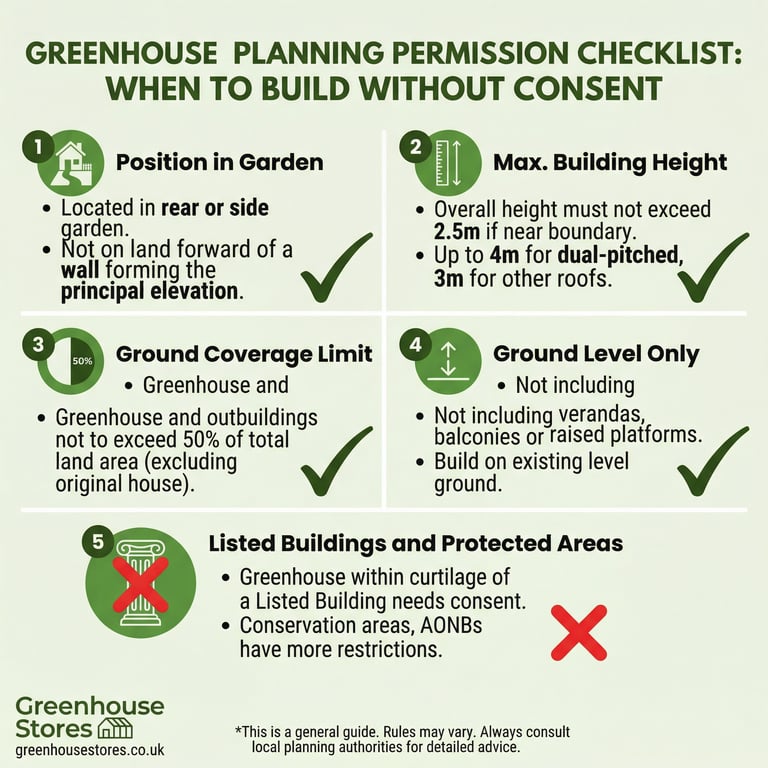
The 5-point planning permission checklist
Run through these five points. If you tick every one, you do not need planning permission.
| # | Rule | What it means |
|---|---|---|
| 1 | Behind the house | The greenhouse must not be forward of the front of your house |
| 2 | Under 2.5m near a boundary | Ridge height must stay under 2.5m if within 2m of any boundary |
| 3 | Under 50% coverage | All outbuildings combined must cover less than half your total plot |
| 4 | Single storey | No raised platforms higher than 300mm above ground level |
| 5 | Not a listed building | Your house must not be a listed building |
That is it. Five rules. Most greenhouse buyers tick all five without even thinking about it.
1. The greenhouse goes behind the house
Your greenhouse must sit behind the front wall of your house. Most people put greenhouses in the back garden anyway. If you want one in a front garden, you will need to apply for planning permission. Side gardens are fine in England, but not in conservation areas.
2. Height stays under 2.5m near a boundary
If any part of your greenhouse is within 2m of a garden boundary, the ridge must not exceed 2.5m. Further than 2m from the boundary, a dual-pitched roof can go up to 4m. A flat or mono-pitch roof can reach 3m. Eaves must stay under 2.5m everywhere.
For reference, here are the ridge heights of some of our best-selling greenhouses.
| Greenhouse | Ridge height | Under 2.5m? |
|---|---|---|
| Vitavia Venus 8x6 | 1,970mm (1.97m) | Yes |
| Elite Belmont 8x10 | 2,475mm (2.48m) | Yes |
| Elite Supreme 10x10 | 2,420mm (2.42m) | Yes |
Every standard greenhouse in our range fits within the 2.5m boundary limit. You can place any of them right next to your fence without an issue.
3. All outbuildings cover less than 50% of the plot
Add up the footprint of every outbuilding on your property. Sheds, garages, summer houses, our potting sheds, and the new greenhouse all count. The total must cover less than half the land around your house. Extensions to the house count too. For most gardens, this is not a problem.
Our greenhouse size guide shows how much ground each size takes up.
4. No raised platforms above 300mm
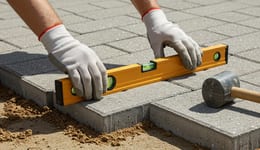
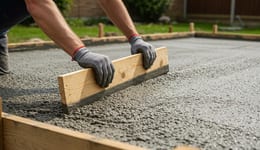
Your greenhouse base must be at ground level. A concrete slab or paving slabs are fine. A raised deck or platform above 300mm is not. Our concrete base guide and paving slab guide cover the details.
5. Your house is not listed
If your house is a listed building, you need Listed Building Consent before putting up any outbuilding. This applies even for a small greenhouse at the far end of the garden. Contact your local council's planning department for advice. The application costs around £132 in England.
Conservation areas and protected land
Conservation areas, AONBs, National Parks, and World Heritage Sites have two extra restrictions.
- No side-of-house placement. The greenhouse must go behind the house, not to the side.
- 10 square metre cap if over 20m from the house. If the greenhouse is more than 20m from any wall of your house, it cannot exceed 10 sq m.
For a standard greenhouse in the back garden within 20m of the house, you are still fine. No permission needed.
Scotland: slightly different rules
Scotland has its own planning legislation. The main rules are similar, but there are a few differences worth knowing.
| Rule | England and Wales | Scotland |
|---|---|---|
| Boundary trigger distance | 2m | 1m |
| Max eaves height | 2.5m | 3m |
| 50% coverage | Total plot | Rear garden only |
| Conservation area cap | 10 sq m | 4 sq m |
The key Scottish difference is the boundary trigger. In Scotland, the 2.5m height limit kicks in at 1m from the boundary instead of 2m. If your greenhouse is between 1m and 2m from a Scottish boundary, check the height carefully. Our standard greenhouses all fit within 2.5m, so this rarely causes an issue.
Matt's Tip: Get a Lawful Development Certificate
Selling your house or want peace of mind? Apply for a Lawful Development Certificate from your council. It costs £122 in England and takes up to 8 weeks. It gives you a legal document confirming the greenhouse is lawful. I recommend this if you live near a conservation area or your neighbour is the type to complain.
What about lean-to greenhouses?
A freestanding lean-to greenhouse follows the standard outbuilding rules above. A lean-to fixed to the house wall may be treated as a house extension instead. Extensions have stricter rules around depth, width, and proximity to boundaries.
If your lean-to is freestanding and simply leans against the wall without being structurally attached, the outbuilding rules apply. Our lean-to installation guide covers fitting options. Browse our lean-to greenhouses to see the range.
In Wales, there is an extra rule. Any outbuilding within 2m of the house itself cannot exceed 1.5m in height. This could affect lean-to greenhouses placed very close to the dwelling.
Do I need building regulations for a greenhouse?
No. Standard domestic greenhouses are exempt from building regulations. They are lightweight, single storey, and not used for sleeping. The only exception is electrical wiring. If you run mains electricity to your greenhouse, the wiring must comply with Part P of the building regulations. A qualified electrician will handle this.
What happens if you get it wrong?
If your greenhouse breaches permitted development rules, your council can issue an enforcement notice. This would require you to alter or remove the greenhouse. You can apply for retrospective planning permission, which costs £258 in England. If refused, you may have to take the greenhouse down.
Since 2024, the enforcement window is 10 years. This means the council can take action within 10 years of the greenhouse being built. Previously it was 4 years.
The simplest approach is to check the five rules above before you buy. Two minutes of checking avoids any risk.
|
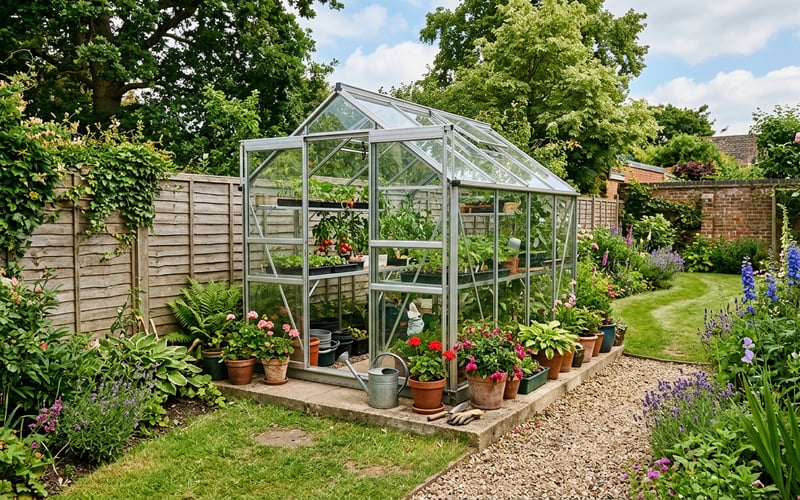
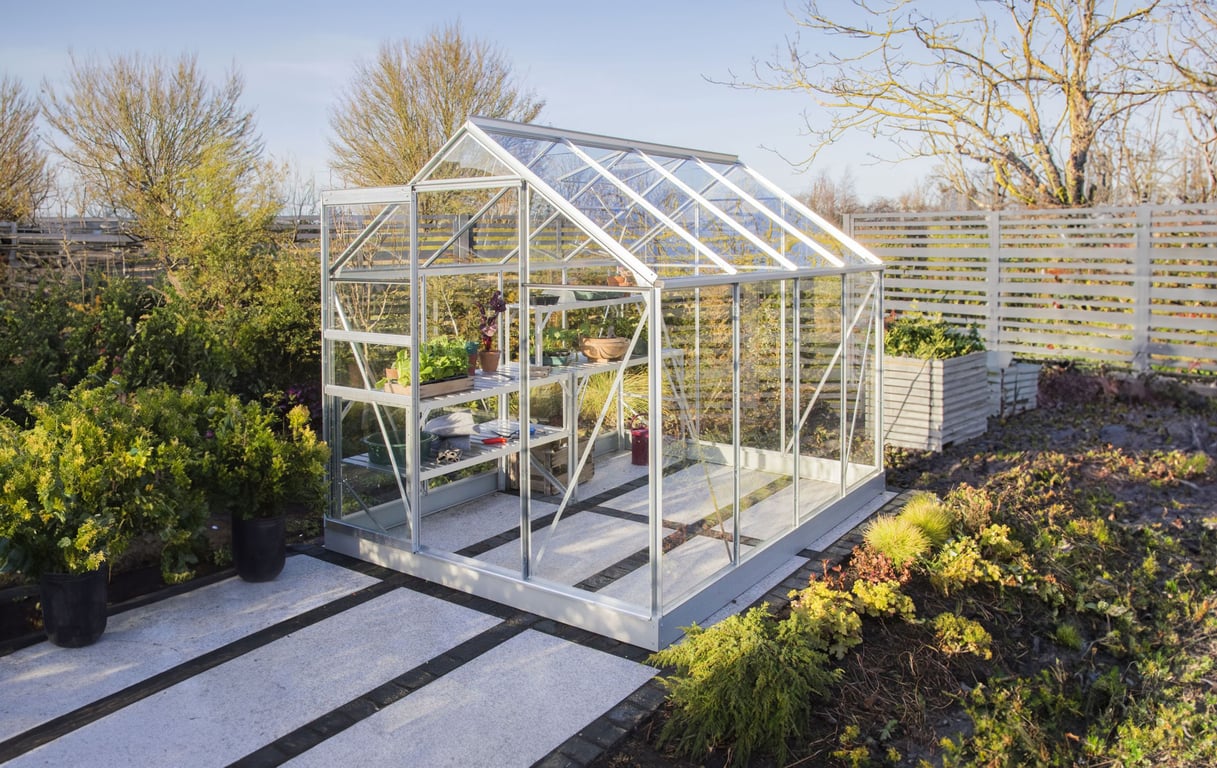
Matt's Pick: most popular greenhouse that fits any gardenBest For: First-time buyers who want a reliable, no-hassle greenhouse Why I Recommend It: The Venus 8x6 is our best seller for good reason. Ridge height of 1.97m means it fits within permitted development even right next to a fence. Twelve-year warranty on the frame. I have fitted hundreds of these and they just work. Price: £509 |
Frequently asked questions
Do I need planning permission for a greenhouse in my garden?
No, most domestic greenhouses do not need planning permission. They fall under permitted development rights. The greenhouse must be behind the house, under 2.5m high near a boundary, and cover less than 50% of the plot. Listed buildings are the main exception.
How tall can a greenhouse be without planning permission?
2.5m at the ridge if within 2m of a boundary. Further away, a dual-pitched greenhouse can reach 4m. Eaves must not exceed 2.5m anywhere. Every standard greenhouse in our range fits within 2.5m at the ridge.
How close to my boundary can I put a greenhouse?
You can build right up to the boundary line. There is no minimum distance. If any part is within 2m of the boundary, the ridge height must stay under 2.5m. In Scotland, this trigger distance is 1m instead of 2m.
Do I need planning permission for a greenhouse in a conservation area?
Usually not, if the greenhouse goes behind the house. Rear-of-house placement following the standard rules is still permitted development. Side placement requires permission. Greenhouses more than 20m from the house are capped at 10 sq m in conservation areas.
Can I put a greenhouse in my front garden?
Not without planning permission. Permitted development only covers outbuildings behind the front wall of the house. A greenhouse in the front garden requires a full planning application. Most applications for front-garden greenhouses are refused.