How to Grow Grapes in a Greenhouse Guide
Greenhouse grapes take 3 years to first harvest but produce fruit for 30+ years. Best UK varieties include Black Hamburg, Muscat of Alexandria, and Boskoop Glory. Vines need 21–26°C day temperatures, pH 6.0–6.5 soil, and annual winter pruning of 90% of growth. Roots can be planted inside or outside the greenhouse. We have been installing greenhouses for 16 years.
Key Takeaways
- Black Hamburg is the most reliable beginner variety for UK greenhouses
- Plant roots outside through a wall hole for natural watering, or inside for faster first crops
- Maintain 21–26°C during the day and 15–18°C at night for best fruit set
- Prune 90% of growth in late winter using the rod and spur system
- Expect your first harvestable grapes 3 years after planting
Installer's Note
We have fitted several greenhouses specifically for grape growing over the years. A south-facing lean-to against a warm brick wall is the best setup we have seen. The wall stores heat during the day and releases it overnight, giving vines the consistent warmth they need. The most common mistake is poor ventilation. Grapes need airflow to avoid powdery mildew.
Choosing Grape Varieties for a UK Greenhouse
The variety you choose determines how much care your vine needs and when you harvest. Not every grape suits a UK greenhouse. Some need long, hot summers that southern England rarely provides. The five varieties below have all been grown successfully under glass in the UK.
| Variety | Type | Colour | Ripening | Best For |
|---|---|---|---|---|
| Black Hamburg | Dessert | Black | Mid-season (Sept–Oct) | Beginners — reliable cropper |
| Muscat of Alexandria | Dessert | White/green | Late (Oct–Nov) | Rich musky flavour |
| Boskoop Glory | Dessert/Wine | Black | Early (Aug–Sept) | Cold-hardy, outdoor wall |
| Flame Seedless | Dessert | Red | Mid-season (Sept–Oct) | Eating fresh, seedless |
| Interlaken Seedless | Dessert | White | Early (Aug–Sept) | Sweet, seedless |
Black Hamburg (also called Muscat Hamburg) is the variety we recommend to anyone growing greenhouse grapes for the first time. It was the grape grown at Hampton Court Palace for over 200 years. It tolerates temperature fluctuations and produces large, sweet black grapes even in average summers. Muscat of Alexandria needs more heat and is better suited to a south-facing lean-to greenhouse against a warm wall.
Boskoop Glory ripens earliest and copes well with cooler conditions. If your greenhouse is unheated, this is a strong alternative. Flame Seedless and Interlaken Seedless suit growers who want table grapes without seeds. Both ripen reliably under glass in the south of England and the Midlands.
How to Plant Grape Vines in a Greenhouse
There are three ways to plant grape vines in a greenhouse. You can put roots outside through a wall hole, plant inside in border soil, or use a container. Each method works. The choice depends on your greenhouse type and watering preference.
Planting with roots outside
This is the traditional method used in Victorian glasshouses. Drill or cut a 100mm hole through the greenhouse wall at ground level. Plant the vine outside and train the main stem (rod) through the hole and up an internal wire support. The roots get natural rainfall, so you water less. The vine still benefits from the warmth inside during the growing season.
Dig a planting hole 450mm deep and 450mm wide. Mix the excavated soil with well-rotted garden compost at a 50:50 ratio. Position the vine so the graft union sits 50mm above soil level. Backfill, firm gently, and water well.
Planting with roots inside
Indoor planting gives warmer soil temperatures, which can bring forward first cropping by a season. Prepare the greenhouse border soil to a depth of at least 400mm. Remove any rubble or compacted subsoil and replace with a mix of loam, garden compost, and grit for drainage. Indoor vines need more frequent watering because they cannot access rainfall.
Growing grapes in containers
Containers suit smaller greenhouses or growers who want to try several varieties. Use a pot at least 450mm in diameter with drainage holes. Fill with John Innes No. 3 compost mixed with 20% perlite by volume. Container vines dry out faster and exhaust nutrients more quickly than border-planted vines. Repot every 2–3 years in fresh compost. If you enjoy growing fruit under glass, our guide to growing strawberries in a greenhouse covers another rewarding crop.
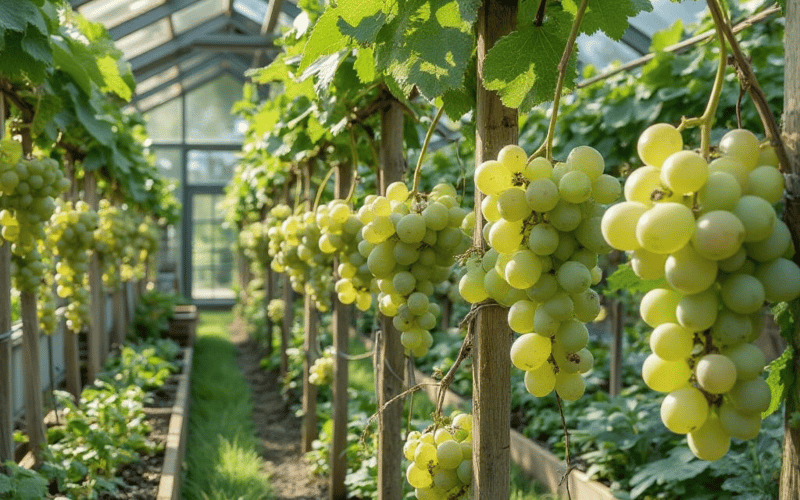
Soil, Feeding, and Watering
Grapes are heavy feeders. Good soil and a proper feeding programme separate a vine that fruits well from one that only produces leaves.
Soil preparation
Grape vines need a pH between 6.0 and 6.5. Test your soil before planting. Amend with garden lime if it reads below 6.0, or sulphur chips if above 6.5. Work well-rotted farmyard manure or garden compost into the top 300mm of soil. Apply roughly one barrowload per square metre. Good drainage is essential. If your greenhouse sits on heavy clay, dig out the planting area to 500mm. Add a 100mm layer of coarse gravel before backfilling with improved soil. Our guide to how to make your own compost explains how to produce the right material.
Feeding schedule
In early spring (March), apply a balanced NPK fertiliser such as Growmore at 70g per square metre. Spread it evenly around the base of the vine. From June onwards, switch to a high-potassium liquid feed every two weeks. Tomato feed works well for this. Potassium drives fruit development and improves flavour. Stop all feeding by late September so the vine hardens off before winter.
Watering
Water deeply but not often. A thorough soak once every 7–10 days during the growing season is better than daily light watering. Deep watering encourages roots to grow downwards rather than staying at the surface. Reduce watering as grapes approach ripeness. Too much water at this stage dilutes flavour and can split skins. Drip irrigation keeps foliage dry and reduces fungal disease risk.
Mulching
Apply a 50–70mm layer of organic mulch around the base of the vine each spring. Well-rotted bark chips, straw, or garden compost all work. Keep the mulch 100mm clear of the stem to prevent rot. Mulching holds soil moisture, suppresses weeds, and feeds the soil as it breaks down.
Temperature and Greenhouse Conditions
Grapes need specific temperature ranges at each stage of growth. The table below shows the targets we recommend based on our experience fitting greenhouses for vine growers.
| Growth Stage | Day Temperature | Night Temperature | Humidity |
|---|---|---|---|
| Dormancy (Dec–Feb) | 4–10°C | 2–7°C | 60–70% |
| Bud Break (Mar–Apr) | 18–22°C | 10–15°C | 70–80% |
| Flowering (May–Jun) | 20–25°C | 13–18°C | 60–70% |
| Fruit Set (Jun–Jul) | 22–28°C | 15–20°C | 60–70% |
| Veraison to Harvest (Aug–Oct) | 25–30°C | 15–20°C | 55–65% |
Sunlight
Grape vines need at least 6–8 hours of direct sunlight each day during the growing season. Position vines on the south or south-west side of the greenhouse. Avoid shading from benches, staging, or taller plants.
Ventilation
Good airflow prevents powdery mildew, the most common grape disease. Open roof vents and louvre vents daily from April to October. On hot summer days, open the greenhouse door as well. Air movement also helps pollination by carrying pollen between flowers.
Insulation
Vines need at least 6 weeks of cold exposure below 7°C to fruit properly the following year. Do not heat your greenhouse during winter dormancy. From bud break in March, use bubble wrap insulation on the north wall to retain daytime warmth. A wooden greenhouse retains heat better than aluminium. This helps vines in cooler regions.
Pruning and Training Grape Vines
Pruning is the single most important task in grape growing. Without it, vines produce masses of leaf growth and very little fruit. The rod and spur system is the standard method for greenhouse grapes in the UK.
The rod and spur system
Train one main vertical rod (the permanent stem) upwards from the base. Fix horizontal galvanised wires along the greenhouse wall or under the roof at 300mm intervals. Allow lateral shoots to grow from the main rod, spacing them 600mm apart along the wires. Each lateral carries one bunch of grapes per year.
Winter pruning
Prune between December and January when the vine is fully dormant. Cut each lateral shoot back to one or two buds from the main rod. This removes roughly 90% of the previous season's growth. It looks severe, but it is how established vines produce the best fruit year after year. Our winter pruning guide covers the same principles applied to fruit trees.
Summer maintenance
During the growing season, pinch out the growing tip of each lateral two leaves beyond the fruit bunch. Remove any secondary side shoots that form. This directs the vine's energy into the grapes rather than leaf growth. Tie in new growth to the wire supports as it extends.
Matt's Tip: Rod and Spur Pruning
I always recommend the rod and spur pruning system for greenhouse grapes. Train one main rod vertically, then allow lateral shoots to grow 600mm apart along horizontal wires. In winter, cut each lateral back to one or two buds. This looks brutal but it is how you get the best fruit. I have seen vines pruned this way produce for over 25 years.
Improving Your Grape Yield
Once the vine is established and pruning is sorted, three techniques push yields higher. These are better pollination, grape thinning, and tendril removal.
Aiding pollination
Greenhouse grapes do not have wind or bees to spread pollen reliably. During flowering in May and June, gently shake each flowering shoot at midday when pollen is driest. Alternatively, use a soft paintbrush to dab between open flowers. Do this every 2–3 days throughout the flowering period.
Thinning dessert grapes
Dessert grapes need thinning for the best-size berries. When individual grapes reach 5mm diameter, use long-nosed grape scissors to remove roughly half the berries from each bunch. Work from the inside of the bunch outwards. This gives remaining grapes room to swell properly. Wine grapes do not need thinning.
Removing tendrils
Grape vines produce curling tendrils that wrap around anything nearby. Cut off tendrils that form near fruit bunches. They divert energy away from the grapes and can distort bunch shape if they grip the fruit. Leave tendrils elsewhere on the vine to help it grip the support wires.
|
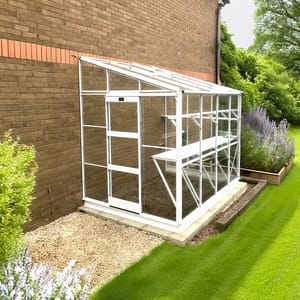
Matt's Pick for Growing GrapesBest For: Training grape vines against a south-facing wall with maximum sun exposure Why I Recommend It: A lean-to against a brick wall is the best setup for grapes in the UK. The Kensington 6×8 gives you 1.8m of height for vertical vine training. The wall absorbs heat during the day and releases it overnight. I have fitted this model for grape growers and the results speak for themselves. Price: £799 |
Common Grape Growing Problems
Greenhouse grapes face fewer pest and disease issues than outdoor vines, but problems still occur. Catching them early makes all the difference.
Powdery mildew
White powdery patches on leaves and fruit. Caused by poor ventilation and high humidity. Improve airflow by opening vents daily. Remove and destroy affected leaves. Spray with a sulphur-based fungicide if the infection spreads. Prevention matters more than cure with mildew.
Grey mould (Botrytis)
Grey fuzzy mould on ripening fruit. Thrives in damp, still air. Thin bunches properly so air circulates between berries. Remove any damaged or rotting grapes immediately. Reduce watering as fruit approaches ripeness.
Red spider mites
Tiny red or brown mites that cause yellow stippling on leaves. They thrive in hot, dry conditions. Mist the underside of leaves with water to raise humidity around the foliage. Introduce the biological control Phytoseiulus persimilis (a predatory mite) for serious infestations. Our greenhouse pest control guide covers biological controls in detail.
Birds
Birds will find a way into greenhouses with open vents. Net individual bunches with fine mesh bags as the grapes start to colour. This is simpler and more effective than trying to seal every vent opening.
When and How to Harvest Greenhouse Grapes
Grapes are ready 3–4 months after flowering, typically from late August through October depending on the variety. Do not rely on colour alone. Some varieties change colour weeks before they are ripe.
Test ripeness by tasting a grape from the bottom of the bunch (the last to ripen). If it tastes sweet with no sharp acidity, the bunch is ready. The berries should feel slightly soft when squeezed gently. The stem where the bunch joins the vine turns woody and brown when ripe.
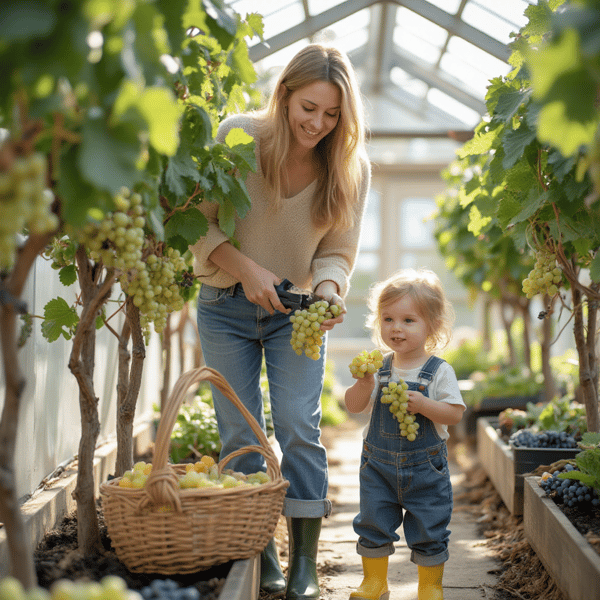
Cut whole bunches with sharp secateurs. Leave a short T-shaped section of the lateral stem attached to the bunch. This gives you a handle and prevents damage to the berries. Handle bunches by the stem only. Touching the berries removes the natural waxy bloom that protects the skin. Freshly cut bunches keep for 2–3 weeks in a cool room at 5–10°C. For more ideas on what to grow alongside your vines, see our guide to growing fruit at home.
Frequently Asked Questions
Can grapes be grown in a greenhouse?
Yes, greenhouses are ideal for growing grapes in the UK. The controlled environment provides the warmth, shelter, and extended growing season that grape vines need. In cooler regions, a greenhouse is the only reliable way to ripen dessert grapes. Black Hamburg and Boskoop Glory are two varieties proven to crop well under glass across England, Wales, and southern Scotland.
How long do grapes take to grow?
Grape vines take 3 years to produce a first harvest. In the first year, the vine establishes its root system and main rod. Year two develops the lateral framework. From year three onwards, each lateral produces one bunch of grapes annually. Individual bunches take 3–4 months from flowering to ripe fruit. Once established, a well-maintained vine produces grapes for 30 years or more.
What compost is best for grape vines?
John Innes No. 3 mixed with 20% perlite works best. This gives the loam-based structure and drainage that grape roots prefer. For border planting, improve existing soil with well-rotted manure and coarse grit. Aim for a pH of 6.0–6.5. Avoid peat-based multipurpose composts for permanent plantings as they compact over time and lose structure.
Are grapes hard to grow in the UK?
Grapes are straightforward in a greenhouse with the right variety. Black Hamburg is almost foolproof under glass. The main ongoing tasks are winter pruning, summer pinching, and a regular feeding schedule. Outdoor grapes in the UK are harder because of unpredictable summers. Under glass, you control the temperature and protect against rain damage to ripening fruit.
How do you prune greenhouse grape vines?
Use the rod and spur system and prune in December or January. Cut each lateral shoot back to one or two buds from the main rod. This removes about 90% of the previous season's growth. During summer, pinch out lateral tips two leaves past the fruit bunch. Remove secondary side shoots. This annual cycle keeps the vine productive.
Related Articles
- How to Grow Melons in Your Greenhouse
- Growing Tomatoes in a Greenhouse
- What to Grow in a Greenhouse: Beginners Guide
- 25 Unusual Things to Grow in a Greenhouse
- How to Grow Seeds in a Greenhouse
Questions about growing grapes or choosing the right greenhouse? Contact our team at info@greenhousestores.co.uk