How to Grow Kiwi Fruit in a Greenhouse UK
Kiwi fruit (Actinidia deliciosa) grows successfully in UK greenhouses when trained on horizontal wires at 40-50cm intervals and kept above 5C in winter. The self-fertile variety Jenny produces full-size fuzzy fruit in 3-4 years without needing a separate male plant. Hardy kiwi berries (Actinidia arguta ‘Issai’) survive unheated greenhouses down to -15C and fruit in 2-3 years. A single mature vine yields 30-50kg of fruit per season in an 8x10ft or larger greenhouse, making kiwi one of the highest-value, longest-lived crops you can grow under glass in the UK.
Key takeaways
- Jenny is the best variety for most UK greenhouse growers. Self-fertile, full-size fuzzy fruit in 3-4 years. Issai is the unheated-greenhouse alternative; Hayward is the gourmet option if you have space for two vines.
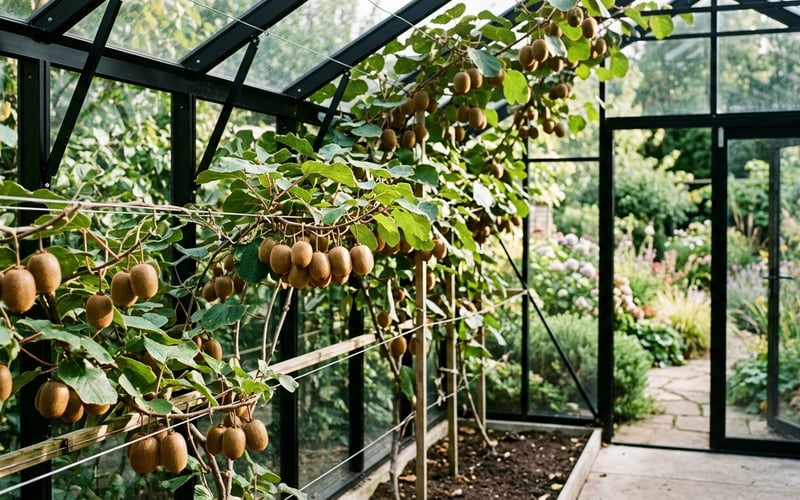
- Train vines on horizontal wires at 40-50cm spacing. A flat fan or T-bar framework gives the vine structure. Kiwi grows 3-6 metres in a single season without training.
- Keep above 5C in winter, below 27C in summer. The vine needs 600-800 hours below 7C for vernalisation, then a frost-free spring and a vented summer.
- Hand-pollinate with a soft brush. Bees cannot access greenhouse flowers. Transfer pollen daily for 2-3 weeks during the May-June flowering window.
- Prune twice: summer pinching and winter framework cuts. Summer: pinch shoots 4-5 leaves beyond fruit. Winter: cut laterals back to 3-4 buds.
- Yields one of the heaviest crops per square metre under glass. A mature Jenny vine delivers 30-50kg (400-600 fruit) a year — more weight than any tomato planting will manage.
Installer’s Note
I have been fitting greenhouses across the UK for over 16 years and kiwi is one of the most underrated crops you can grow under glass. Customers who plant a Jenny vine in an 8x10 greenhouse are genuinely shocked when it produces 30-40kg of fruit three years later. The vine itself is beautiful too. The heart-shaped leaves and twisting stems look like an ornamental climber until the fruit appears. The key mistake I see is people underestimating how fast kiwi grows. Without pruning, a single vine will fill a 10x12 greenhouse in two seasons. Train it properly from day one and you will have fruit for 30 years.
Why grow kiwi in a UK greenhouse?
Kiwi outperforms almost every other greenhouse crop on three measures: yield per plant, fruit value, and how long the vine keeps cropping. A single Jenny vine produces 30-50kg of fruit a year — the supermarket equivalent of around £120-£200 of kiwi at 2026 prices — from one corner of an 8x10 greenhouse. Tomatoes top out at 4-5kg per plant. Cucumbers manage 2-3kg. A kiwi vine matches an entire row of tomato plants from a footprint of two square metres.
The vine also lasts. A properly trained kiwi will fruit for 30 years. That is three decades of fruit from a one-off £15-£25 plant purchase, against an annual tomato sowing cycle that costs roughly the same in seeds and compost every spring. The maths quietly stacks up.
Three less obvious reasons to grow kiwi under glass:
- It is technically a berry. Botanically, kiwi (genus Actinidia) is classified as a true berry — like a tomato or grape — and each fruit contains 400 to over 1,000 tiny black seeds. The greenhouse environment lets you grow the largest and sweetest fruit the species is capable of.
- It is one of the most nutrient-dense crops you can grow. A 100g portion of kiwi contains around 98mg of vitamin C, nearly double the equivalent weight of oranges. The same fruit contains serotonin precursors that some studies link to improved sleep and mood — one reason kiwi is sometimes recommended as an evening fruit.
- It is a better climber than grapes for a UK greenhouse. Grapes need a hot, dry summer for good ripening and are prone to powdery mildew under glass. Kiwi tolerates British summers, ripens reliably in October even in the north of England, and has fewer disease problems than vinifera grapes. If you have been debating which climber to plant, kiwi is the lower-risk choice.
For a wider view of which fruit crops repay their bench space, our greenhouse ROI guide compares yields and savings across every major crop.
Which kiwi variety should you grow in a UK greenhouse?
Six kiwi varieties suit UK greenhouse growing. Each fits a slightly different setup. The right choice depends on your greenhouse size, whether you heat it in winter, how patient you are, and whether you want gourmet flavour or the heaviest harvest.
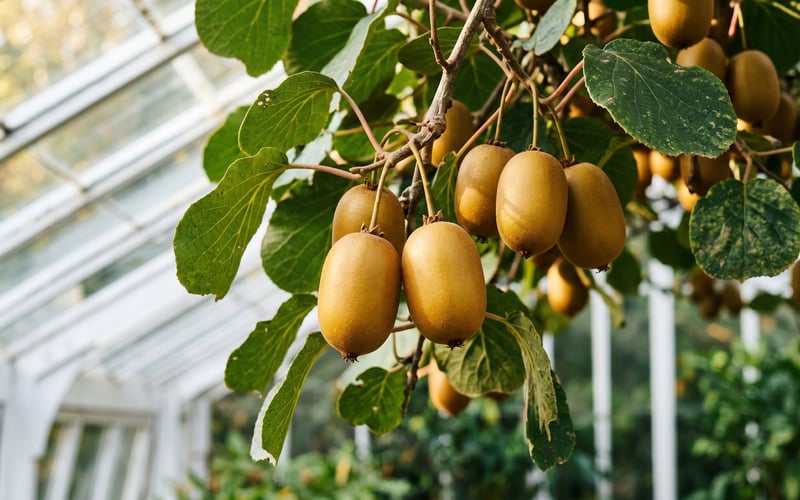
Actinidia deliciosa ‘Jenny’ is the top choice for most growers. Self-fertile (so one plant fruits), full-size fuzzy fruit identical to supermarket kiwis, 3-4 years to first crop. Needs winter temperatures above 5C and summer temperatures below 27C. Suits heated or well-insulated greenhouses in all UK regions. A mature vine produces 30-50kg of fruit a year.
Actinidia deliciosa ‘Hayward’ is the commercial standard. Produces larger fruit than Jenny with superior flavour — this is the variety almost every supermarket kiwi descends from. The catch is that Hayward is female-only and needs a male pollinator plant (usually ‘Tomuri’) planted within 3 metres. You need space for two vines, which means a 10x12ft greenhouse minimum. Plant one male for every six to eight female vines if you scale up.
Actinidia deliciosa ‘Boskoop’ is a Dutch-bred self-fertile cultivar gaining popularity in northern Europe. Fruit is slightly smaller than Hayward but the flavour is sharper and the vine is more cold-tolerant than Jenny. A good middle ground between Jenny and Hayward for cooler greenhouses in Scotland and northern England.
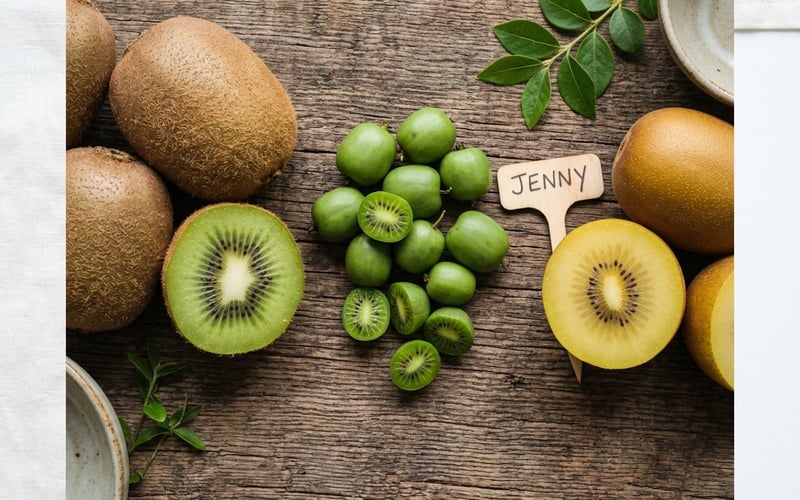
Actinidia arguta ‘Issai’ is the hardy option. Small smooth-skinned kiwi berries that you eat whole, skin and all. Self-fertile, tolerates temperatures down to -15C, fruits in just 2-3 years. The best choice for unheated greenhouses, cold frames, and gardens north of Manchester. Fruit is grape-sized but sweeter than standard kiwi — closer to a melon-grape hybrid in flavour.
Actinidia chinensis (golden kiwi) is the gourmet option. Smooth bronze-yellow skin, sweet golden-yellow flesh, almost no acidity. Sold in UK supermarkets as ‘SunGold’ or ‘Zespri Gold’ at premium prices (£1.50-£2 per fruit). Slightly less hardy than deliciosa, so suits a heated greenhouse in the south of England. Cultivars to look for: ‘Hort 16A’ and the more recent ‘Gold3’.
Actinidia kolomikta (silver vine / variegated kiwi) is the ornamental dual-purpose choice. Heart-shaped leaves splashed with pink and white — striking against a backdrop of plain glazing. Produces small grape-sized fruit similar to arguta. Tolerates cold well. Excellent if you want a kiwi vine that looks decorative outside the fruiting season. Cats love the foliage (the leaves contain actinidine, the active compound in catnip-style attractants) — not always welcome inside a greenhouse.
| Variety | Species | Self-fertile? | Fruit size | Years to fruit | Min winter temp | Best for |
|---|---|---|---|---|---|---|
| Jenny (Matt’s Pick) | A. deliciosa | Yes | Standard (60-80g) | 3-4 | 5C | Most greenhouse growers |
| Hayward | A. deliciosa | No (needs male) | Large (80-120g) | 3-4 | 5C | Larger greenhouses, best flavour |
| Boskoop | A. deliciosa | Yes | Standard (50-70g) | 3-4 | 2C | Northern UK, cooler greenhouses |
| Issai | A. arguta | Yes | Small berry (8-15g) | 2-3 | -15C | Unheated greenhouses, cold regions |
| Golden (SunGold) | A. chinensis | No (needs male) | Standard (90-110g) | 4-5 | 5C | Heated greenhouses, premium fruit |
| Silver vine (kolomikta) | A. kolomikta | No (needs male) | Grape-sized (5-10g) | 3-4 | -20C | Ornamental + fruit, cold regions |
| Tomuri (male) | A. deliciosa | Pollinator only | No fruit | N/A | 5C | Pollinator for Hayward |
What size greenhouse do you need for kiwi?
A single kiwi vine needs a greenhouse that is at least 8x10ft (2.4m x 3m). The vine will fill this space within 2-3 years when trained on wires. For two vines (one male, one female), you need 10x12ft (3m x 3.6m) minimum. Space plants 3-3.5 metres apart.
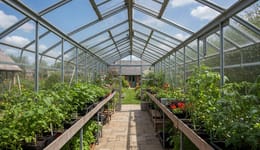
Eave height matters more than floor space for kiwi. The vine grows vertically before being trained horizontally. A greenhouse with 1.5m eave height and 2.5m ridge height gives the best growing structure. The lowest training wire sits at 60cm, with two or three horizontal tiers above it at 40-50cm intervals up to the eaves.
If you are choosing a new greenhouse for kiwi growing, consider our aluminium greenhouse range. Aluminium frames are ideal for attaching training wires with bolt-on clips.
When to plant kiwi in a UK greenhouse
Plant kiwi vines in late spring once the risk of hard frost has passed — mid-April to late May for most UK regions, two weeks later in Scotland and the north. Container-grown vines from a nursery can technically go in any time the soil is workable, but spring planting gives the roots a full growing season to establish before the first dormant winter.
Avoid autumn planting under glass. The vine puts on a flush of soft growth in the warm greenhouse, then runs into its first frosty night without time to harden off — the result is dieback to the graft and a year lost. Wait until April.
How to set up training wires for kiwi vines
Training wires are the single most important element of kiwi growing. Without them, the vine grows into an unmanageable tangle within one season. Install wires before planting.
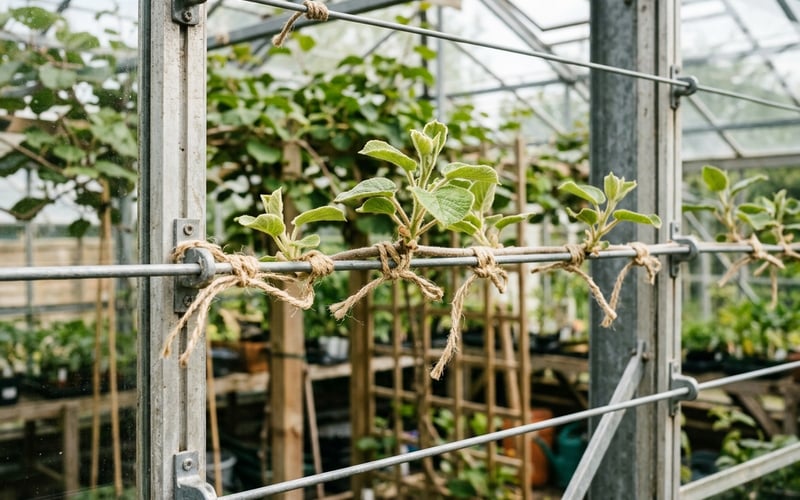
Run horizontal galvanised wire along the longest wall of your greenhouse at 40cm, 80cm, 120cm, and 160cm from the ground. Fix each wire to the aluminium frame using stainless steel vine eyes or wire clips bolted through the glazing bar. Tension wires taut with turnbuckles at each end. The wires need to support 15-20kg of fruit plus foliage when the vine matures.
Shop Elite Wire Clips (50 pack) £30 →
Plant the kiwi at the base of the wire system. Train one main stem (the leader) vertically up a bamboo cane to the top wire. As lateral branches develop, tie them horizontally along each wire using soft garden twine. Remove any shoots growing away from the wire framework. This makes a flat, fan-shaped structure that maximises light exposure to every leaf and fruit.
Planting and soil preparation
Plant kiwi vines in late spring (April-May) when the risk of frost has passed. Dig a planting hole 60cm wide and 45cm deep at the base of your wire framework. Mix the excavated soil with well-rotted garden compost at a 50:50 ratio. Kiwi prefers a slightly acidic, well-drained but moisture-retentive soil with a pH between 5.5 and 6.5 — somewhere between rhododendron soil and ordinary garden loam. A pH above 7 causes iron deficiency and yellow leaves; below 5 stunts root development.
If planting directly into greenhouse borders, improve drainage by adding a 10cm layer of gravel at the base of the planting hole. If your greenhouse has a concrete base, grow in a large container (minimum 50-litre pot) filled with John Innes No.3 compost mixed with perlite for drainage.
Water the new plant thoroughly after planting. Apply a 5cm mulch of bark chips or garden compost around the base, keeping it 5cm away from the stem to prevent rot. Kiwi roots are shallow and benefit from mulch that keeps them cool and moist in summer.
Temperature management: the key to UK kiwi success
Temperature control is where greenhouse kiwi growing succeeds or fails in the UK. The vine needs warmth to grow and fruit but suffers in extreme heat. Getting this balance right across all four seasons is the challenge.
Spring (March-May): New shoots are extremely vulnerable to late frosts. Keep the greenhouse above 7C at night until mid-May. An electric fan heater with a thermostat set to 7C handles this automatically. Open vents during the day when temperatures exceed 18C. A second layer of horticultural fleece draped over the vine on the worst nights gives an extra 2-3C of frost protection without needing the heater on full.
Summer (June-August): Kiwi grows fastest at 20-25C. Above 27C, growth slows. Above 35C, pollen dies and fruit set fails. Automatic vent openers are essential. Damp down the greenhouse floor 2-3 times daily in heatwaves to lower air temperature by 3-5C. Read our ventilation guide for detailed temperature management advice.
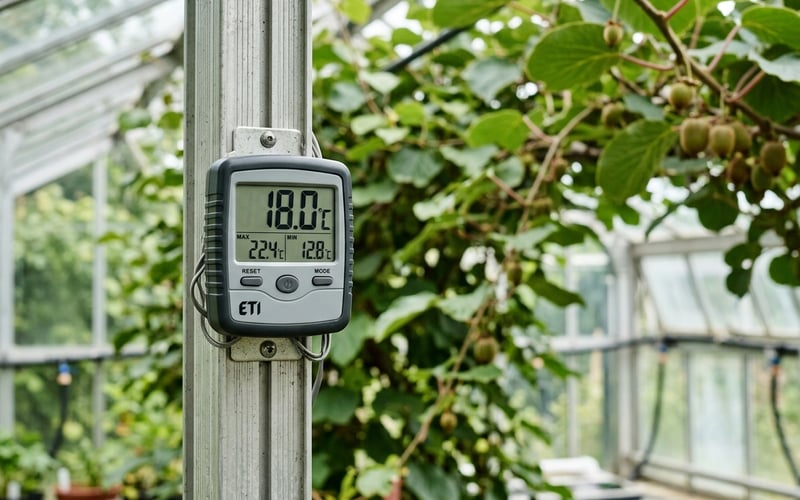
Shop Elite Digital Thermometer £44 →
Autumn (September-November): Allow temperatures to drop gradually as the vine prepares for dormancy. Stop feeding in September. Reduce watering from October. The leaves will yellow and drop naturally in November.
Winter (December-February): Kiwi needs a cold period (vernalisation) to set fruit the following year. The vine must experience 600-800 hours below 7C during winter dormancy. In an unheated greenhouse, this happens naturally. If you heat your greenhouse, set the thermostat to 5C minimum to prevent frost damage to the trunk while still allowing the cold period. Do not heat above 10C in winter or the vine will not fruit properly the following year.
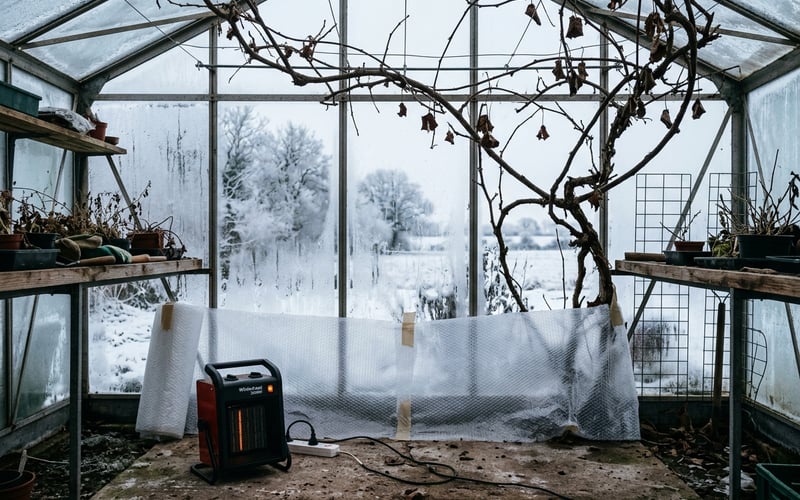
Shop Eden 2KW Greenhouse Heater £140 →
Matt’s Tip: Ventilation for kiwi
I always recommend fitting at least two automatic vent openers when a customer plans to grow kiwi or grapes. The wax cylinder inside the opener reacts to temperature and starts opening the vent at 15C. By 25C the vent is fully open. This means your kiwi vine never overheats, even if you are at work all day. The Elite automatic louvre vent opener costs £59 and saves you from losing an entire fruit crop to one hot afternoon. I have seen it happen more than once.
How to pollinate kiwi in a greenhouse
Greenhouse-grown kiwi must be hand-pollinated because bees and other insects cannot access the flowers through glass. This is the step most beginners forget, and it results in a vine that grows but produces no fruit.
Kiwi flowers open in May-June. They last 3-5 days each. Use a small soft paintbrush or cotton bud to collect yellow pollen from the stamens of an open flower. Transfer this pollen to the stigma (the central sticky part) of another flower. Repeat for every open flower. Do this daily for 2-3 weeks during the flowering period.
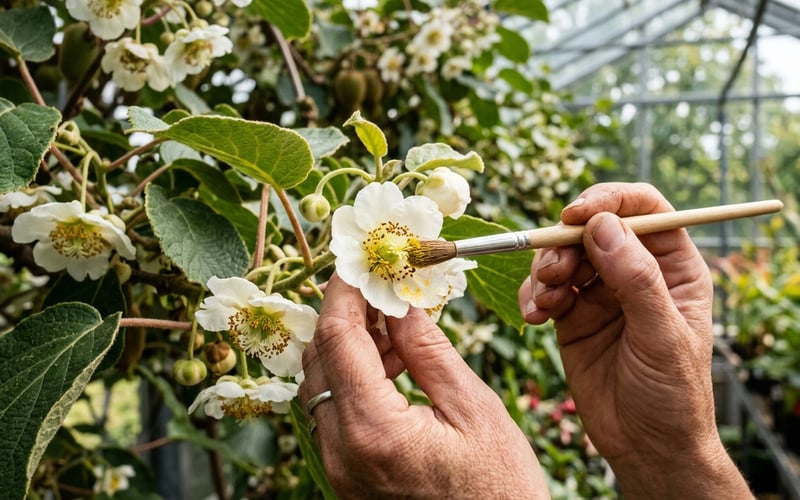
If you are growing a self-fertile variety like Jenny, you still need to transfer pollen between flowers on the same plant. The flower structure means wind alone is not enough indoors. A gentle shake of the vine combined with brush work gives the best fruit set. Our fruit growing guide covers hand pollination technique in more detail.
Pruning: summer pinching and winter framework
Kiwi grows 3-6 metres of new growth per season. Without pruning, the vine becomes a dense tangle that shades its own fruit and fills the greenhouse. Prune twice a year: a light summer pinch and a harder winter cut.
Summer pruning (June-August): Pinch or cut the growing tip of each fruiting shoot 4-5 leaves beyond the last fruit. This directs energy into the fruit rather than leaf growth. Remove any shoots growing straight up or away from the wire framework. Remove suckers from the base of the trunk.
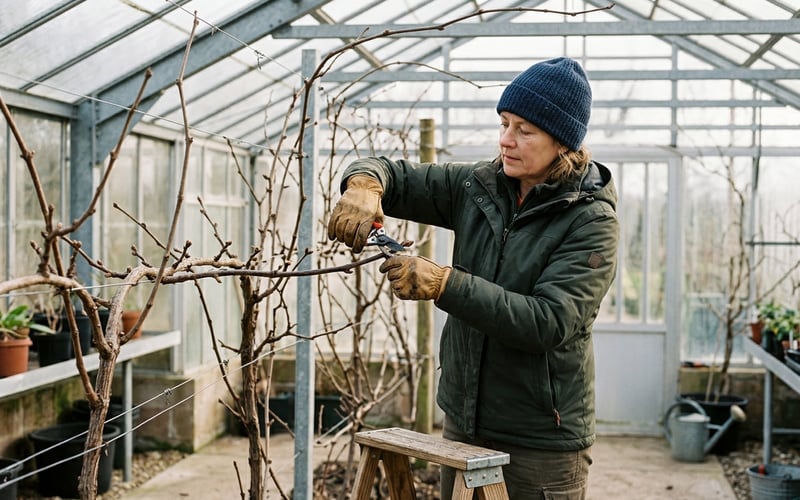
Winter pruning (December-January): Once the leaves have dropped, cut each lateral shoot back to 3-4 buds from the main framework wire. Remove any dead, damaged, or crossing branches. Remove one-quarter of the oldest lateral branches each winter to encourage new productive wood. Keep the main leader and primary arms untouched unless they have outgrown the greenhouse.
Sharp bypass secateurs make clean cuts that heal quickly. Read our common greenhouse growing mistakes guide for more on the consequences of skipping pruning on vigorous crops.
Pests and diseases of greenhouse kiwi
Kiwi is one of the more pest-resistant climbers under glass, but the warm, sheltered environment of a greenhouse will eventually attract problems. Five issues are worth knowing about:
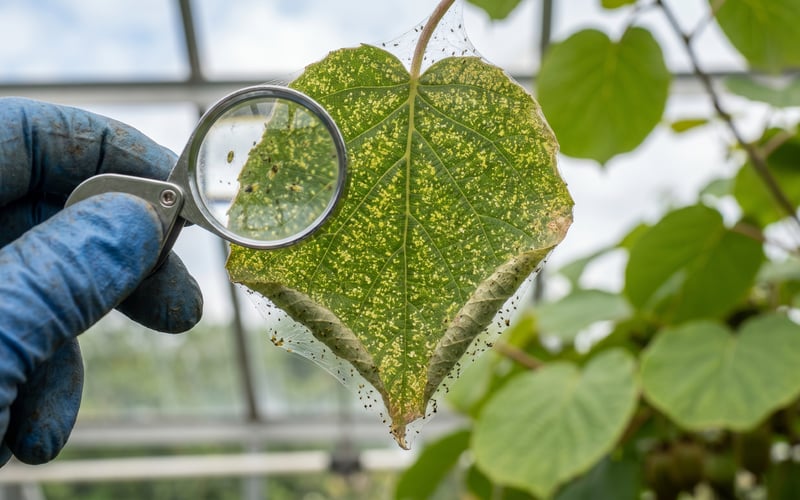
Two-spotted spider mite (red spider mite). The most common pest on greenhouse kiwi. Hot, dry conditions in July-August trigger outbreaks. The first sign is faint yellow stippling on the upper leaf surface, with fine webbing visible on the underside. Increase humidity by damping down twice a day, introduce Phytoseiulus persimilis biological predators if the infestation spreads, and spray badly affected leaves with diluted insecticidal soap (1 tablespoon to 1 litre of water) every five days for three weeks.
Vine weevil. Adult weevils chew distinctive notches in leaf margins from spring to autumn. The serious damage is from the grubs that hatch in late summer and eat the kiwi’s shallow roots. Water container-grown vines with biological nematodes (Steinernema kraussei) in August-September to wipe out the larvae before they kill the plant.
Thrips. Tiny slender black insects that scrape the leaf surface, leaving silvery patches that turn brown. Heaviest damage is in April-May when the new shoots are soft. Sticky blue traps catch flying adults; horticultural soap controls populations on the leaves.
Phytophthora root rot. A soil-borne fungal disease that attacks waterlogged kiwi roots in winter. The symptom is sudden vine collapse in spring after the leaves emerge. Prevention is everything: improve drainage at planting (gravel layer at the base of the hole), do not water from October to March, and avoid heavy clay borders without a 50% sand-and-grit improvement.
Honey fungus (Armillaria). Rare in greenhouse soils but worth checking if your kiwi suddenly dies after years of healthy growth. White fungal sheets under the bark at the base of the trunk are the giveaway. There is no cure; remove the vine and replace the top 30cm of border soil.
None of these are common enough to deter most growers. A well-ventilated, well-drained greenhouse with one annual nematode drench in August keeps almost every kiwi vine pest-free for its full 30-year life.
Watering and feeding
Kiwi vines are heavy drinkers during the growing season (April-September). Water deeply 2-3 times per week in summer, more often during hot spells. The soil should be consistently moist but never waterlogged. Shallow watering encourages surface roots that dry out quickly.
From October to March, reduce watering dramatically. The dormant vine needs almost no water. Waterlogged soil during winter dormancy causes root rot, which is the most common reason for vine death in UK greenhouses.
Feed with a high-potassium liquid fertiliser (tomato feed works well) every two weeks from April to August. Switch to a phosphorus-rich feed when flowers appear in May to improve fruit set. A monthly drench with diluted comfrey or seaweed feed adds the trace minerals (boron, manganese, zinc) that improve fruit size and storage life. Stop feeding entirely in September to help the vine harden off before winter.
Month-by-month growing calendar
| Month | Task | Temperature |
|---|---|---|
| January | Winter pruning. Cut laterals to 3-4 buds. Remove oldest wood. | Keep above 5C |
| February | Check wire tensions. Repair any frost-damaged branches. | Keep above 5C |
| March | New growth begins. Start watering lightly. Apply first feed. | Min 7C at night |
| April | Tie new shoots to wires. Increase watering. Feed fortnightly. | 10-20C ideal |
| May | Flowers open. Hand-pollinate daily. Watch for late frost. | 15-25C ideal |
| June | Summer pruning begins. Pinch shoots 4-5 leaves beyond fruit. | 18-25C ideal |
| July | Continue pruning. Water heavily. Damp down in heatwaves. Watch for spider mite. | Keep below 27C |
| August | Fruit swelling. Maintain watering. Apply nematode drench against vine weevil. | Keep below 27C |
| September | Stop feeding. Reduce watering. Fruit begins to ripen. | Let cool naturally |
| October | Harvest when fruit gives slightly to thumb pressure. | Let cool naturally |
| November | Leaves drop. Stop watering. Clean up fallen leaves. | No heating yet |
| December | Dormant. Start winter pruning late December. | Keep above 5C |
Harvesting and storing kiwi fruit
Kiwi fruit ripens in October-November in UK greenhouses. The fruit does not all ripen at once, so harvest over 3-4 weeks. Pick when the fruit gives slightly to gentle thumb pressure. Unripe fruit can be picked hard and ripened indoors at room temperature over 1-2 weeks.
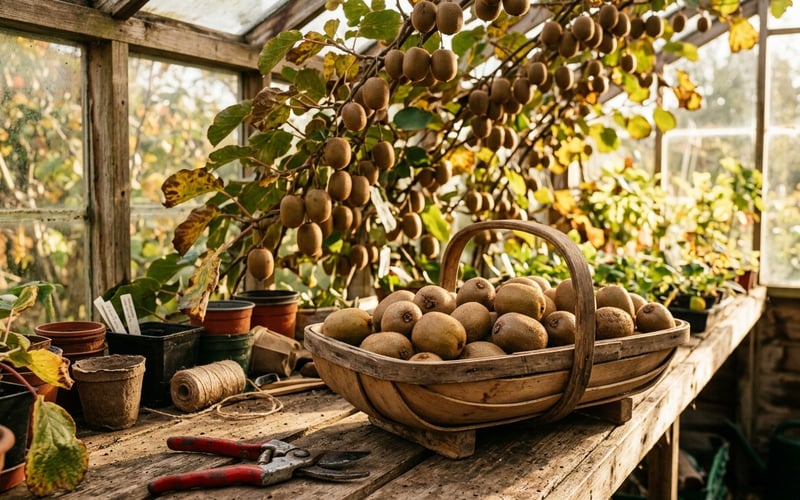
Store harvested kiwi in a cool place (4-8C) for up to 3 months. A garage, unheated porch, or the fridge works well. Whole kiwi can also be frozen for up to a year — peel and slice first; the texture is poor after thawing but the flesh works well in smoothies and baking. To speed up ripening, place kiwi in a paper bag with a banana. The ethylene gas from the banana triggers ripening within 3-5 days.
A single mature Jenny vine produces 30-50kg of fruit per year. That is roughly 400-600 individual kiwis. Most growers end up giving fruit away to neighbours, which is not a bad problem to have.
Kiwi vs grapes: which climber is right for your greenhouse?
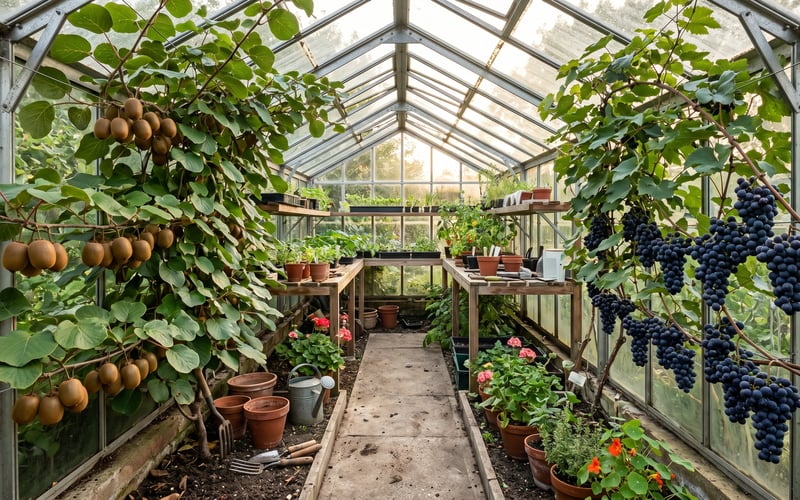
The two big greenhouse climbers in the UK are grapes and kiwi. Both produce 30+kg of fruit a year from a single vine, both live 25-30 years if pruned, and both train onto the same wire framework. The differences come down to disease, ripening reliability, and what you do with the fruit.
| Factor | Kiwi (Jenny) | Greenhouse grapes (Black Hamburgh) |
|---|---|---|
| Years to first crop | 3-4 | 3-5 |
| Annual yield (mature) | 30-50kg | 15-25kg |
| Disease risk under glass | Low | High (powdery mildew, downy mildew) |
| Ripening reliability in UK | Reliable in north and south | South of England only without heat |
| Storage life | 3 months refrigerated | 1-2 weeks fresh |
| Vine lifespan | 30+ years | 25-30 years |
| Hand pollination needed? | Yes | No (wind/self-pollinating) |
| Pruning complexity | Twice a year, simple | Twice a year, more complex |
If you want the most reliable, longest-storing crop with the fewest disease problems, plant kiwi. If you want fresh dessert fruit with no pollination work, plant a grape vine. Many of our customers plant both — kiwi at one end of an 8x14 greenhouse, grapes at the other — for full glass-to-glass productivity. Read our greenhouse grapes guide for the parallel walkthrough.
|
Matt’s pick: essential for kiwi growingBest For: Monitoring overnight lows and daytime highs in your kiwi greenhouse Why I Recommend It: The ETI digital thermometer records maximum and minimum temperatures over 24 hours. I tell every kiwi grower to check the min reading each morning from March to May. If it dropped below 7C overnight, your new shoots are at risk and you need to adjust your heater thermostat. This one tool prevents the most common cause of failed kiwi crops: spring frost damage to new growth. Price: £44 |
Common problems and solutions
No fruit after 4+ years: The three most common causes are insufficient winter chill (keep greenhouse below 7C for 600+ hours), failed pollination (hand-pollinate daily during flowering), or excessive nitrogen fertiliser (switch to high-potassium feed).
Leaf scorch and wilting in summer: Temperature above 27C. Improve ventilation with automatic vent openers. Damp down the greenhouse floor. Apply temporary shade paint to south-facing glass panels.
Yellow leaves with green veins: Iron deficiency from alkaline soil. Test soil pH; if above 7, apply chelated iron (sequestered iron) as a foliar feed in spring. Long-term, top-dress the planting hole with ericaceous compost each autumn.
Root rot and vine death: Overwatering during winter dormancy. Reduce watering from October. Improve drainage in the planting hole. Never let the root zone sit in standing water.
Small or misshapen fruit: Poor pollination. Hand-pollinate more thoroughly next season. Use a soft brush rather than just shaking the vine.
Vine growing too fast, no fruit: Too much nitrogen. Stop using general-purpose fertiliser. Switch to tomato feed (high potassium, low nitrogen) from April onwards.
Frequently asked questions
Can you grow kiwi fruit in an unheated greenhouse in the UK?
Yes, hardy kiwi berries (Actinidia arguta ‘Issai’) survive down to -15C. This variety produces small smooth-skinned fruit in unheated greenhouses across all UK regions. Standard fuzzy kiwi (Actinidia deliciosa) needs winter heating above 5C, which means an electric heater with thermostat in most parts of the UK.
How long does kiwi take to fruit in a greenhouse?
Most varieties fruit in 3-4 years from planting. Hardy kiwi berries (Issai) can fruit in 2-3 years. Golden kiwi (A. chinensis) takes 4-5 years. The vine grows vigorously from year one but directs energy into establishing roots and framework before fruiting.
Do you need two kiwi plants to get fruit?
Not if you grow a self-fertile variety like Jenny, Boskoop, or Issai. These produce fruit from a single plant. Hayward and golden kiwi (SunGold) are female-only and need a male pollinator (Tomuri) within 3 metres. One male pollinates up to eight female plants.
How do you pollinate kiwi in a greenhouse?
Use a soft paintbrush to transfer pollen between flowers. Kiwi flowers open in May-June. Touch the brush to the yellow stamens of one flower, then dab the sticky stigma of another. Repeat for every open flower daily for 2-3 weeks during the flowering period.
What temperature does kiwi need in a greenhouse?
Growing season: 18-25C ideal, never above 27C. Winter dormancy: 5-7C minimum, with 600-800 hours below 7C needed for vernalisation. Spring: protect new shoots from frost, keep above 7C at night from March to May.
Is kiwi fruit a berry?
Yes, kiwi is botanically classified as a true berry. Like tomatoes and grapes, kiwi develops from a single ovary with multiple seeds embedded in the flesh — the botanical definition of a berry. Each kiwi fruit contains 400 to over 1,000 tiny seeds. The bright green flesh under the fuzzy skin is the ovary wall.
When do you harvest kiwi from a greenhouse in the UK?
October to November in most UK regions. Pick when fruit gives slightly to gentle thumb pressure. Unripe fruit can be picked hard and ripened at room temperature over 1-2 weeks. Store ripe fruit at 4-8C for up to 3 months, or freeze peeled and sliced for up to a year.
How much fruit does one kiwi vine produce?
A mature vine yields 30-50kg of fruit per season. That is roughly 400-600 individual kiwi fruits from a single plant. Yields start small in year 3-4 and increase annually until the vine reaches full maturity at 8-10 years old.
Are kiwi vines better than grapes in a greenhouse?
Kiwi vines are more reliable and disease-resistant than grapes in UK greenhouses. A Jenny kiwi vine yields 30-50kg of fruit a year against 15-25kg from a Black Hamburgh grape vine, suffers less from powdery and downy mildew, ripens reliably across the UK, and stores for three months refrigerated. Grapes still win on fresh dessert flavour and easier pollination.