Red Spider Mite in a Heatwave: Why Your Predators Fail
Glasshouse red spider mite explodes in hot, dry weather, and 2026 has handed it the best summer in years. The RHS puts the lifecycle at 55 days at 10C and just 12 days at 21C. Push into the thirties and it drops to about a week. The trap most growers fall into is buying Phytoseiulus in a heatwave: the mite's peak breeding temperature is 30C, which is exactly where that predator starts to fail. From our work with Greenhouse Stores customers since 2012, here is what actually works.
Key Takeaways
- They are not red in summer. The RHS describes them as yellowish-green with two darker markings. Orange-red is the overwintering colour.
- The lifecycle collapses from 55 days at 10C to 12 days at 21C (RHS), and roughly 7 days around 30C.
- Female fecundity peaks at exactly 30C, at about 89 eggs each, then falls back at 35C.
- Phytoseiulus persimilis stops feeding above 35C and needs humidity over 70%. It is the wrong predator for a heatwave.
- Neoseiulus californicus works from 13C to 32C and tolerates drier air. In a hot spell it is the better buy.
- Damping down slows them and helps the predator, but the RHS is clear it "will not, on its own, control this mite".
- Yellow sticky traps monitor whitefly. They do not control it, and they kill the parasitic wasps you paid for.
Browse Greenhouse Growing Accessories →
Expert Tip
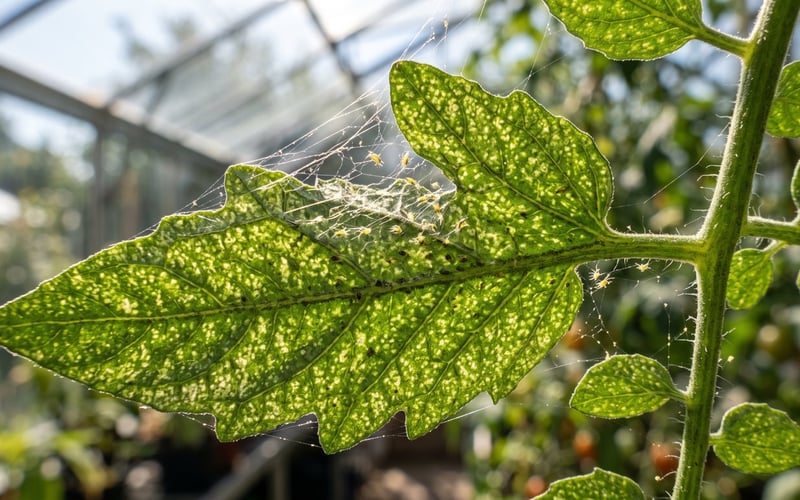
Every year I get called to a greenhouse in late July where the cucumbers look dusty and grey and the owner tells me they have not got red spider mite, because there is nothing red on the leaves. There never is. By the time you see anything actually red, you are usually looking at mites that are leaving because the plant is finished. The thing that gives it away long before the webbing is the light. Hold a leaf up against the glass and look for a fine pale speckling, like someone has gone over it with a pin. That is feeding damage, and at that point you have a fortnight to act rather than a season to regret.
How to identify glasshouse red spider mite
Start with the name, because it misleads more people than any other pest in a British greenhouse.
The RHS describes them in spring and summer as "yellowish-green with a pair of darker markings", and notes they "typically only become orange-red during the autumn and winter resting period, or when a plant has become uninhabitable due to their feeding activity". Read that second half again. If your mites are red in July, it is not because they are healthy. It is because the plant they are on is finished and they are preparing to move.
They are small. The RHS says "up to 1 mm, less than 1/16 in, just visible to the naked eye", and most references put adult females at roughly half a millimetre. Either way, you will see them as moving dust rather than as animals. They sit on the underside of leaves.
What you actually spot first, in order:
- Fine pale mottling on the upper leaf surface. The RHS wording is exact and worth memorising, because this is the early sign. Backlight the leaf against the glass and it shows up as a pin-prick stipple.
- Loss of colour, then a dull bronze cast across whole leaves.
- Fine silk webbing between leaves and stems. This is a late sign. Webbing means a heavy, established population, not an early warning.
- Leaves drying and falling. Game over for that plant.
Worst affected under UK glass: tomatoes, cucumbers, aubergines, peppers and vines. Cucumbers usually go first, and they go fast.

Why red spider mite explodes in a heatwave
Because heat compresses the lifecycle, and dry air removes the only natural brake.
The RHS gives two figures that tell the story on their own. At 10C, egg to adult takes about 55 days. At 21C, it takes 12. That is not a gentle acceleration. That is a different animal.
Push higher and it tightens further. US extension work puts development at around 7 to 8 days at 27 to 28C, and roughly 7 days at 30C, with the optimum sitting at 25 to 30C combined with humidity below 60%. Breeding runs continuously from March to October under glass, and greenhouses commonly see eight to ten overlapping generations in a year.
| Temperature | Egg to adult | Source | What it means in your greenhouse |
|---|---|---|---|
| Below 12C | Development stops | US extension | The developmental threshold |
| 10C | About 55 days | RHS | Barely ticking over |
| 15C | 33 days | US extension | Slow build |
| 21C | 12 days | RHS | Now it is a problem |
| 27-28C | 7-8 days | US extension | Doubling weekly |
| 30C, under 60% humidity | About 7 days | US extension | Their perfect storm |
Now add the breeding rate. Female fecundity peaks at 30C, at around 89 eggs each, and actually falls back to about 71 at 35C. A single female lays 100-plus in a lifetime. Seven-day generations, ninety eggs a female, no brake: that is why a greenhouse goes from clean to webbed in three weeks in a July like this one.
2026 has been unusually good for them. England had its warmest June on record, the Met Office logged 37.7C at Lingwood in Norfolk on 26 June, and there have been eight days above 34C, more than in any year on record. Days in the low thirties under glass are days at the top of that table.
The heatwave trap: why Phytoseiulus is the wrong buy right now
This is the part that costs people money, and almost nobody mentions it.
Phytoseiulus persimilis is the predatory mite everyone knows and every garden centre sells for red spider mite. It is genuinely excellent. At around 20C an adult female eats up to five adult mites or twenty eggs and larvae a day, and it will clear an infestation.
But look at its numbers. Koppert give the optimal range as 13 to 27C, with prey consumption falling away above 30C and feeding stopping altogether above 35C. Dragonfli put activity as reduced above 27C and below 70% humidity. It is sensitive to humidity under 70%.
Now hold that against the mite. The pest breeds fastest at 30C in air below 60% humidity. Which is to say: the conditions the pest likes best are precisely the conditions the predator likes least. Tipping a sachet of persimilis into a 35C greenhouse with dry air in the middle of a heatwave is close to setting fire to a twenty pound note. The prey are breeding on a seven-day clock and your predator has stopped eating.
Matt's Installation Tip
Check what you sprayed before you buy any predator. Dragonfli are explicit: do not introduce if you have used chemical treatments in the past two weeks. Natural pyrethrum and SB Plant Invigorator need a two day gap. Other insecticides leave residues that will kill predatory mites long after they have stopped touching the pest. I have watched a customer spray on the Saturday, release forty pounds of predators on the Sunday, and wonder on the Friday why nothing happened. The order matters more than the products.
Buy Neoseiulus californicus instead
There is a predator built for exactly this weather, and hardly anyone recommends it.
Neoseiulus californicus, also sold as Amblyseius californicus, is active from 13C to 32C and tolerates humidity down to around 60 to 65%. Koppert describe it as more tolerant of higher temperatures, lower humidities and pesticides than Phytoseiulus persimilis. The RHS lists it for preventative, out-of-season use.
| Factor | Phytoseiulus persimilis | Neoseiulus californicus | Matt's verdict |
|---|---|---|---|
| Working range | 13-27C | 13-32C | californicus in a heat spell |
| Above 30C | Prey consumption drops | Still working | californicus |
| Above 35C | Stops feeding entirely | Struggles too | Cool the house either way |
| Humidity needed | Over 70% | 60-65% is enough | californicus in dry air |
| Appetite when conditions suit | Ferocious: clears infestations | Steadier, more persistent | persimilis once it cools |
| Best use | Established outbreak at 15-27C | Hot, dry spells and prevention | Cool first, then either works |
The honest summary: get the temperature down and persimilis becomes the better animal again. If you cannot get it down, californicus is the one with a chance. And whichever you buy, timing beats quantity. Introduce at the first stippling on one or two leaves, not when you can see webbing. Predators are a control, not a cure.
Damping down: what it does and what it does not
Damping down is the free lever, and it works on two fronts at once. Soaking the floor and paths raises humidity and drops the air temperature, which slows the mite's development and nudges conditions towards what the predator needs.
Be clear about the limit, though, because most articles are not. The RHS states that regular syringing and maintaining high humidity "reduce the risk, but will not, on its own, control this mite". It is a brake. It buys you time and makes everything else work better. It will not clear an infestation, and anyone telling you a wet floor fixes red spider mite has not had a real one.
There is a cost, too. Push humidity hard in still air and you invite botrytis. Damp down in the morning and again at midday, never in the evening, and keep the air moving. That last point is where ventilation and pest control turn out to be the same job.
For the mechanics of damping down and the order to cool a greenhouse in, see our greenhouse cooling guide. Shading is the other half of the answer, because you cannot damp your way out of an unshaded 45C roof: the shading guide compares the methods and costs.

Shop the Elite Shade Netting Kit →
|
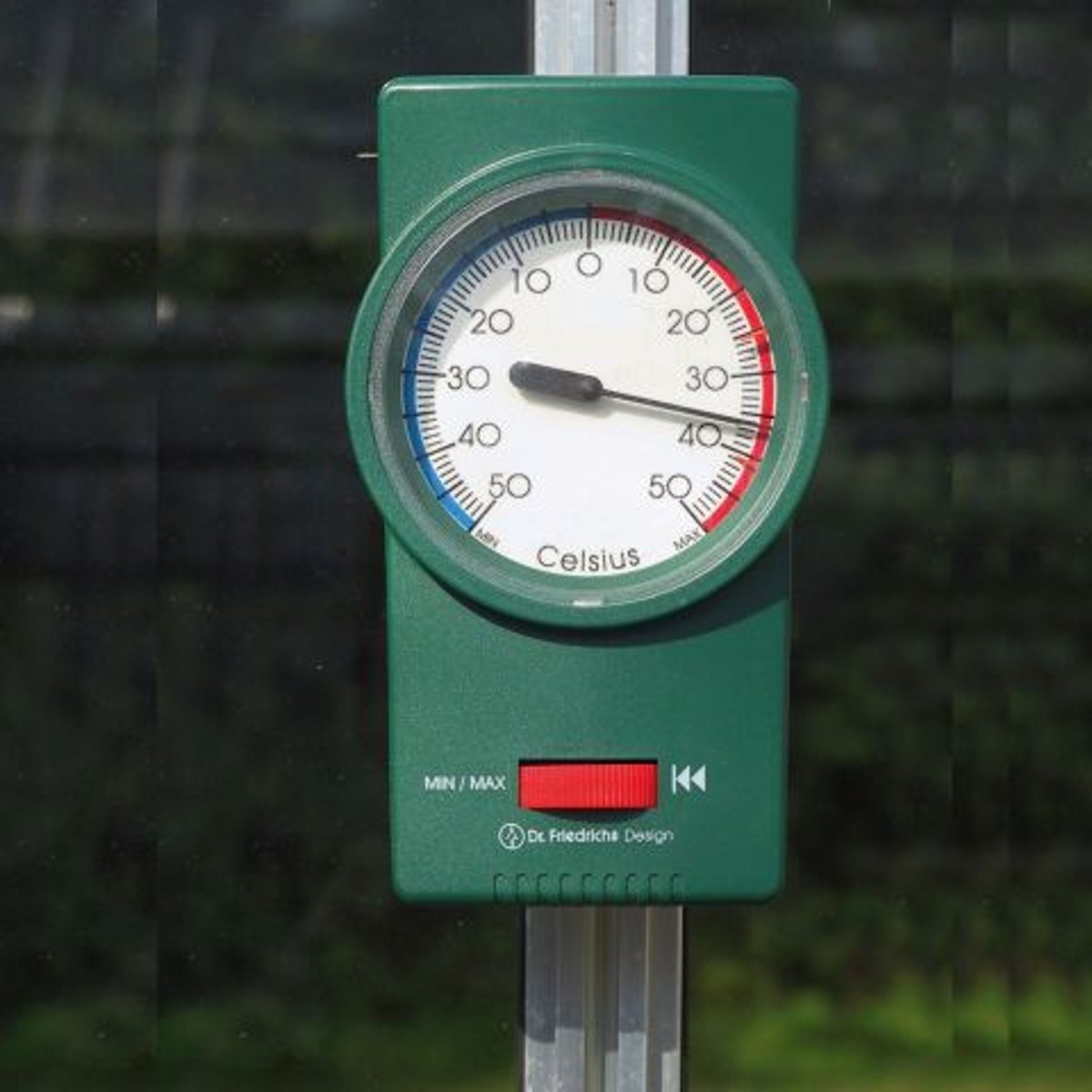
Matt's Pick for Getting Ahead of Red Spider MiteBest For: knowing whether your greenhouse is sitting in the mite's favourite band Why I Recommend It: every number in this article is a temperature, and almost nobody actually knows what their greenhouse does at its peak. A max-min tells you whether you spent the week at 24C or at 31C, and those two greenhouses have completely different pest problems. I would rather a customer spent thirty pounds finding out than fifty on predators that were never going to work in the conditions they had. Price: £30 |
Whitefly: the other hot-weather headache
Glasshouse whitefly rides the same warm summer, but the story is not identical and it is worth being accurate.
Adults are about 1.5mm, white, and fly up in a cloud when you brush the plant. The nymphs are the damaging stage: flat, oval, scale-like and creamy white on leaf undersides. The RHS puts the lifecycle at several months at 10C and about three weeks at 21C, and each female lays more than 200 eggs, without needing a male. Both adults and nymphs excrete honeydew, which then grows black sooty mould.
Here is where the naive version goes wrong. Warmth accelerates whitefly through the twenties, which drives the summer build-up. But Trialeurodes vaporariorum is a temperate species and genuinely extreme heat stresses it too: egg-laying drops off at 37C and above, and at 43C females almost stop laying entirely. So whitefly is the warm-summer winner. Red spider mite is the heatwave winner. In a 35C greenhouse the mite is your problem.
Matt's Tip: Yellow Sticky Traps Are Not Pest Control
The RHS says yellow sticky sheets help "monitor whitefly activity rather than give control", and warns they "often catch non-target organisms including parasitoid wasp predators". Read that twice if you have just bought Encarsia. The traps will happily catch the wasps you paid for. Use one trap as a thermometer for the population, so you know when numbers are climbing. Do not paper the greenhouse with them and call it a strategy.
If you are using Encarsia formosa against whitefly, it needs a 24-hour average above 17C to work properly, with 20 to 25C the sweet spot, and its survival drops above 30C. The RHS makes the timing point plainly: introduce the parasitoid "before plants are heavily affected as it cannot give instant control". Parasitised nymphs turn black, which makes progress easy to check. Do not hang the cards in direct sunlight.
What about sprays?
We follow the RHS's lead here and name no pesticide products, for a reason that is worth stating.
The RHS pages for both glasshouse red spider mite and glasshouse whitefly contain no pesticide recommendation at all. Their position is that gardeners have "a duty to avoid the use of neonicotinoids and other pesticides", that non-chemical methods "should be the first line of control", and that any chemical control "should be used only in a minimal and highly targeted manner". Since spring 2023 the RHS has stopped selling registered pesticides in its plant centres and online entirely.
Products approved for home gardeners are legally available, and authorisations change. If you want to check what is currently approved, the HSE pesticides database is the authoritative source and it is the one the RHS points to. We would rather send you there than print a product name that is out of date by next season. It would also be an odd look for us to be keener on spraying than the RHS is.
For the non-chemical options across every greenhouse pest, our greenhouse pest control guide works through them, and companion planting covers what the research actually supports.
Autumn clean-down: where next year's infestation is sitting right now
The mites you have in July decide what you get next April, and this is the step everyone skips.
Come autumn, mature females turn orange-red and go dormant. The RHS describes them resting in "cracks and crevices, glasshouse frames, stakes, canes, soil and plant debris", emerging from late March onwards. They are not on the plants. They are in your greenhouse.
So: pull severely affected plants in late summer, before shortening days push the females into dormancy. Clear out plant debris, old canes, stakes and ties before spring. Where you can empty a house completely, clean it thoroughly with a glasshouse disinfectant. An hour with a brush in October beats a season of predators next year.
"We do not sell biological controls, and I am not going to pretend otherwise in an article about them. Buy your predators from a specialist who ships them alive and overnight, because that is the bit that matters and it is not something we do well. What I do sell is the shade netting and the vents, and honestly that is the half of the problem worth spending money on. Get the house out of the thirties and the predators do their own work. Leave it at 35C and no sachet will save you."
— Matt W, Greenhouse Stores
Frequently asked questions
Why are my red spider mites not red?
Because in summer they are yellowish-green with two dark spots. The RHS says they typically only turn orange-red during the autumn and winter resting period, or when a plant has become uninhabitable through their feeding. Red mites in July usually mean the plant is already finished and they are moving on.
How quickly does red spider mite multiply in hot weather?
Egg to adult drops to about seven days near 30C. The RHS gives 55 days at 10C and 12 days at 21C. Above that it tightens further, with US extension work putting it at 7 to 8 days at 27 to 28C. Females also lay most eggs at 30C, around 89 each.
Does raising humidity kill red spider mite?
No. It slows them down but will not control them. The RHS states that high humidity and syringing reduce the risk but "will not, on its own, control this mite". Damping down mainly helps by shifting conditions towards what predatory mites need. Treat it as a brake, not a cure.
Will Phytoseiulus persimilis work in a heatwave?
Not well. It falters exactly where the mite thrives. Koppert give its optimum as 13 to 27C, with prey consumption dropping above 30C and feeding stopping above 35C. It also needs humidity above 70%. The pest breeds fastest at 30C in air below 60% humidity.
Which predatory mite is best for hot dry greenhouses?
Neoseiulus californicus, which works from 13C to 32C. It tolerates humidity down to about 60 to 65% and handles heat and pesticide residues better than Phytoseiulus persimilis. The RHS lists it for preventative use. Once the greenhouse cools below 27C, persimilis is the more aggressive option again.
Do yellow sticky traps control whitefly?
No. They monitor whitefly rather than control it. That is the RHS's own wording. They also warn the traps often catch non-target organisms including parasitoid wasps, so heavy use actively undermines an Encarsia formosa programme. Use one trap to track numbers, not as a control.
What should I spray for red spider mite?
Nothing, if you can avoid it. The RHS recommends no pesticide for it. Their pages name no product, they advise non-chemical control first, and they stopped selling registered pesticides in spring 2023. Check the HSE pesticides database for what is currently authorised in the UK before buying anything.
How do I stop red spider mite coming back next year?
Clean the greenhouse out in autumn, not the plants. Overwintering females rest in frame crevices, canes, stakes, soil and debris rather than on foliage, emerging from late March. Remove badly affected plants in late summer, clear all debris before spring, and disinfect the empty structure.