Blossom End Rot in Greenhouse Tomatoes: Why Sprays Fail
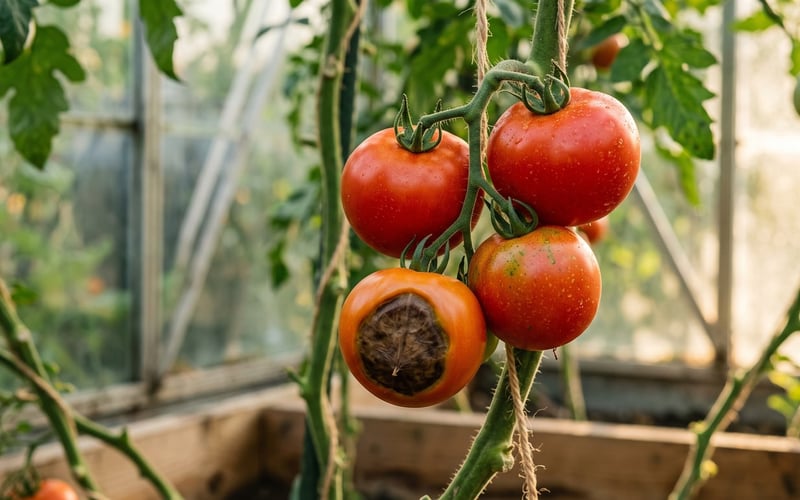
Blossom end rot is not a disease and it is almost never a calcium shortage in your compost. It is a transport failure: calcium cannot reach the base of a fast-growing fruit during the first two weeks after set. That is why calcium sprays fail. A 2023 trial tested five calcium preparations on a susceptible variety and none raised fruit calcium or cut the rot. From our work with Greenhouse Stores customers since 2012, the fix we give customers is steady moisture, not a bottle.
Key Takeaways
- The RHS is blunt about this: it is "very rare" for soil, growbags or compost to actually lack calcium. Your compost is not the problem.
- Calcium moves only in the transpiration stream. Leaves transpire hard and win. Fruit has almost no stomata, so it loses.
- Damage happens in the first two weeks after fruit set, long before you see a black base.
- A five-product calcium spray trial produced no increase in fruit calcium and no reduction in rot. Non-marketable fruit stayed at 15.11% across every treatment.
- Growbags suffer most because the root reservoir is tiny. The RHS advises watering twice daily in hot spells rather than once at double volume.
- Affected fruit is safe to eat. Cut the black end away generously and use the rest.
Browse Greenhouse Growing Accessories →
Expert Tip
I get asked about this every July, and the question is always the same: which calcium feed should I buy? None of them. Over the years, I have not seen blossom end rot fixed by a bottle, and I have seen plenty of people spend a fortnight spraying while the actual cause sat under their feet in a bone-dry growbag. The people who beat it are the ones who changed how they water, not what they feed. That is the whole article in three sentences, but the reason why is worth understanding, because it tells you exactly which watering habit matters.
What actually causes blossom end rot in greenhouse tomatoes?
Blossom end rot is a calcium delivery problem inside the plant. The calcium is usually there in the compost. It just never arrives at the part of the fruit that needs it, at the moment it needs it.
Here is the mechanism. Calcium travels in the xylem, and the xylem only flows where water is being pulled. Leaves pull hard, because they are covered in stomata and they transpire all day. A tomato fruit is a waxy, near-sealed object with almost no stomata, so it exerts very little pull of its own. When the plant is under heat stress and the canopy is transpiring flat out, the leaves take the lion's share of the stream and the fruit gets what is left.
Worse, calcium is a one-way passenger. It moves in the xylem but not in the phloem, which means the plant cannot take calcium it has already parked in a leaf and move it back into a fruit. There is no reserve to draw on. Whatever the fruit gets on the way past is all it will ever have.
That explains why the blossom end goes first, rather than the shoulders. The blossom end is the far end of the line, the last stop in the stream, and during early fruit development it is served by only a few thin xylem strands. Research on the disorder found that what matters is not the total calcium in the fruit but the gradient between the stalk end and the blossom end: the bigger the difference, the worse the rot.
Matt's Tip: You Are Looking at Last Fortnight's Weather
The black base you can see today was decided about two weeks ago. Symptoms show up during the second week after pollination, when the fruit is doing its fastest cell division and outrunning its own calcium supply. By the time the fruit is big enough for you to notice the mark, the damage is long done. So when you find rot in the third week of July, do not go looking at what you did yesterday. Look at what the weather did a fortnight ago, and whether you were away for a weekend.
Why calcium sprays and eggshells do not work
This is where most advice goes wrong, and it is worth being direct about it.
The RHS states the position plainly: foliar sprays of calcium salts such as calcium nitrate "are not effective because calcium is not readily absorbed by the fruits and transport from leaves to fruit is poor". You are spraying calcium onto a surface designed not to absorb things, in the hope it reaches a place the plant itself cannot deliver to.
The evidence backs that up hard. A commercial glasshouse trial published in 2023 tested five different preparations on a rot-susceptible variety, spraying young fruit weekly straight after set. It ran Brexil Duo, Greenstim, Calmax Zero N, calcium nitrate and calcium chloride against a plain water control. The results were unambiguous.
| Measure | Result | What it means for you |
|---|---|---|
| Fruit calcium content | 0.07-0.09% of dry matter across every treatment | No spray raised it. Not one. |
| Non-marketable fruit | 15.11% average, no significant difference vs control | The rot carried on regardless |
| Yield | Three treatments ran about 10% below the control | No benefit, and possibly a small cost |
| Steady moisture (Matt's Pick approach) | Addresses the actual transport failure | The only lever that works |
The authors concluded that spraying with calcium-containing or calcium-stimulating preparations after fruit set "was not effective in increasing Ca content to prevent BER and did not contribute to the tomato fruit yield".
There is a more striking result still. Researchers bred tomatoes engineered to pump more calcium into their fruit. Those plants had higher total fruit calcium and showed 100% blossom end rot. The calcium had been locked away inside cell vacuoles instead of sitting in the cell walls where it does the structural job. More calcium, more rot. That is the clearest proof going that this is not a quantity problem.
Eggshells fall at the same hurdle, with an extra one of their own. If your compost already has adequate calcium, adding more cannot fix a delivery failure. And eggshells break down over years, not weeks, so they cannot influence the crop you are worried about now. Crushed shell in a growbag is a slow-release supply of a nutrient that was never short.
Lime is the one nuance. If a soil test genuinely shows low calcium or a low pH in a border, lime has a job to do. That is fixing a soil problem you can measure, not fixing blossom end rot. Do not add lime to a growbag on spec.
See All Greenhouse Tomato Problems →
Why growbags get it far worse than border soil
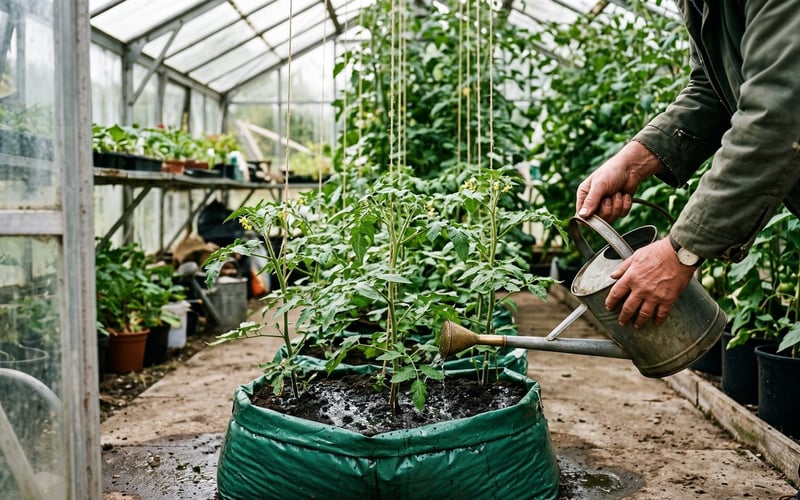
The RHS singles out plants "grown with limited root space (e.g. in pots or growing bags)" as the susceptible ones, and every installer knows why. A standard growbag holds a few litres of compost. On a 30C afternoon a mature tomato plant can shift a couple of litres of water in a day. The bag goes from wet to dry and back again, sometimes twice, and every one of those swings interrupts the transport stream feeding your fruit.
Border soil is more forgiving because it is a bigger reservoir with a deeper buffer. The plant can hunt for moisture rather than depending entirely on whether you turned up at lunchtime.
Both extremes hurt, which surprises people. Dry is obvious: no water, no stream, no calcium. But waterlogging causes it too. Roots sitting in saturated compost run out of oxygen, and roots short of oxygen stop taking up calcium. That is why the panic response of flooding a dried-out growbag is close to the worst thing you can do. You swing it from one failure mode straight into the other.
Matt's Installation Tip
Cut bigger holes, and stand the bag on soil if you can. Most people plant into the little crosses printed on the growbag and leave the plastic sealed everywhere else, which turns the bag into a bathtub with three plugholes. Slit the underside so water can drain, and where the greenhouse floor is soil rather than slabs, cut the base out entirely and let the roots go through into the ground beneath. That single change turns a five-litre reservoir into an unlimited one, and I have watched it end a customer's rot problem in a fortnight without them buying a thing.
How to stop blossom end rot in a heatwave
Steady is the whole game. Not more water. Steadier water.
The RHS gives the most useful single instruction on this, and it is one almost nobody follows: in hot periods, water twice a day rather than once with double the volume. The same total, delivered twice, keeps the compost inside a narrow moisture band. One big soak gives you a saturated bag at noon and a dry one by evening, which is exactly the swing that causes the trouble.
In practice, for a growbag in July:
- Check twice daily. Morning and early evening. Push a finger in to the second knuckle rather than judging by the surface, which lies.
- Mulch the bag. A layer of compost or bark over the surface cuts evaporation and flattens the swing considerably.
- Only feed onto moist compost. Liquid feed into a dry bag concentrates salts around the roots, and high potassium actively competes with calcium at the root surface. So does ammonium nitrogen. If you are hammering a high-potash tomato feed in a heatwave, you are making the transport problem worse, not better.
- Cool the house. Every degree you take off the canopy is transpiration demand you are not asking the fruit to compete with. This is where shading and venting earn their money. Our greenhouse cooling guide covers the order to work in, and the shading guide compares the methods.
- Do not cultivate around the roots. Hoeing deeply near the stem after fruit set cuts the fine roots doing the absorbing.
If you cannot be there twice a day, automate it. This is the honest answer for anyone who works away from the house, and it is what the RHS recommends too: automatic watering, a larger container, or border soil. Our greenhouse watering and irrigation guide compares the systems, and if you are growing in bags specifically, the grow bag setup guide covers spacing and depth.
One 2026 wrinkle worth knowing: several water companies brought in hosepipe bans through July, including South East Water in Kent from 3 July and Southern Water across Hampshire and the Isle of Wight from 10 July. A can filled indoors is generally still allowed, and a gravity-fed reservoir system is unaffected once filled. We set out the detail in our guide to watering a greenhouse legally during a hosepipe ban.

|
Matt's Pick for Automatic Container WateringBest For: Potted plants grouped on a flat-bottomed tray. Why I Recommend It: The power-free AQUAvalve5 feeds the tray from a reservoir as plants use the water. It suits busy weeks and holidays without needing mains water or electricity. Price: £35 |
Shop the Drip Irrigation Kit →
Which tomato varieties are most at risk?
Shape is the risk factor, and there is a mechanical reason for it. Elongated fruits have fewer working xylem strands reaching their far end, so the tip of a long fruit is even harder to supply than the base of a round one. Research comparing varieties found that the more tolerant ones simply had better xylem function in that distal tissue.
That puts plum and paste types at the front of the queue. San Marzano and Roma are elongated paste tomatoes by definition, and they are the ones I hear about most. Large beefsteaks are next, because a big fruit growing fast makes the heaviest demand. Cherry types tend to get off lightest: a small fruit reaches full size before it can outrun its own supply.
If you have had rot two years running in the same spot with the same variety, change one of them. Our guide to the best greenhouse tomato varieties sets out what performs under UK glass.
Can you still eat tomatoes with blossom end rot?
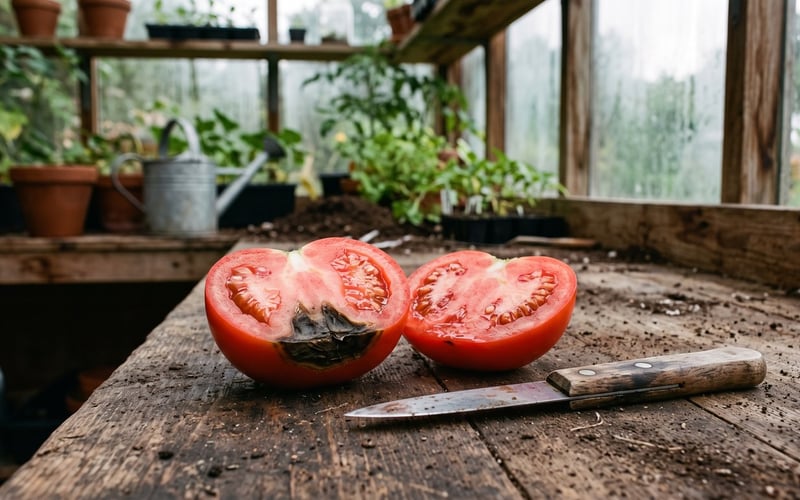
Yes. It is a physiological disorder, not an infection, and there is nothing on the plant that will hurt you. Cut the blackened end away generously, well back into clean flesh, and use the rest. If more than about half the fruit is affected, or the flesh has gone soft beyond the base, bin it: secondary moulds move into that dead tissue and those are a different matter.
Do take affected fruit off the plant. It will not recover, it will never ripen properly, and while it hangs there it carries on drawing water and calcium that the healthy fruit above it needs. Picking it off is not tidying up. It is redirecting the supply.
"I stock gravity watering systems rather than calcium feeds, and I get asked why. It is because I have read the trial data and I have watched it play out on customers' benches for many years. The bottle sells better. The reservoir actually works. If a supplier ever shows me a calcium product that beats a steady growbag in a side-by-side, I will stock it that afternoon. Nobody has yet."
— Matt W, Greenhouse Stores
Frequently asked questions
Is blossom end rot a disease?
No. It is a physiological disorder, not an infection. Nothing spreads it from plant to plant, and no fungicide will touch it. It is caused by calcium failing to reach the blossom end of a fast-growing fruit, usually because the compost swung between wet and dry while that fruit was forming.
Will calcium spray fix blossom end rot?
No. Sprayed calcium does not reach the fruit. The RHS states that foliar calcium salts are not effective because fruits absorb calcium poorly and transport from leaves to fruit is weak. A 2023 glasshouse trial of five calcium preparations found no increase in fruit calcium and no reduction in rot against a plain water control.
Should I add eggshells or lime to stop blossom end rot?
No, in almost every case. The RHS notes it is very rare for soil, growbags or compost to genuinely lack calcium, so adding more cannot fix a delivery problem. Eggshells also break down far too slowly to affect the current crop. Lime is only worth it where a soil test shows genuinely low calcium in a border.
Why do my growbag tomatoes get it but my border ones do not?
Growbags hold too little compost to buffer a hot day. A few litres of compost can swing from saturated to dry within hours at 30C, and every swing interrupts calcium delivery. Border soil is a deeper reservoir. Cutting the base out of the bag so roots reach the soil below usually solves it.
How often should I water tomatoes in a heatwave?
Twice a day, splitting the volume rather than doubling it. The RHS advises watering twice daily during hot periods rather than once at double volume. Two moderate waterings hold the compost in a narrow band. One large soak gives a waterlogged bag at midday and a dry one by night, which is the swing that causes rot.
Can I eat tomatoes with blossom end rot?
Yes. Cut the blackened part away and eat the rest. The disorder is not an infection and the undamaged flesh is fine. Cut generously back into clean tissue. Discard any fruit where more than half is affected or where the flesh has gone soft, as secondary moulds colonise the dead tissue.
Will the rest of my crop be ruined?
No. It usually affects the earliest trusses and then stops. Once the plant establishes a bigger root system and your watering steadies, later trusses commonly come through clean. Remove the affected fruit, fix the moisture routine, and the trusses forming now should be fine.