How to Run Electricity to a Greenhouse: UK Safety Guide
Running electricity to a greenhouse in the UK requires a Part P qualified electrician for any new circuit work. Under the Building Regulations 2010, a new outdoor circuit from your consumer unit is notifiable work. The typical cost is £400-£1,200 depending on the distance from your house to the greenhouse, and the job usually takes one day. After fitting over 4,000 greenhouses across the UK, we get asked about electricity on nearly every installation. This guide covers exactly what is required, what it costs, and what you can legally do yourself.
Key Takeaways
- Any new electrical circuit to an outbuilding is notifiable under Part P of the Building Regulations. You must use a qualified electrician registered with a competent person scheme (NICEIC, NAPIT, or ELECSA).
- The standard approach is 2.5mm² SWA (steel wire armoured) cable buried at least 500mm deep in a trench, with yellow warning tape above.
- Every greenhouse circuit needs 30mA RCD protection. This trips the power in 30 milliseconds if it detects a fault, stopping electrocution in wet conditions.
- Expect to pay £400-£800 for a short run (under 15m) or £800-£1,200 for longer distances. The electrician should issue a BS 7671 electrical installation certificate on completion.
- Plug-in solutions using weatherproof extension leads do NOT meet regulations for permanent outdoor use and are a fire risk in greenhouse conditions.
Installer's Note
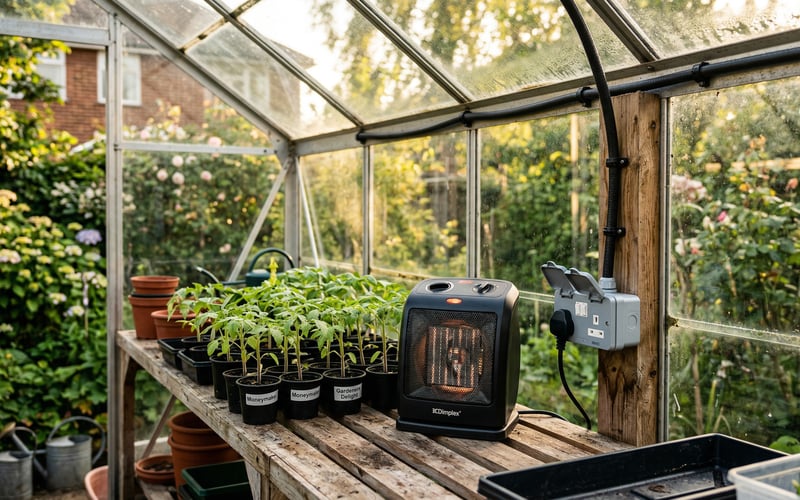
We fit greenhouses for a living. We do not fit electrics. But from our work with Greenhouse Stores customers since 2012, we know exactly what a greenhouse electrical installation should look like. We have seen the bodge jobs too: extension leads dragged across wet lawns, indoor sockets taped to greenhouse frames, cable ties holding live wires to aluminium glazing bars. Every one of those is a potential fatality in a wet greenhouse environment. Get it done properly.
Do you need an electrician to run electricity to a greenhouse?
Yes. Under Part P of the Building Regulations 2010 (England and Wales), any new electrical circuit in a "special location" requires notification to your local Building Control. A greenhouse counts as a special location because it is an outbuilding, and any work involving a new circuit from the consumer unit to an outbuilding is notifiable. Scotland has separate but similar rules under the Building (Scotland) Regulations 2004.
The simplest way to comply is to hire an electrician registered with a competent person scheme. They can self-certify the work without a separate Building Control inspection. The main schemes are:
| Scheme | Full Name | Website |
|---|---|---|
| NICEIC | National Inspection Council for Electrical Installation Contracting | niceic.com |
| NAPIT | National Association of Professional Inspectors and Testers | napit.org.uk |
| ELECSA | Electrical Self-Assessment | elecsa.co.uk |
| STROMA | Stroma Certification | stroma.com |
If you use an unregistered electrician, the work must be inspected and signed off by your local Building Control department. This adds £200-£400 to the cost and causes delays. It is almost always cheaper to use a registered electrician in the first place.
For more on the regulations around greenhouse structures themselves, see our greenhouse planning permission guide.
What type of cable do you need for a greenhouse?
SWA (steel wire armoured) cable is the standard choice for underground runs to a greenhouse. The steel armouring protects the copper conductors from accidental damage by garden forks, fence posts, and tree roots. For a typical greenhouse circuit running a heater, grow lights, and a few sockets, 2.5mm² twin and earth SWA cable is sufficient.
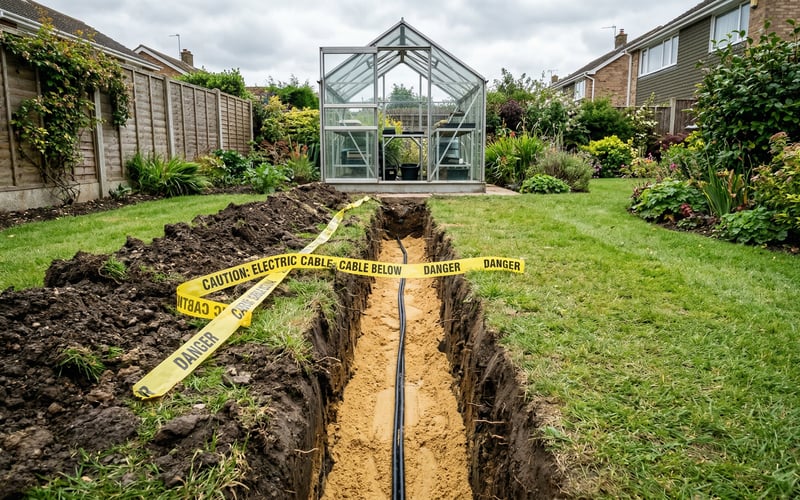
SWA cable specifications for greenhouse circuits
| Specification | Requirement | Why |
|---|---|---|
| Cable type | 2.5mm² 3-core SWA | Sufficient for up to 20A (4.6kW) at the greenhouse end |
| Trench depth | Minimum 500mm | BS 7671 requirement for buried cable protection |
| Sand bedding | 50mm above and below cable | Prevents stone damage to the armouring |
| Warning tape | Yellow "ELECTRIC CABLE BELOW" tape | Placed 150mm above the cable as a visual warning |
| Duct (optional) | Orange underground duct | Extra protection in areas with heavy foot traffic or vehicles |
| Gland termination | SWA gland at both ends | Maintains the earth continuity of the steel armouring |
For longer runs over 25 metres, your electrician may need to upsize to 4mm² cable to avoid voltage drop. BS 7671 limits voltage drop to 5% for lighting circuits and 5% for power circuits. On a 30-metre run at 20A, 2.5mm² cable produces roughly 4.2% drop, which is within limits but tight. Your electrician will calculate the exact figure based on your run length and expected load.
Matt's Tip: Mark Your Cable Route
Before the trench is backfilled, take photographs of the cable route from multiple angles with fixed reference points (corners of the house, fence posts, patio edges). Save them with your electrical certificate. I have seen homeowners hit their own buried cable while digging a fence post five years after installation because nobody recorded where the cable actually runs. A photo takes 30 seconds and could save you a £500 repair bill.
How much does it cost to run electricity to a greenhouse?
A dedicated greenhouse electrical circuit typically costs £400-£1,200 including materials and labour. The biggest variable is the distance from your house consumer unit to the greenhouse. Trenching is labour-intensive, especially if the route crosses paving, concrete paths, or established garden beds.
| Component | Typical Cost | Notes |
|---|---|---|
| Electrician labour (1 day) | £250-£450 | Higher in London and the South East |
| SWA cable (per metre) | £3-£5 | 2.5mm² 3-core. Budget £60-£150 for a typical 20-30m run |
| Mini consumer unit | £40-£80 | Mounted inside the greenhouse with RCD and MCB |
| Weatherproof sockets (x2) | £30-£60 | IP66 rated with hinged covers |
| SWA glands, connectors, fixings | £20-£40 | Two glands minimum (one at each end) |
| Trenching (if not DIY) | £100-£300 | You can save this by digging the trench yourself |
| Testing and certification | Included | A registered electrician issues the certificate as part of the job |
| Total (short run, under 15m) | £400-£800 | |
| Total (long run, 15-30m) | £800-£1,200 |
One way to reduce the cost is to dig the trench yourself before the electrician arrives. A 500mm deep trench across a lawn is straightforward spade work. Just make sure it is deep enough and reasonably straight. Your electrician can inspect it before laying the cable.
If you are weighing up costs for your entire greenhouse project, our greenhouse heating costs guide breaks down the ongoing running costs once the power is connected.
What electrical equipment can you run in a greenhouse?
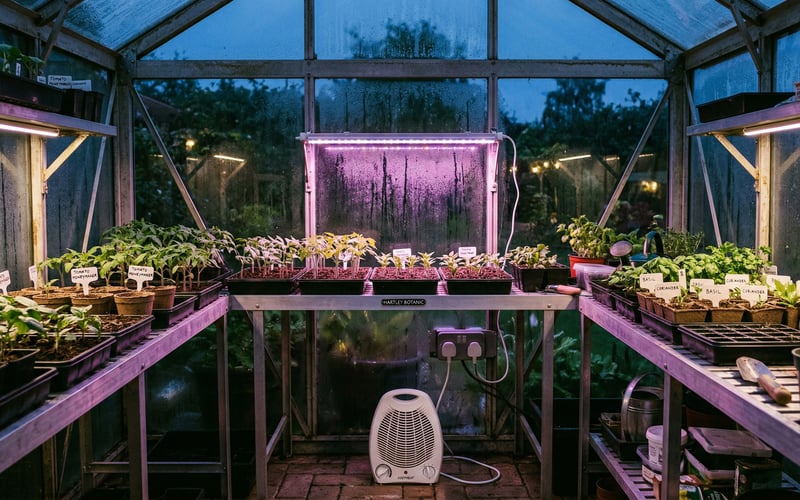
A standard 20A greenhouse circuit supports up to 4.6kW of equipment simultaneously. That is more than enough for the combination of heater, lights, and propagator that most growers need. Here is what a typical setup looks like:
| Equipment | Typical Wattage | When Used |
|---|---|---|
| Electric fan heater (2kW) | 2,000W | October-April, thermostat-controlled |
| LED grow lights | 100-300W | October-March, supplementing short days |
| Heated propagator | 50-100W | February-May, for seed starting |
| Circulation fan | 20-50W | Year-round for air movement |
| Capillary watering pump | 10-30W | Intermittent, timer-controlled |
| Typical total load | 2,200-2,500W |
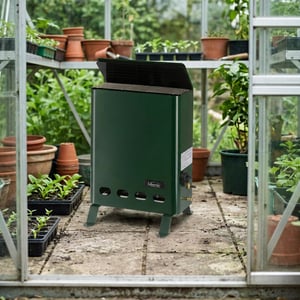
An electric greenhouse heater is the single biggest reason most growers run power to their greenhouse. Our Eden 2kW Greenhouse Heater is the most popular choice for greenhouses up to 8x10ft. It has a built-in thermostat, so it only draws power when the temperature drops below your set point.
|
Matt's pick for most greenhousesBest For: Greenhouses up to 8x10ft (6-8m²) Why I Recommend It: Built-in thermostat, 2kW output keeps a small greenhouse frost-free all winter. We have sold hundreds of these and the failure rate is practically zero. Price: £140 |
For larger greenhouses (10x12ft and above), the Eden Pro 4.2kW Greenhouse Heater at £199 provides enough output to maintain 5-7°C above ambient even in January. Bear in mind that a 4.2kW heater on a 20A circuit leaves limited headroom for other equipment running simultaneously.
What sockets and switches do you need inside a greenhouse?
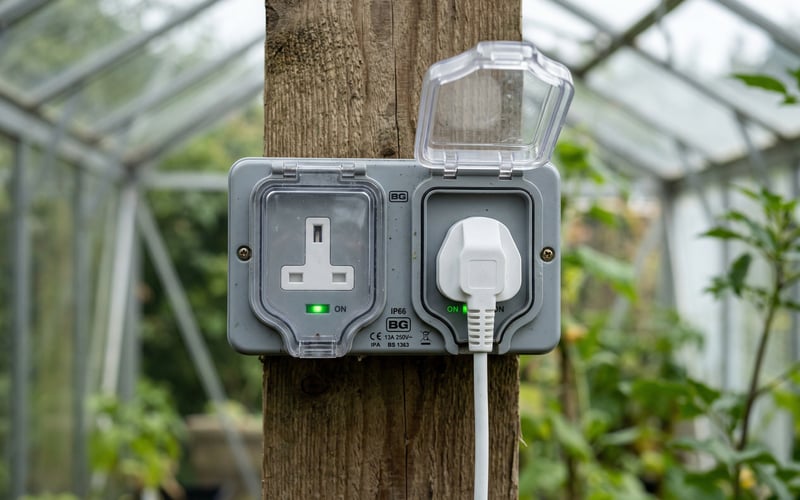
Every socket and switch inside a greenhouse must be rated at least IP65, though IP66 is the recommended standard. A greenhouse is classified as a wet environment. Condensation, watering, and damping down mean surfaces are regularly damp. Standard household sockets will corrode, short circuit, and eventually cause a fire or electric shock.
IP ratings explained for greenhouses
| IP Rating | Dust Protection | Water Protection | Suitable for Greenhouse? |
|---|---|---|---|
| IP44 | Objects >1mm | Splashing water | No. Insufficient for condensation and watering |
| IP55 | Dust-protected | Low-pressure jets | Minimum for covered areas only |
| IP65 | Dust-tight | Low-pressure jets from any direction | Acceptable |
| IP66 | Dust-tight | Powerful water jets from any direction | Recommended standard |
| IP67 | Dust-tight | Temporary submersion (1m for 30 mins) | Over-specified but perfectly fine |
Most electricians will install two double sockets as standard: one at bench height for heaters and propagators, one higher up for grow lights and timers. Ask your electrician to position them away from the door and any overhead vents, where rain and drips are most likely.
If you are setting up your greenhouse for the first time, our new greenhouse owner's checklist covers everything else you need alongside the electrical supply.
What is RCD protection and why does a greenhouse need it?
An RCD (residual current device) monitors the current flowing in and out of a circuit. If it detects an imbalance of 30mA or more, it cuts the power in approximately 30 milliseconds. That imbalance means current is flowing somewhere it should not be, usually through a person or through water to earth. In a greenhouse where you are standing on damp ground, handling wet pots, and working near water, RCD protection is not optional. It is the difference between a harmless trip and a fatal shock.

BS 7671 (the IET Wiring Regulations, 18th Edition) requires 30mA RCD protection for all socket outlets and any circuit supplying an outdoor installation. Your greenhouse circuit must have its own dedicated RCD, either in the main consumer unit at the house or in a separate mini consumer unit inside the greenhouse.
Test the RCD every three months. Press the test button on the front of the unit. The power should cut immediately. If it does not trip, call your electrician. A faulty RCD offers zero protection.
Can you use an extension lead instead of a permanent supply?
No. A permanent outdoor extension lead does not comply with the Building Regulations and is genuinely dangerous in a greenhouse environment. Here is why:
- Standard extension leads are rated IP20. They have zero water protection. Greenhouse condensation will corrode the connections within months.
- A cable run across a garden is a trip hazard and a mower hazard.
- Extension leads suffer voltage drop over distance. A 25-metre run on a standard 1mm² extension lead loses roughly 10% of voltage at 2kW load, which can damage motors and thermostats.
- There is no RCD protection at the greenhouse end unless you add a plug-in RCD adaptor, which is a single point of failure.
- Your home insurance may not cover fire damage caused by non-compliant electrical installations.
The one exception is a short-term temporary setup: plugging a single appliance into an RCD-protected outdoor socket on the house wall, using a heavy-duty outdoor-rated cable reel (1.5mm² minimum, fully unwound) for occasional use. This is acceptable for a weekend propagation session but not as a permanent supply.
If you want to avoid the cost of a full electrical installation, consider whether a non-electric heating setup might work for your needs. Paraffin heaters like our Elite Super Warm 5 at £110 provide frost protection without any mains connection.
What can you legally do yourself?
You can dig the trench, lay the duct, and prepare the route. You cannot connect or modify any electrical circuit without either being qualified yourself or using a registered electrician.
Here is the breakdown:
| Task | DIY? | Notes |
|---|---|---|
| Digging the cable trench | Yes | Saves £100-£300. Must be 500mm+ deep with sand bedding. |
| Laying underground duct | Yes | Orange 50mm duct from any builder's merchant |
| Mounting socket back boxes | Yes | Fix the IP66 enclosures to posts/frame before the electrician arrives |
| Pulling cable through duct | With electrician | The electrician needs to verify the cable is undamaged |
| Connecting at the consumer unit | No | Notifiable work. Must be done by a qualified person. |
| Wiring sockets and switches | No | Notifiable work in a special location. |
| Installing the RCD/MCB | No | Must be done and tested by a qualified person. |
| Testing and certification | No | BS 7671 testing requires calibrated instruments. |
The most cost-effective approach is to dig the trench and lay the duct yourself over a weekend, then book the electrician for a single day to do the cable, connections, and certification. This typically halves the labour portion of the bill.
Step-by-step: how the installation works
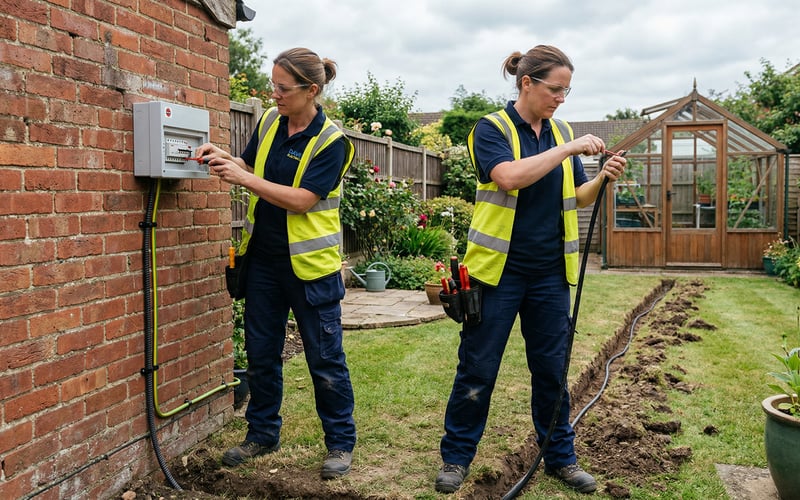
A typical greenhouse electrical installation follows this sequence:
- Survey and quote. The electrician visits, measures the cable run, checks your existing consumer unit for spare capacity, and provides a fixed-price quote. If your consumer unit is full, a new way (circuit breaker slot) may need adding, which adds £50-£150.
- Trench preparation. A 500mm deep trench is dug from the house to the greenhouse. The route should be as direct as possible, avoiding tree roots, drainage pipes, and other buried services. If crossing a path or patio, the cable goes through duct beneath the surface.
- Cable laying. The SWA cable is laid on a 50mm bed of sand in the trench. Yellow "ELECTRIC CABLE BELOW" warning tape is placed 150mm above the cable. The trench is backfilled with sand, then topsoil or sub-base material.
- Greenhouse end. A small consumer unit (with RCD and MCB) is mounted inside the greenhouse. IP66 sockets are wired from this unit. The SWA cable is terminated with proper glands.
- House end. The SWA cable is connected to a new MCB in the main consumer unit. If an RCD is fitted at the greenhouse end, the house end only needs an MCB. If not, an RCBO (combined RCD/MCB) is fitted here.
- Testing. The electrician performs insulation resistance, earth fault loop impedance, and RCD trip time tests. All results are recorded on a BS 7671 Electrical Installation Certificate.
- Certification. The registered electrician self-certifies the work and notifies Building Control. You receive the certificate, which you should keep with your property deeds.
Read our professional greenhouse installation guide →
How to find a good electrician for the job
Not every electrician has experience with outbuilding circuits. When getting quotes, ask these three questions:
- "Are you registered with a competent person scheme?" They should be able to give you their NICEIC, NAPIT, or ELECSA registration number immediately. Verify it on the relevant scheme's website.
- "Will you issue a BS 7671 Electrical Installation Certificate?" Not a "minor works certificate." A new outdoor circuit is not minor works. The full installation certificate is the correct document.
- "Have you done outbuilding circuits before?" SWA cable termination and outdoor consumer units are slightly different from standard domestic wiring. An electrician who has done this before will be faster and more competent.
Get three quotes. In our experience, prices vary by 40-60% for identical work. The cheapest quote is not always the best, but the most expensive is not always the most competent either. Check the registration, ask for a reference, and pick the one who explains what they will do in plain language.
What about solar panels or battery power for a greenhouse?
A small solar panel and battery setup can power LED lighting and a circulation fan, but it cannot run a heater. A 2kW heater running for 8 hours overnight uses 16kWh of energy. A battery system capable of delivering that would cost £3,000-£5,000 and take up significant floor space. For comparison, the mains electricity to run that same heater costs roughly £3.20 per night at current UK rates (20p/kWh).
Solar works well as a supplement for low-power equipment: lighting, fans, and small water pumps. It does not replace a mains supply for heating. If you are considering the full picture of keeping your greenhouse warm in winter, a mains electric supply with a thermostat-controlled heater remains the most reliable and cost-effective option.
Frequently asked questions
Do I need Building Regulations approval to run electricity to a greenhouse?
Yes, a new circuit to an outbuilding is notifiable under Part P. Use a registered electrician who can self-certify the work. If you use an unregistered electrician, you must apply to Building Control separately, which costs £200-£400 and adds weeks to the timeline.
How deep should the cable trench be for greenhouse electricity?
The minimum depth is 500mm (roughly two spade depths). BS 7671 specifies this depth for buried cables with mechanical protection (SWA). The cable must sit on 50mm of sand with yellow warning tape placed 150mm above it.
Can I run a greenhouse heater from a plug-in extension lead?
Not safely or legally for permanent use. An extension lead across a garden has no RCD protection at the greenhouse end, no water resistance, and creates a trip hazard. It also voids most home insurance policies if it causes a fire. A proper SWA cable and dedicated circuit costs £400-£800 and lasts decades.
What size cable do I need for a greenhouse?
2.5mm² 3-core SWA cable for runs under 25 metres. For runs over 25 metres, your electrician may specify 4mm² cable to compensate for voltage drop. The exact size depends on the total load, cable length, and installation method. Your electrician will calculate this as part of the design.
How much does it cost to run an electric greenhouse heater?
A 2kW heater running on thermostat costs roughly £1.50-£3.20 per night in winter. The thermostat prevents continuous running. On a mild night (5°C outside, set to 7°C), the heater may run for 3-4 hours total. On a hard frost night (-3°C), it may run for 10+ hours. Our full greenhouse heating costs breakdown covers seasonal running costs in detail.
Is an armoured cable necessary or can I use conduit?
SWA cable is the standard for underground runs to outbuildings in the UK. The steel armouring provides both mechanical protection and an earth path. PVC conduit alone does not provide adequate protection against garden tools and is not suitable as the sole protection method for direct burial. Your electrician may use conduit for above-ground sections entering the greenhouse, but the underground run should always be SWA.
Will the electrician need to turn off my house electricity?
Yes, for approximately 30-60 minutes while connecting the new circuit to your consumer unit. The rest of the work (trenching, cable laying, greenhouse wiring) is done with the new circuit isolated. Ask the electrician to schedule the consumer unit connection at a convenient time.
Related articles
- How Much Does It Cost to Heat a Greenhouse? UK Running Costs 2026
- Heating a Greenhouse Without Electricity: What Actually Works
- Greenhouse Ventilation Guide: Vents, Fans and Stopping Overheating
- Essential Greenhouse Accessories: What You Actually Need
- How to Insulate a Greenhouse: Materials, Methods and Heat Savings