Drying Apricots, Peaches & Plums: A UK Stone Fruit Guide
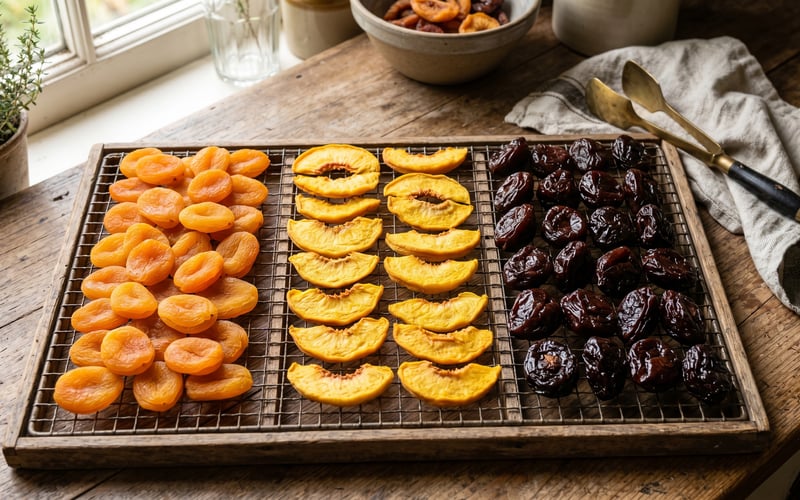
Drying apricots, peaches, and plums at home is the simplest way to preserve a glut of UK stone fruit. Each fruit needs slightly different handling: apricots halve and dry skin-down on the tray, peaches need a 30-second boiling-water dip to slip the skin, plums dry whole with the skin pricked to make traditional prunes. All three finish at 57C in a dehydrator over 8-24 hours, or at 60C in a low oven, and store for 12 months in airtight glass jars. From our work with Greenhouse Stores customers since 2012, stone fruit is the most flavour-packed category to dry — supermarket apricots cannot compete with home-dried Moorpark.
Key takeaways
- Apricots are the easiest stone fruit to dry. Halve, stone, lay skin-down on the tray, dry at 57C for 8-12 hours. Moorpark and Tomcot are the UK varieties that crop reliably under glass.
- Peaches need a 30-second skin slip before drying. Boiling water, then ice bath, then peel by hand — the skin turns leathery and bitter if you leave it on.
- Plums dry to prunes only if you prick the skin. Sterling silver pin or a metal skewer, 8-10 pricks per plum. Without this step the skin stays waterproof and the inside ferments.
- Stone fruit takes 2-3 times longer than apples. Higher water content, denser flesh. Allow 12-24 hours for plums, 8-12 for apricots and peaches.
- Sulfur dip is optional but transforms apricot colour. Bright orange dried halves keep their colour for 18-24 months instead of browning over 6.
Expert Tip
Stone fruit is the category our customers most often write off as “not worth the bother” — right up until they try a home-dried Moorpark apricot. Supermarket dried apricots are 18 months out from a Turkish or Iranian harvest, treated with sulphur dioxide, and have lost most of their fragrance. A UK apricot from a south-facing wall or a greenhouse-trained tree, dried within 36 hours of picking, retains a perfume that I have not found in any retail product. The same applies to home-dried plums: a Victoria prune at Christmas tastes like a different fruit to anything in a shop. Worth the bother.
UK stone fruit at a glance
Three stone fruits dry well in a UK kitchen. Each has its own preparation, drying time, and best storage approach. Cherries are technically in the same family but dry to small intensely-sweet beads that take a different process — not covered here.
| Fruit | Best UK varieties | Prep | Dehydrator time | Dried weight (per kg fresh) |
|---|---|---|---|---|
| Apricots | Moorpark, Tomcot, Flavorcot | Halve and stone, lemon dip | 8-12 hr at 57C | ~200g |
| Peaches | Peregrine, Rochester, Duke of York | Skin slip, halve, stone, lemon dip | 10-14 hr at 57C | ~180g |
| Plums | Victoria, Czar, Marjorie’s Seedling | Prick skin (8-10 times each) | 18-24 hr at 57C | ~250g |
If you are growing stone fruit under glass, our growing fruit at home guide covers the wall-trained and greenhouse-trained options that crop most reliably in the UK climate.
Drying apricots: the easy starter
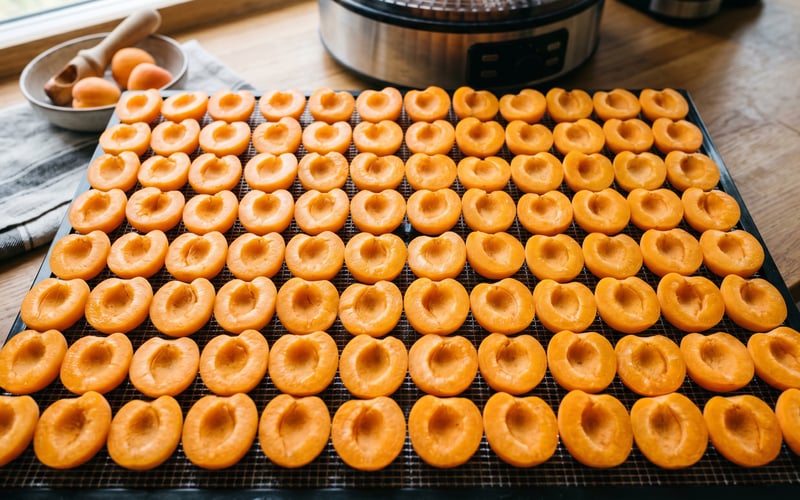
Apricots are the most forgiving stone fruit to dry. The flesh is firm enough to hold its shape on the tray, the stones lift cleanly with a fingernail, and the natural acidity preserves colour better than peaches. Two productive UK varieties handle the bulk of home crops: Moorpark (the Victorian heritage choice, smaller fruit but intense flavour) and Tomcot (modern, larger, slightly less perfumed).
Method:
- Pick or buy apricots when fully ripe but still firm. A barely-yielding fruit is right; a squashy fruit will slump on the tray.
- Wash, halve along the natural seam, twist the two halves apart, and lift the stone out with a teaspoon.
- Dip each half in acidulated water (1 litre water + 1 tbsp lemon juice) for 30 seconds.
- Lay cut-side-up on a dehydrator tray or a wire-rack-lined oven tray, 5mm gaps between halves.
- Dehydrator: 57C for 8-12 hours. Oven: 60C fan-bake for 10-14 hours.
- Done when the halves are leathery but still slightly tacky. Cool 30 minutes on a wire rack before jarring.
Optional sulphur dip. Commercial dried apricots stay bright orange because they have been exposed to sulphur dioxide. The home equivalent is a 30-second dip in a solution of 1 teaspoon of sodium metabisulphite (Campden tablets) per litre of water before drying. This is harmless if rinsed afterwards and dramatically extends shelf life to 18-24 months at full colour. Skip it if you want a pure unsulphured product — just expect the apricots to brown over 6 months.
Drying peaches: the skin-slip trick
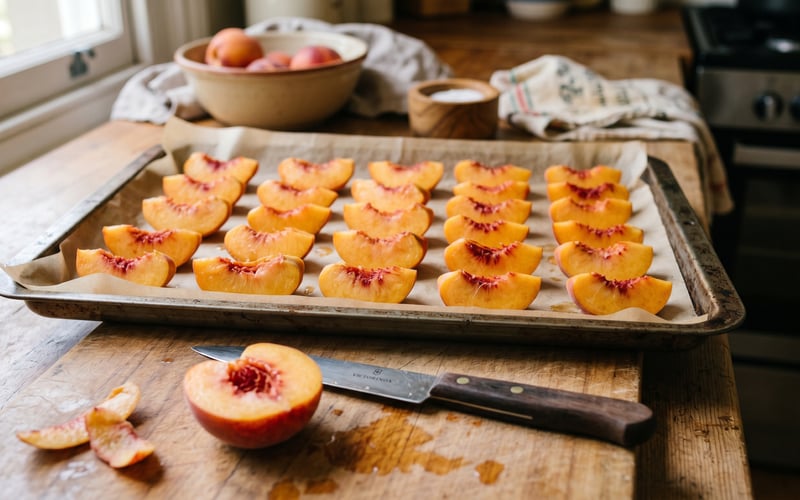
Peaches dry well but the skin must come off first. Dried skin-on peach turns leathery, bitter, and shrivels away from the flesh. The fix is the same skin-slip trick used for making jam: a 30-second dip in boiling water, then an ice bath, then peel by hand. The skin lifts off in clean sheets.
UK varieties worth growing: Peregrine (heritage, gold flesh, sweet), Rochester (modern, larger fruit, good cropper), and Duke of York (early-cropping, suits cold greenhouses). All three crop on south-facing walls in the southern half of the UK and inside a 6x8 or larger greenhouse anywhere.
Method:
- Score a shallow cross on the base of each ripe peach with a sharp knife.
- Drop 4-6 peaches into a pan of boiling water for 30 seconds. Lift out with a slotted spoon straight into a bowl of iced water.
- Peel the skin off in sheets, starting from the scored cross. It comes away cleanly when the fruit is properly ripe.
- Halve, stone, and cut each half into 4-6 wedges, or leave as halves for slow drying.
- Lemon-water dip for 30 seconds.
- Lay on a dehydrator tray cut-side-up, 5mm gaps.
- Dehydrator: 57C for 10-14 hours. Oven: 60C fan-bake for 12-16 hours.
- Cool 30 minutes before jarring.
Peaches reduce by about 80% by weight — 1kg of fresh peaches dries to 180g. They are the most labour-intensive of the three stone fruits, but the dried slices are extraordinary in winter porridge or chopped into fruit cake.
Drying plums to prunes: the pricking method
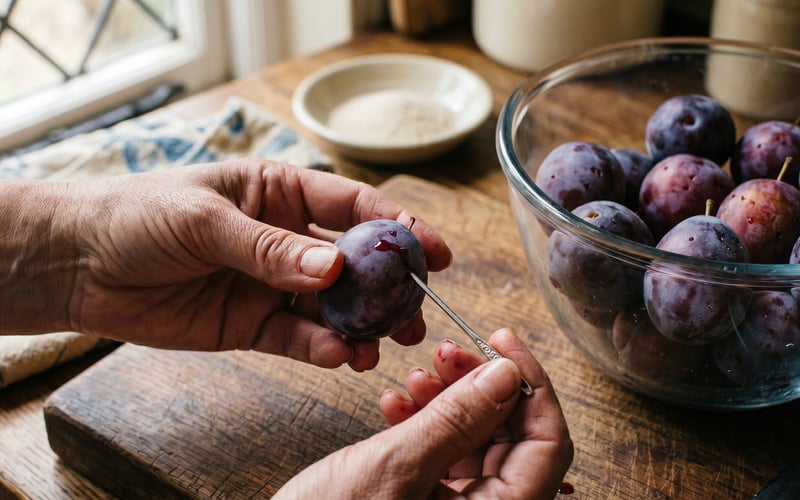
A prune is a dried plum — specifically, a dried plum with the skin pricked to let moisture escape during drying. Without the pricking step the waxy skin acts as a moisture seal: the inside ferments, the fruit turns to mush, and you get the worst kind of preserving failure (smells terrible, has to be discarded).
UK varieties worth drying: Victoria (the classic, dual-purpose, prolific), Czar (cooker, dries to a deep mahogany prune), Marjorie’s Seedling (firm late-season fruit, holds shape well). Damsons can be dried by the same method but are smaller and more acidic — better as a sweetened leather.
Method:
- Pick or buy plums when fully ripe but not soft. The skin should give slightly under gentle pressure.
- Wash and pat dry. Leave the plums whole — do not halve.
- Prick each plum 8-10 times all over with a small sterling silver needle, a metal skewer, or a cocktail stick. Aim to pierce only the skin, not push deep into the flesh.
- Optional: a 30-second dip in 1 litre boiling water plus 1 tablespoon bicarbonate of soda speeds drying. This breaks down the waxy bloom on the skin further. Drain and pat dry.
- Lay whole on a dehydrator tray, 1cm gaps between plums.
- Dehydrator: 57C for 18-24 hours, rotating trays every 4 hours. The plums shrink to roughly one-third of their original size.
- Oven: 60C fan-bake for 20-30 hours — not practical unless you have a slow-oven Rayburn or Aga.
- Done when the plums are leathery, dark mahogany, and a gentle squeeze produces no liquid.
- Optional: rest the cooled prunes in a sealed jar with a teaspoon of brandy for a week before final storage. They absorb the spirit and keep for 18 months.
1kg of fresh plums dries to roughly 250g of prunes. A productive Victoria plum tree drops 30-40kg in a good year, which is the equivalent of 8-10kg of dried prunes — more than most households will use in two years.
Storage: keep stone fruit dry and dark
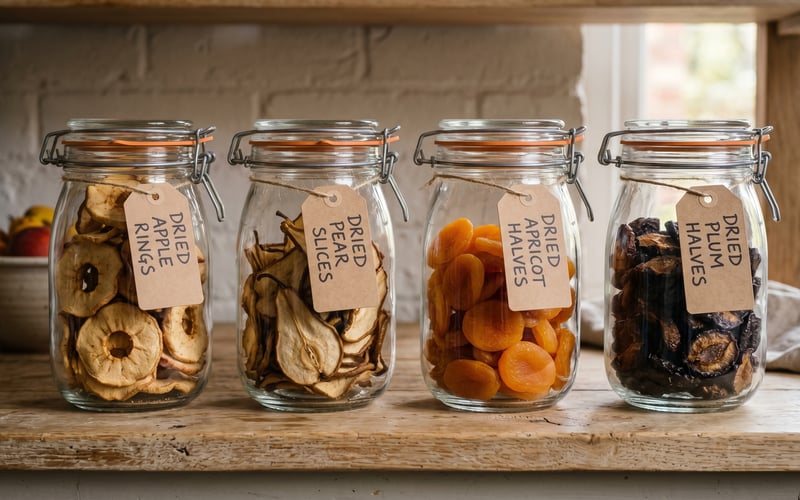
Stone fruit is more prone to mould than pome fruit because the flesh holds more residual sugar. Three rules:
- Cool fully before jarring. 30 minutes minimum on a wire rack. Sealing warm fruit traps moisture and starts mould inside 10 days.
- Glass jars, dark cupboard, 5-15C. Light degrades the colour and flavour faster than air. Pantry shelves or north-facing cupboards are ideal.
- Vacuum-pack the surplus. Half the batch in vacuum bags for the freezer (24-month life) and half in jars in the cupboard (12 months) is a sensible split.
For the full storage spec, see our drying apples and pears guide which covers the same storage principles in more depth.
Common problems
Apricots browned despite the lemon dip: The dip was too short or the bath was too weak. Use 1.5 tablespoons of lemon juice per litre and dip for a full 30 seconds. The Campden tablet method gives the brightest result.
Peach halves shrivelled to tiny leather discs: The fruit was overripe before drying. Peach drying needs fruit at exactly the just-ripe stage; overripe fruit collapses. Use the failed batch for fruit leather instead.
Plums fermented during drying (sour smell, sticky surface): Skin not pricked enough or thoroughly enough. Re-prick the remaining plums with 12-15 holes each and start the cycle again. Discard the fermented ones.
White bloom on dried prunes: Natural sugar crystallisation. Harmless and adds sweetness. More common on Czar and Marjorie’s Seedling than Victoria.
Hard outer layer, soft inside (case hardening): Temperature too high at the start. The skin set before the moisture escaped. Drop the temperature 5C lower for the first 2 hours next time.
Matt’s Pick: grow your own stone fruit under glassBest for: Households who want a reliable apricot or peach crop without depending on south-facing wall space. Why I recommend it: Stone fruit blossom is the most frost-sensitive of any UK orchard crop. A greenhouse trained apricot or peach blossoms 4-6 weeks earlier than its outdoor cousin and crops reliably even in the coldest UK winters. A 10x10 frame fits two fan-trained trees comfortably and produces 30-50kg of stone fruit a year — enough for two full preserving sessions. Price: £1,999 |
Matt’s Tip: brandy-finished prunes
Once the prunes are dry, transfer them while still slightly warm into a sterilised glass jar with a teaspoon of brandy or armagnac per 200g of fruit. Seal and shake gently. Leave for a week in a dark cupboard. The fruit absorbs the spirit and softens, the brandy takes on the plum flavour, and you end up with the kind of Christmas prune that gets quietly eaten out of the jar at midnight. Keeps 18 months. The same trick works on dried apricots with sweet white wine instead of brandy.
Frequently asked questions
Can you grow apricots and peaches in the UK to dry?
Yes — apricots and peaches both crop reliably in the southern half of the UK on south-facing walls, and anywhere in the UK inside a greenhouse. Moorpark and Tomcot apricots, Peregrine and Rochester peaches are the standard fan-trained choices. A 6x10 or larger greenhouse gives the most reliable harvest.
How long do dried apricots, peaches and plums keep?
Home-dried stone fruit keeps 12 months in airtight glass jars at room temperature. Vacuum-packed they keep 24 months. Sulphured apricots keep 18-24 months even in glass jars. Store in a dark cupboard at 5-15C — warm or sunny shelves cut the life in half.
Do you have to prick plums to make prunes?
Yes — the waxy plum skin is waterproof and the fruit will ferment from the inside if the skin is not pricked. Use a sterling silver needle, metal skewer, or cocktail stick to make 8-10 holes per plum before drying. A 30-second dip in boiling bicarbonate-of-soda solution speeds drying further.
Can you dry stone fruit in an oven?
Yes, though plums take so long (20-30 hours at 60C) that the electricity cost makes a dehydrator a better choice. Apricots and peaches dry well in an oven at 60C fan-bake over 10-16 hours. Use wire racks set on baking trays to improve air circulation underneath the fruit.
Why are my dried apricots dark brown instead of orange?
The fruit has oxidised because the lemon water dip was too weak or too short. Use 1.5 tablespoons of lemon juice per litre and dip each half for a full 30 seconds. For a stable bright orange, use a Campden tablet (sodium metabisulphite) dip instead, rinsing well afterwards.
Can I dry mirabelle plums and damsons?
Yes, mirabelles and damsons dry well using the same pricked-skin method as Victoria plums. Mirabelles dry to a small golden prune that suits gift jars; damsons dry to a tart dark fruit ideal for fruit leather. Both reduce in size more than Victoria — expect 200-220g of dried fruit per 1kg fresh.
Is sulphuring dried apricots safe?
Yes — Campden tablets (sodium metabisulphite) are the same food-grade preservative used in winemaking and commercial dried fruit. A 30-second dip in a 1g-per-litre solution, followed by a clean-water rinse, leaves a residue well below the UK Food Standards Agency limit for dried fruit. Skip the dip if you prefer an unsulphured product — the apricots brown over 6 months but remain safe to eat.