Greenhouse Grow Lights UK: What to Buy and What They Cost
Greenhouse grow lights are most useful for seedlings, winter salads and light-hungry crops during short UK days. The LED Grow Lights collection contains 13 active models. Propagation Lights adds the 9.5W Flex II 10 featured here. At Ofgem's 26.11p/kWh capped average, a 150W fixture costs £7.05 for 180 monthly hours. Match the light to the planted bench, not the greenhouse floor.
A grow light can rescue a weak winter crop, but buying too much light wastes money. The useful question is not greenhouse size. It is the area of plants you intend to illuminate.
A single seed tray needs a small propagation bar. A 600mm square fruiting area needs far more output. Lighting an empty path, cold glazing and unused staging achieves nothing.
Key takeaways
- Use grow lights where winter daylight cannot support the crop or growing stage.
- A 9.5W bar suits one propagation tray; fruiting plants may need 150W or more.
- Compare PPF, PPFD and coverage maps. Wattage only describes electricity use.
- A 150W fixture costs £7.05 for 180 monthly hours at 26.11p/kWh.
- Greenhouse fittings need RCD protection, suitable connectors and moisture protection.
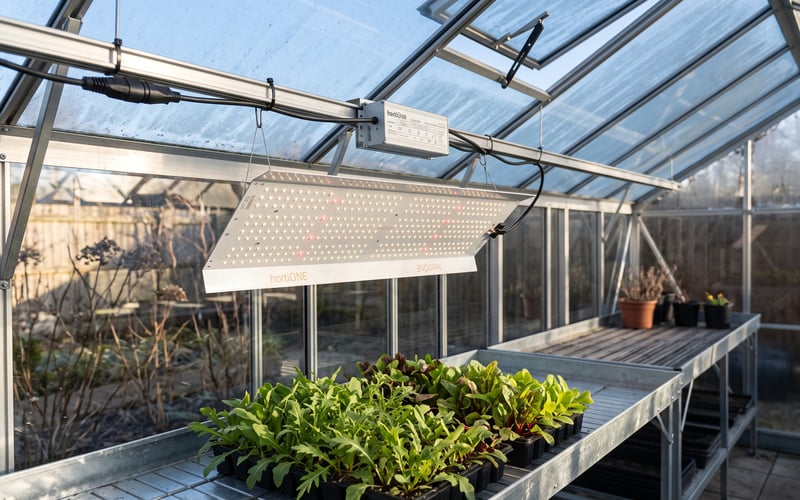
The HortiONE 420 over a compact salad bench. Its published data sheet does not state an IP rating.
View the HortiONE 420 LED Grow Light at £227
Expert tip: start with one bench
We checked 13 active LED models and the Flex II propagation bar for this guide. Coverage separated them more usefully than wattage. Measure one planted bench first, then compare the manufacturer's map at that exact size.
Do you need grow lights in a greenhouse?
Most UK greenhouses do not need artificial lighting throughout the year. Natural light normally supports summer tomatoes, cucumbers, peppers and salad crops.
Extra light becomes useful during late autumn, winter and early spring. It also helps seedlings started before natural days lengthen.
Consider lighting when:
- seedlings lean towards the glazing or develop long, weak stems;
- winter salads remain pale and stop producing usable leaves;
- a shaded greenhouse receives little direct winter sun;
- young chillies or tomatoes start indoors before moving under glass;
- cuttings need steady light on a propagation shelf.
Dormant plants usually need frost protection rather than strong light. Established hardy salads may also grow slowly without added lighting. Our winter greenhouse crop guide identifies crops that tolerate short days.
Do not expect light to solve cold roots, waterlogged compost or poor ventilation. Those problems need separate fixes.
What do watts, PPF and PPFD mean?
Wattage measures electricity use, while PPF and PPFD describe useful light output. Comparing fixtures by watts alone can produce a poor choice.
| Measurement | What it tells you | How to use it |
|---|---|---|
| Watts | Electricity drawn by the fixture | Calculate running cost and circuit load |
| PPF | Total photosynthetic photons emitted each second | Compare the overall output of two fixtures |
| PPFD | Photosynthetic photons reaching one square metre each second | Check usable intensity at canopy level |
| Efficacy | Light output produced for each joule used | Compare electrical efficiency |
| Coverage map | PPFD measured across a stated growing area | Find weak edges and suitable hanging height |
A higher PPF figure does not guarantee even coverage. A narrow beam can create a bright centre and weak edges.
Read the manufacturer's coverage map for the stated height. Check both the average and the lowest edge readings.
How much grow light does each crop need?
Young seedlings need less intense light than mature fruiting plants. Leafy crops sit between those two stages.
| Use | Sensible starting point | Typical daily schedule | Best fixture style |
|---|---|---|---|
| One seed tray | 9.5W close-mounted bar | 14-16 hours when daylight is inadequate | Propagation bar |
| Several trays or cuttings | Several linked bars over one shelf | 14-16 hours when daylight is inadequate | Linked propagation system |
| Winter herbs and salads | Supplement the darkest hours | Four to six added hours | Dimmable full-spectrum LED |
| Young chillies or tomatoes | Light a defined bench area | Adjust using daylight and plant response | 150W-200W LED panel |
| Mature fruiting crop | Use manufacturer PPFD maps | Crop-specific schedule | High-output full-spectrum LED |
| Dormant tender plants | Use natural light where possible | Usually no extra light | None unless growth remains active |
These are starting points rather than crop prescriptions. Natural daylight changes with location, glazing, weather and the greenhouse's orientation.
Read our greenhouse propagation guide before building a seedling lighting schedule.
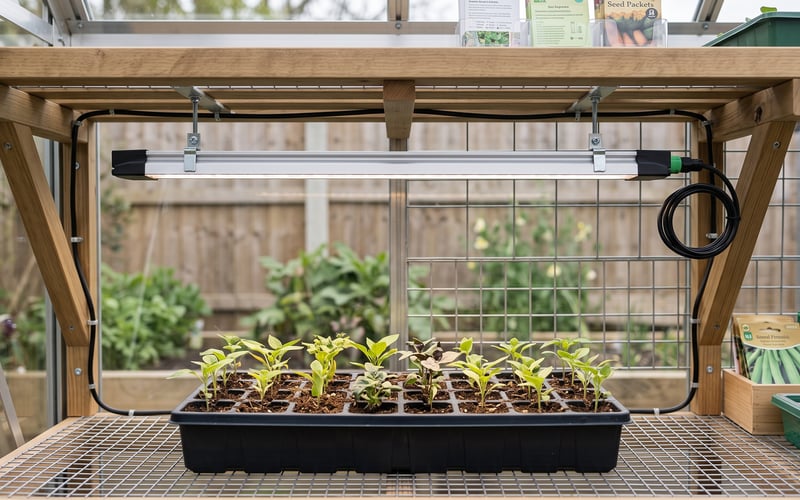
The 9.5W Sanlight Flex II 10 suits one seed tray or a narrow propagation shelf.
View the Sanlight Flex II 10 Propagation Light at £68
Which greenhouse grow light should you buy?
Choose the smallest fixture that covers the planted area at the required intensity. A dimmer adds useful control across different growth stages.
| Model | Input | Published output | Matt's verdict | Live price |
|---|---|---|---|---|
| Sanlight Flex II 10 | 9.5W | Low-output propagation bar | Best fit for one propagation tray | £68 |
| HortiONE 420 | 150W | 408 micromol/s PPF | Lowest input panel in this comparison | £227 |
| G-Bars 170 | 170W | 416 micromol/s PPF | Pick for a defined 600mm square area | £341 |
| Sanlight EVO 3-100 | 200W | 545 micromol/s PPF | Longer IP65 fixture for deeper benches | £455 |
| Sanlight EVO 4-120 | 265W | 725 micromol/s PPF | Highest output for a 1200mm area | £555 |
|
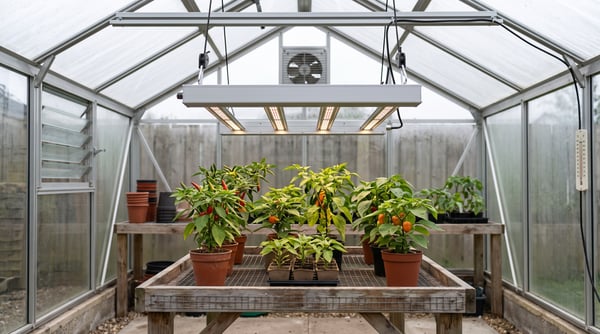
Matt's specification pick for a compact benchBest for: A dry, ventilated 600mm x 600mm growing area with protected connections. Why I picked it: It is the only model here combining IP65 protection with a four-stage dimmer in the box. Its 416 micromol/s PPF covers a compact area without lighting an empty path. Price: £341 |
The HortiONE 420 produces 408 micromol/s PPF from 150W. Its checked data sheet does not state an IP rating.
Sanlight's EVO 3-100 and EVO 4-120 are IP65 rated. Their connection cables are sold separately, so include that part in the budget.
How much do LED grow lights cost to run?
Running cost depends on input wattage, daily hours and your electricity unit rate. The standing charge does not change when you add a light.
The table uses Ofgem's 26.11p/kWh capped average for Direct Debit customers in England, Scotland and Wales. It applies from 1 July to 30 September 2026 and includes VAT. Your tariff may differ.
| Fixture | Input | Six hours daily | 14 hours daily |
|---|---|---|---|
| Sanlight Flex II 10 | 9.5W | 1.71kWh / £0.45 monthly | 3.99kWh / £1.04 monthly |
| HortiONE 420 | 150W | 27kWh / £7.05 monthly | 63kWh / £16.45 monthly |
| G-Bars 170 | 170W | 30.6kWh / £7.99 monthly | 71.4kWh / £18.64 monthly |
| Sanlight EVO 3-100 | 200W | 36kWh / £9.40 monthly | 84kWh / £21.93 monthly |
| Sanlight EVO 4-120 | 265W | 47.7kWh / £12.46 monthly | 111.3kWh / £29.06 monthly |
Use this formula with your own tariff:
Watts ÷ 1,000 x daily hours x 30 x unit price = monthly cost.
A timer prevents forgotten hours. A dimmer may also reduce consumption when full output is unnecessary.
Matt's tip: calculate the bench, not the building
I would price one useful growing area before considering a second light. A smaller, evenly covered bench beats a bright centre surrounded by weak edges.
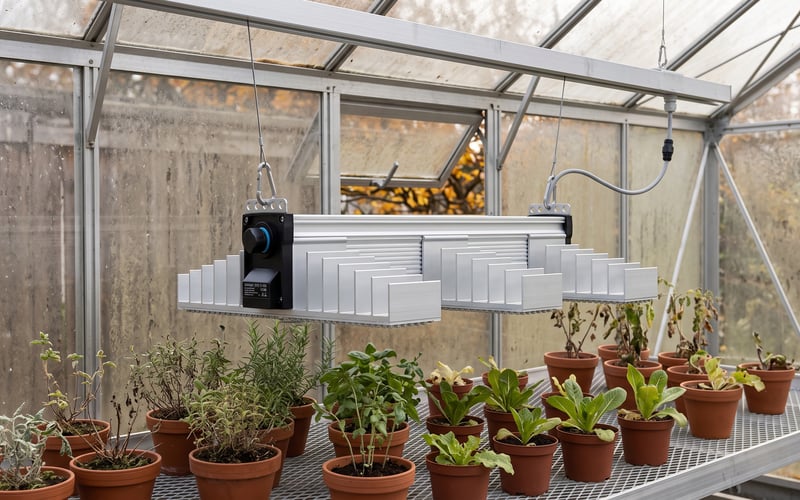
The Sanlight EVO 3-100 is IP65 rated, but its manual still excludes condensing conditions.
View the Sanlight EVO 3-100 LED Grow Light at £455
How high should grow lights hang above plants?
Use the fixture's PPFD map and the plant's response to set height. Generic distance rules ignore lens design, output and dimming.
G-Tools publishes a light-intensity figure of 940 at 200mm, but does not state the full unit. Ask for its PPFD map before setting height. HortiONE and Sanlight publish model-specific maps.
Start at the manufacturer's stated height and check plants each day. Raise or dim the fixture if upper leaves bleach, curl or feel unusually warm.
Lower the fixture gradually when seedlings stretch towards it. Keep the canopy level so one tall plant does not sit dangerously close.
Matt's installation tip: support the fixture independently
Do not hang a heavy light from an unsupported glazing bar. Use a rated greenhouse member or a separate frame. SANlight requires an 8kg permanent-load capacity for EVO suspension. Check the exact fixture weight and greenhouse limits first.
A timer gives plants a repeatable schedule. Avoid running lights continuously, because plants still require a dark period.
Are LED grow lights safe in a damp greenhouse?
Greenhouse lighting needs protection against moisture, cable damage and electrical faults. A domestic indoor fitting is not automatically suitable under glass.
Use an RCD with outdoor electrical equipment. Choose outdoor-rated leads, connectors and cable reels. Fully unwind reels before use to prevent heat build-up.
IP65 means a fitting is dust-tight and protected against water jets. It does not make the fitting suitable for immersion or careless hosing.
Keep plugs, drivers and connections away from irrigation spray and floor puddles. Mount drivers where air can circulate without exposing them to drips.
| Model | Published operating limit | Greenhouse implication |
|---|---|---|
| HortiONE 420 | 0-35°C; no IP rating in the checked data sheet | Use only after confirming the intended environment |
| Sanlight Flex II 10 | 5-40°C; IP68 module and IP65 connection | Protect the connector and use the specified power supply |
| Sanlight EVO 3-100 and EVO 4-120 | 5-30°C; up to 90% humidity when non-condensing | Keep at least 150mm from plants and prevent condensation |
| G-Bars 170 | IP65; no temperature range on the checked product page | Confirm greenhouse use with the manufacturer before purchase |
A permanent greenhouse supply should be designed by a registered electrician. Our greenhouse electricity safety guide covers RCD protection, circuits and outdoor cabling.
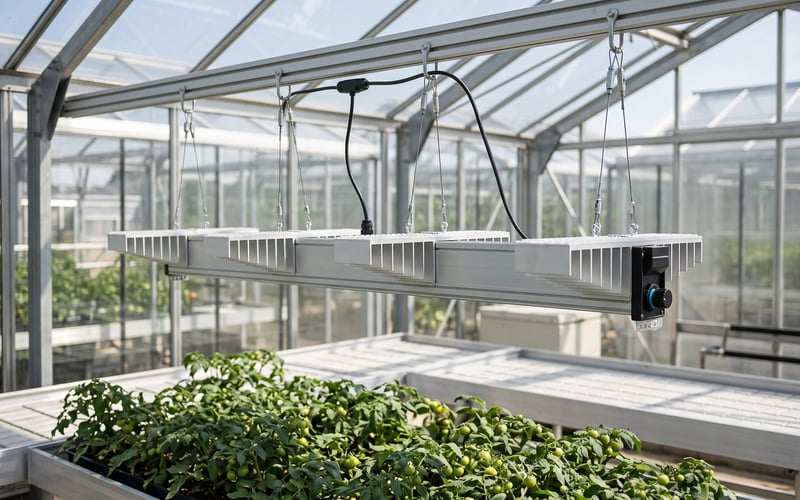
The 265W EVO 4-120 covers a longer bench. Keep it between 5°C and 30°C in non-condensing conditions.
View the Sanlight EVO 4-120 LED Grow Light at £555
Are LEDs better than fluorescent or HPS lights?
LEDs are the best default choice for most domestic greenhouse growers. They use less electricity and release less radiant heat than HPS fixtures.
| Light type | Efficiency | Heat | Control | Verdict |
|---|---|---|---|---|
| Modern horticultural LED | High | Low radiant heat | Many fixtures support dimming | Best default for home greenhouses |
| T5 fluorescent | Lower than modern LED | Moderate | Limited | Useful for close propagation setups |
| HPS | Lower than modern LED | High radiant heat | Limited without extra equipment | Usually excessive for domestic use |
| Ordinary household bulb | Poor plant-level output | Varies | Limited | Use for visibility, not crop lighting |
LEDs still produce heat at the fixture and driver. Do not treat them as cold equipment.
Blue and red wavelengths both matter, but there is no single ideal spectrum for every crop. Full-spectrum white fixtures make plant colour easier to inspect.
What mistakes waste the most money?
The costliest mistake is lighting unused space. The second is buying a fixture without checking its accessories and protection rating.
- Buying by watts alone. Compare PPF, PPFD and coverage before comparing price.
- Lighting the entire greenhouse. Concentrate light over a productive shelf, tray or bed.
- Ignoring the power cable. Some Sanlight EVO fixtures require a separate connection cable.
- Copying a generic hanging height. Use the map supplied for the exact model.
- Running lights all day and night. Use a timer and keep a dark period.
- Ignoring damp conditions. Check IP ratings and keep connections away from water.
- Trying to replace heating with lighting. Light and temperature solve different plant problems.
The right setup is often smaller than expected. A focused 600mm square area is cheaper and easier to manage.
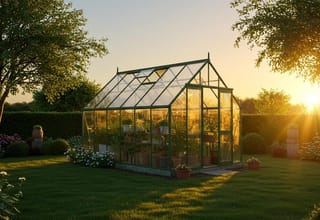
A safer, more useful grow-light setup
A focused bench setup keeps useful light on the crop while protecting electrical connections from moisture.
Compare LED fixtures for different growing areas
Which setup makes sense for you?
Buy a propagation bar for seedlings and a dimmable panel for a compact crop area. Avoid greenhouse-wide lighting unless every square metre earns its cost.
For one tray, start with the 9.5W Flex II 10. For a defined 600mm square area, compare the HortiONE 420 and G-Bars 170.
The G-Bars has the clearest protection specification in this shortlist. HortiONE uses less electricity, but its installation environment needs confirmation.
Longer Sanlight EVO fixtures suit larger benches. Their separate cable requirement belongs in the buying decision.
Measure first. Then compare the manufacturer's map, protection rating, accessories and monthly cost. That order prevents most expensive mistakes.
Why we chose this range
"I chose these five because they cover one tray, two compact panels and two longer IP65 fixtures. Together they show how coverage, accessories and operating limits change between 9.5W and 265W."
- Matt W, Greenhouse Stores
Frequently asked questions
Do I need grow lights in a greenhouse during winter?
Most dormant plants do not, but seedlings and winter crops often benefit. Use extra light when natural daylight cannot support the growing stage. Hardy salads may simply grow more slowly without it.
How many hours should grow lights run?
Use 14 to 16 hours for seedlings when natural light is insufficient. Supplemental winter lighting may only need four to six added hours. Use a timer and retain a dark period.
What wattage grow light suits a small greenhouse?
Light the growing bench, not the greenhouse floor area. A 9.5W bar can serve one tray. A defined 600mm square fruiting area may need 150W-170W.
Can normal LED bulbs grow greenhouse plants?
Ordinary household bulbs usually lack enough plant-level intensity. Choose horticultural lighting with published PPF, PPFD or coverage data. A domestic bulb remains useful for seeing paths and tools.
Do LED grow lights heat a greenhouse?
LED fixtures add some heat, but they cannot replace a greenhouse heater. Most input energy eventually becomes heat. However, the temperature effect depends on fixture wattage, ventilation and greenhouse size.
Are grow lights safe in a greenhouse?
Use moisture-rated fixtures, RCD protection and outdoor-rated cables. Keep plugs and drivers dry. Ask a registered electrician to design any permanent greenhouse circuit.